A specific chile pepper grown in northeastern India is cultivated almost entirely by women — a pattern rooted in land access, household economics, and which crops get coded as 'women's work.'
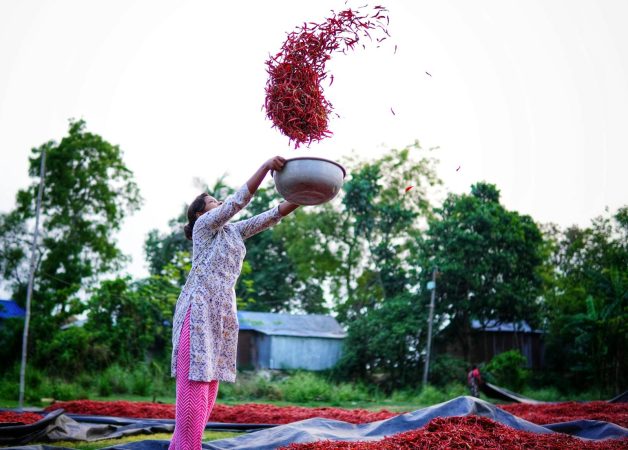
In Nagaland's Tening district, Neikhoünuo Meyase rises before dawn to tend rows of Naga King Chiles — the Bhut Jolokia, once certified by Guinness as the world's hottest pepper at over one million Scoville heat units. She is one of an estimated 80,000 women across northeastern India's hill states who cultivate these incendiary crops on terraced plots rarely exceeding a quarter acre. In Nagaland, Manipur, and parts of Mizoram, women make up roughly 70 to 80 percent of all chile pepper farmers, according to regional agricultural surveys. "My mother grew these peppers, and her mother before that," Meyase told a reporter from the North East Network in 2022. "The men go for timber or government jobs. The peppers are ours."
The conventional assumption is that when a crop becomes profitable, men take it over. Cash crops across the developing world have historically followed similar patterns. Chile peppers in this region have bucked the trend, and understanding why matters for anyone thinking about how food systems actually work.
The peppers — predominantly Bhut Jolokia, but also the lesser-known Naga Morich and local landraces like U Morok in Manipur — grow on small plots, often intercropped with rice, beans, or greens the family eats. They require patient, detailed attention rather than heavy machinery or large capital investment: hand-planting seedlings, checking for aphids, harvesting individual fruits at peak ripeness over weeks. That combination (low entry cost, high labor intensity, compatibility with subsistence farming) has historically kept a crop in women's hands in rural South Asia, where agricultural roles remain sharply divided along gender lines.
The peppers also serve a dual purpose beyond income. They flavor household meals. They get dried, stored, traded in small quantities at local markets. Development economists distinguish between what they call food security agriculture and wealth agriculture — research suggests that women-headed agricultural households tend to prioritize crops that feed families, while cattle and larger commercial ventures are typically managed by men.
There's a harder economic reading of this pattern too. Women end up with the crops that men don't want. When a product stays small-scale and labor-heavy, it gets coded as domestic work. The gender lock isn't a celebration of female agricultural expertise so much as a reflection of who gets left with the less lucrative slice of the supply chain. In Nagaland's local mandis, women sell fresh Bhut Jolokia for roughly 200 to 400 rupees per kilogram ($2.40 to $4.80) during peak harvest season, when supply floods the market. Dried and processed, the same pepper fetches 1,500 to 3,000 rupees per kilo at wholesale spice markets in Guwahati or Delhi.
And yet the peppers travel. They end up in spice markets, in export shipments, in hot sauces sold far from the fields where they were grown. A 150-gram bottle of Bhut Jolokia hot sauce retails for $8 to $15 in American and European markets — the equivalent of more than 6,000 rupees per kilo, roughly 20 times what growers like Meyase receive for their raw harvest. The value added along that chain (drying, grading, packaging, branding, distribution) is where most of the money is made, and it's rarely captured by the women who grew the crop.
For readers thinking about where their food comes from, the chile pepper story is a useful corrective to the idea that "supporting small farmers" is a single, simple act. The farmer at the origin of a spice jar is likely a woman working a plot smaller than a suburban backyard, earning as little as 15,000 to 25,000 rupees ($180 to $300) across an entire growing season. What she earns per kilo bears almost no relationship to the retail price of the finished product.
The fix isn't charity. It's structural: cooperative ownership of processing facilities, direct-trade sourcing that pays producers more than commodity rates, and investment in the unglamorous middle of the supply chain. Some organizations working in the region have experimented with cooperative models — the Naga Mothers Association has organized women's self-help groups around chile processing, and Manipur's Ima Keithel (one of Asia's largest all-women markets) provides a rare example of female-controlled trade infrastructure, though scaling these models beyond local markets has proved slow and uneven.
The peppers themselves are extraordinary. Fiery, fragrant, used in regional cuisines that are finally getting attention beyond India. But the more interesting story sits behind the heat: a crop that became women's work because it wasn't worth men's time, and a global market that still hasn't figured out how to pay the people at the start of the line what the product is actually worth.