
Emotional attentiveness in childhood shapes how we relate to connection as adults, and many of us were raised in homes where presence was scarce even when chaos wasn't.
Maya is 29, a product manager in Austin, and she cannot figure out why her therapist keeps circling back to her childhood dinners. Her parents weren't cruel. They didn't divorce. Nobody drank. The house was fine, she says, the way people say "fine" when they mean nothing dramatic happened. But when her therapist asked her to describe a typical weeknight meal, Maya remembered this: her father at the table with a laptop open beside his plate, her mother asking about school with her phone face-up next to the salt, and the specific texture of answering a question while watching the asker's eyes flick somewhere else mid-sentence. She had learned, without anyone teaching her directly, that her day was a formality. Something to get through before the adults returned to what mattered.
This is the part that surprised her in therapy. Not that her parents weren't attentive. That the inattention had cost her something she was still paying for.
The conventional wisdom about privilege tends to get sorted into tidy categories. Money. Education. Safety. Stable housing. These matter enormously, and pretending otherwise is a kind of dishonesty I have no patience for. But there's a quieter variable that rarely makes the list, and when you start looking at the developmental research, it keeps showing up as one of the most consequential things a child can receive: the experience of being listened to by an adult who wasn't performing the act of listening.
What conversational attention actually builds
Attachment researchers have been circling this for decades. The technical language is contingent responsiveness, which is a clinical way of describing something most of us recognize instantly: a caregiver who reads a child's signal, responds to the actual signal, and waits for the child's reaction before moving on. It sounds almost too simple to matter. It turns out to be one of the primary architectural elements of a secure mind.
Work summarized by Psychology Today on attachment theory has shown that these early patterns of being heard and validated shape how people form relationships for the rest of their lives. Kids who experience responsive attention develop what researchers call a secure base. Adults with a secure base tend to handle conflict with less defensiveness, recover from rejection faster, and, this part matters, don't confuse being loved with being watched.
The neuroscience is catching up to what attachment theorists have argued for years. A recent study highlighted by researchers examining infant brain connectivity found that brain network patterns as early as three months old predict emotional development later in childhood. Connection isn't metaphorical. It's neural.
The difference between asking and waiting
Here is the distinction that gets lost in most parenting advice. Asking a child how their day was is not the same as waiting for the answer. The asking is cheap. Any halfway-present adult can manage the asking. The waiting is expensive, because it requires the adult to stop doing whatever else their mind was reaching for. The email, the news, the second glass of wine, the internal rehearsal of tomorrow's meeting. And then sit inside the child's slow, meandering, frequently boring account of what happened at recess.
Children know the difference. They know it the way animals know weather. They learn to edit themselves to fit the available bandwidth, and by the time they're adults, they've often forgotten they're doing it.
I grew up in a house where dinner was simple and the television was off. My parents were teachers, which meant the house was not wealthy, but it had the other currency. Curiosity. My mother asked questions and waited. My grandmother, especially at her Sunday roasts, had a way of leaning slightly forward when you spoke, as though your sentence was something she didn't want to miss the middle of. I did not know at the time this was a privilege. I thought it was just what houses were.
Why this gets classified as privilege
The word privilege does real work here, and I want to be careful with it. Attentive parenting isn't reserved for families with money, and families with money frequently fail at it spectacularly. But sustained attention requires something most economies actively strip from parents: time that isn't already spoken for. A parent working two shifts cannot offer the same conversational patience as a parent with a predictable schedule and household help. A household under chronic financial stress has a harder time creating what researchers call a space where everyone's inner life is treated as real and worth exploring.
So when we talk about the privilege of being listened to, we're also talking about the structural conditions that make listening possible. It's rarely a failure of love. It's usually a failure of bandwidth, imposed from the outside.
There's also a harder distinction worth naming. Research summarized in a Psychology Today analysis of parenting styles separates behavioral control (setting rules, monitoring activities) from psychological control (using guilt or love-withdrawal to shape a child's inner world). Studies suggest that behavioral control, within reason, tends to produce good outcomes, while psychological control, the strategy of making kids feel bad for having thoughts that differ from their parents', has been associated with higher rates of anxiety and depression. A parent who asks and waits is practicing the opposite of psychological control. They are saying: your inner life is allowed to be different from mine, and I still want to hear about it.
What the absence teaches
The children of distracted attention don't grow up broken. They grow up efficient. They learn to compress their stories into the shape that fits the available window. They become good at reading which mood the adult is in and calibrating accordingly. They develop what looks, on the surface, like emotional intelligence, and often it is, but underneath is a quieter assumption that the price of being heard is being useful, entertaining, or brief.
In adulthood this tends to show up in predictable ways. They apologize for taking up time. They pre-edit their feelings before speaking them. They are often the person everyone calls when things fall apart. I've written about that specific loneliness before. They are rarely the person anyone thinks to call when things are quietly going well.
There's nothing pathological about this. Most of us are carrying some version of it. But the data on early responsiveness suggests these patterns aren't purely psychological overlays. Research on parent-child bonding has repeatedly found that quality time, meaning time where the adult is actually present, not just physically co-located, tracks with measurably better developmental outcomes. The time itself is the intervention.
The concrete hasn't set
Here is where I want to push back on the tidy version of this argument, because it usually ends with something like: if you didn't get this as a kid, you're damaged now, good luck. That framing is both bleak and, increasingly, inaccurate.
Research on adult brain development has found that the brain continues building efficient connections well into the early thirties. A 2026 paper covered by Science Daily on adult brain development analyzed brain scans from over 4,200 people and found that what researchers called the adolescent stage of brain network development runs from roughly age nine to 32, not shutting the door at 25 the way internet folklore suggests. What that means practically: the wiring for attention, emotional regulation, and social learning is still being laid down long after childhood ends.

You can, in other words, learn what you didn't get. Not by time-traveling back into your childhood, but by building relationships in adulthood where the listening is real, and by becoming the kind of adult who can offer the same thing to the next person. The concrete, as that study's author put it, hasn't set. The mindfulness literature is useful here in a way I don't usually say out loud, because the word has been diluted by wellness marketing into something that sounds like a candle brand. But the underlying research is solid. A body of work summarized in Nature's overview of mindfulness and mental health shows that trained present-moment attention improves emotional regulation and reduces cognitive-affective interference, the specific kind of mental noise that makes it hard to fully hear another person. Translation: the skill your parents either had or didn't have is trainable. You can become the listener you wish you'd grown up with, for your friends, your partner, your kids if you have them, the person across from you at dinner tonight.
I learned a version of this in Thailand, where I lived for three years before coming back to Austin. The Thai word sabai doesn't translate cleanly into English. It's something like ease, comfort, unhurriedness. A state where the body and the conversation are moving at the same speed. Meals there often stretched because nobody was performing being busy. People asked questions and waited for answers, and the waiting wasn't awkward. It was where the actual relationship lived.
The dinner table as a unit of measurement
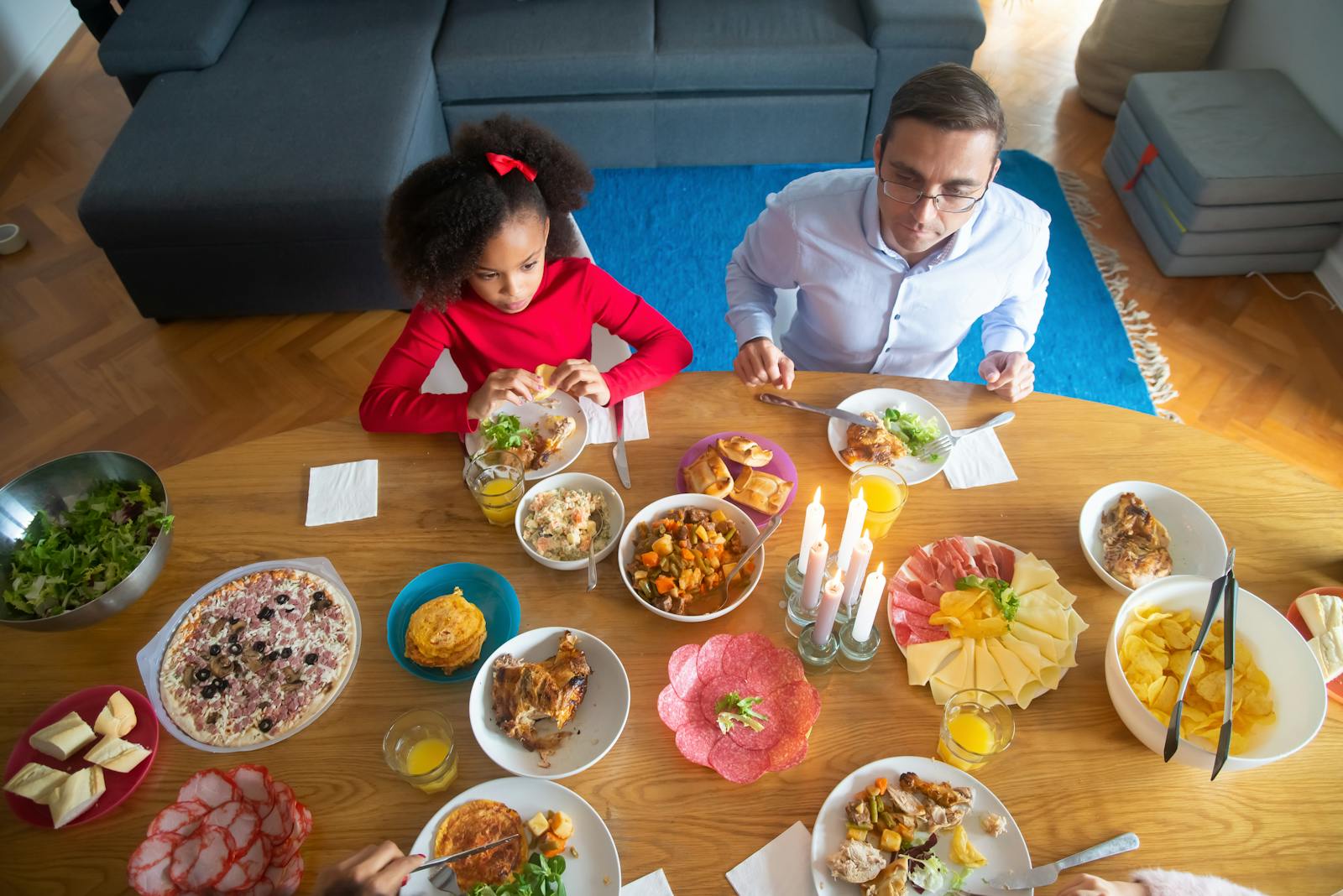
If you want to audit the attention economy of your own household, or the one you grew up in, the dinner table is the easiest laboratory. Who talks. Who gets interrupted. Whose stories are treated as content and whose are treated as filler. I wrote recently about the unspoken hierarchy at family dinners and how the quietest person often has the most to say. They've just learned the room doesn't reliably make space for it.
The fix isn't elaborate. It's mostly mechanical. Put the phone in another room. Let the silence between question and answer last longer than feels comfortable. Resist the urge to relate everything back to your own experience before the speaker has finished. Treat the other person's day as genuinely unknown territory, because it is.
Maya's full answer
What Maya is working on in therapy isn't her parents. It's her reflex to compress herself into the bandwidth she expects to be given. She's practicing taking up a full answer's worth of space. It's slower than she wants it to be. It's also, she told me, the first time she can remember feeling like her day was a thing worth describing in full.
Last month she had dinner with her mother. Phones in another room, a rule Maya requested in advance. Her mother looked surprised at first, then a little uncomfortable with the silence, then gradually something else. They talked for two hours. Maya told her about a project at work that had gone sideways, not the compressed version she would have offered at the old dinner table, but the real one, the version with the doubt in the middle. Her mother listened. Not perfectly. She interrupted twice, caught herself the second time, and said, "Sorry. Keep going." Maya said it was the first adult conversation with her mother where she felt like her full answer had been received. That dinner didn't erase twenty years of learned compression. It didn't need to. It was one meal where the attention was real, offered in both directions, and that turned out to be enough to prove the pattern could change.
The privilege of having been listened to is not a trophy. It's a starting point, and like most starting points, most of us didn't get the whole thing, and some of us got almost none of it. What we do get to decide is whether the attention stops with us or keeps going. Every dinner is a small referendum on that question. The phone stays face-down. The question gets asked. And then, this is the part that matters, you wait. Not because the answer will be extraordinary. But because the person giving it deserves to find out what they'll say when they're not editing for length.
If You Were a Healing Herb, Which Would You Be?
Each herb holds a unique kind of magic — soothing, awakening, grounding, or clarifying.
This 9-question quiz reveals the healing plant that mirrors your energy right now and what it says about your natural rhythm.
✨ Instant results. Deeply insightful.

Adam Kelton
Adam Kelton is a writer and culinary professional with deep experience in luxury food and beverage. He began his career in fine-dining restaurants and boutique hotels, training under seasoned chefs and learning classical European technique, menu development, and service precision. He later managed small kitchen teams, coordinated wine programs, and designed seasonal tasting menus that balanced creativity with consistency.
After more than a decade in hospitality, Adam transitioned into private-chef work and food consulting. His clients have included executives, wellness retreats, and lifestyle brands looking to develop flavor-forward, plant-focused menus. He has also advised on recipe testing, product launches, and brand storytelling for food and beverage startups.
At VegOut, Adam brings this experience to his writing on personal development, entrepreneurship, relationships, and food culture. He connects lessons from the kitchen with principles of growth, discipline, and self-mastery.
Outside of work, Adam enjoys strength training, exploring food scenes around the world, and reading nonfiction about psychology, leadership, and creativity. He believes that excellence in cooking and in life comes from attention to detail, curiosity, and consistent practice.
More Articles by Adam