
The flinch comes fastest in the people who wanted closeness the longest.
Longitudinal research on attachment has spent decades making the same uncomfortable point: the nervous system you build in childhood is the nervous system you bring to every adult relationship, whether it fits the current situation or not. Early isolation doesn't simply produce adults who hunger for connection. It produces adults whose threat-detection circuitry fires in the presence of the very thing they're hungry for.
Which brings me to Greta.
A woman in her mid-fifties, she once described what happens when her husband reaches for her hand under the dinner table. Her fingers tighten. Her breath catches somewhere between her collarbone and her throat. She doesn't pull away. She's practiced enough to override the impulse. But for a half-second, maybe less, her entire nervous system reads the gesture as a warning. His palm is warm and his intention is love, and still her body treats the contact like the opening notes of something that historically ended in pain.
She told me she's been married for twenty-two years. That her husband has never once given her a reason to flinch. That she flinches anyway.
Most people assume that a lonely childhood produces adults who hunger for connection, who reach toward others with open hands and grateful hearts, relieved to finally have what they missed. The assumption is neat and intuitive: deprivation creates desire, desire creates receptivity. Give a starving person a meal and they eat. But emotional starvation operates on a different logic entirely, one where the meal itself triggers the memory of hunger, and hunger triggers the memory of the conditions that produced it, and those conditions were rarely safe.
What Greta carries, and what millions of adults carry, is a nervous system that learned two lessons simultaneously: closeness is essential, and closeness is where you get hurt. Those lessons didn't arrive in sequence. They arrived together, fused, stored in the same neural architecture. The want and the warning became one signal.
The Drawer That Won't Stay Organized
Think of emotional memory as filing. Most of us develop reasonably organized systems. Pleasure in one drawer, threat in another, boredom somewhere in between. But children who grew up lonely, particularly those whose loneliness came paired with unpredictability or emotional neglect, never got the chance to sort their files properly. Intimacy arrived tangled with danger. Vulnerability arrived tangled with punishment. The drawer that should have held warmth and trust also held the sharp things.
A large longitudinal study covered by Scientific American examined how childhood relationships shape adult attachment styles, finding that the nature of our earliest bonds doesn't just influence how we relate to others. It lays the neurological groundwork for whether closeness registers as reward or threat. Research on attachment patterns has found that children whose caregivers were inconsistent, present and then absent, warm and then cold, were especially likely to develop what researchers call a fearful-avoidant pattern: wanting connection intensely while simultaneously bracing for its collapse.
This pattern doesn't soften automatically with time. The adult doesn't simply "grow out of it" when better people arrive. Better people trigger the same circuitry. Sometimes they trigger it worse, because better people offer more to lose.
Greta's husband isn't the problem. He's the context in which the problem becomes visible.
Why Better Love Can Feel More Dangerous
Here's what struck me about Greta's description: the flinch didn't happen with acquaintances. She could shake a stranger's hand, hug a colleague, accept a compliment from someone she'd never see again. The flinch was reserved for the person she loved most. The person whose opinion mattered. The person who could, theoretically, destroy her.
That targeting isn't random. Adults who grew up needing very little from others as a survival strategy often find that the flinch activates in proportion to emotional investment. Low-stakes interactions feel fine. High-stakes intimacy, the kind where someone truly sees you, truly holds weight in your life, sets off alarms.
The logic, translated from nervous system language into English, goes something like this: the last time someone mattered this much, I was small and couldn't leave, and it went badly. The body doesn't distinguish between then and now. It distinguishes between safe (meaning: no one here can hurt me because no one here matters enough) and unsafe (meaning: this person has the proximity to wound me, just like before).
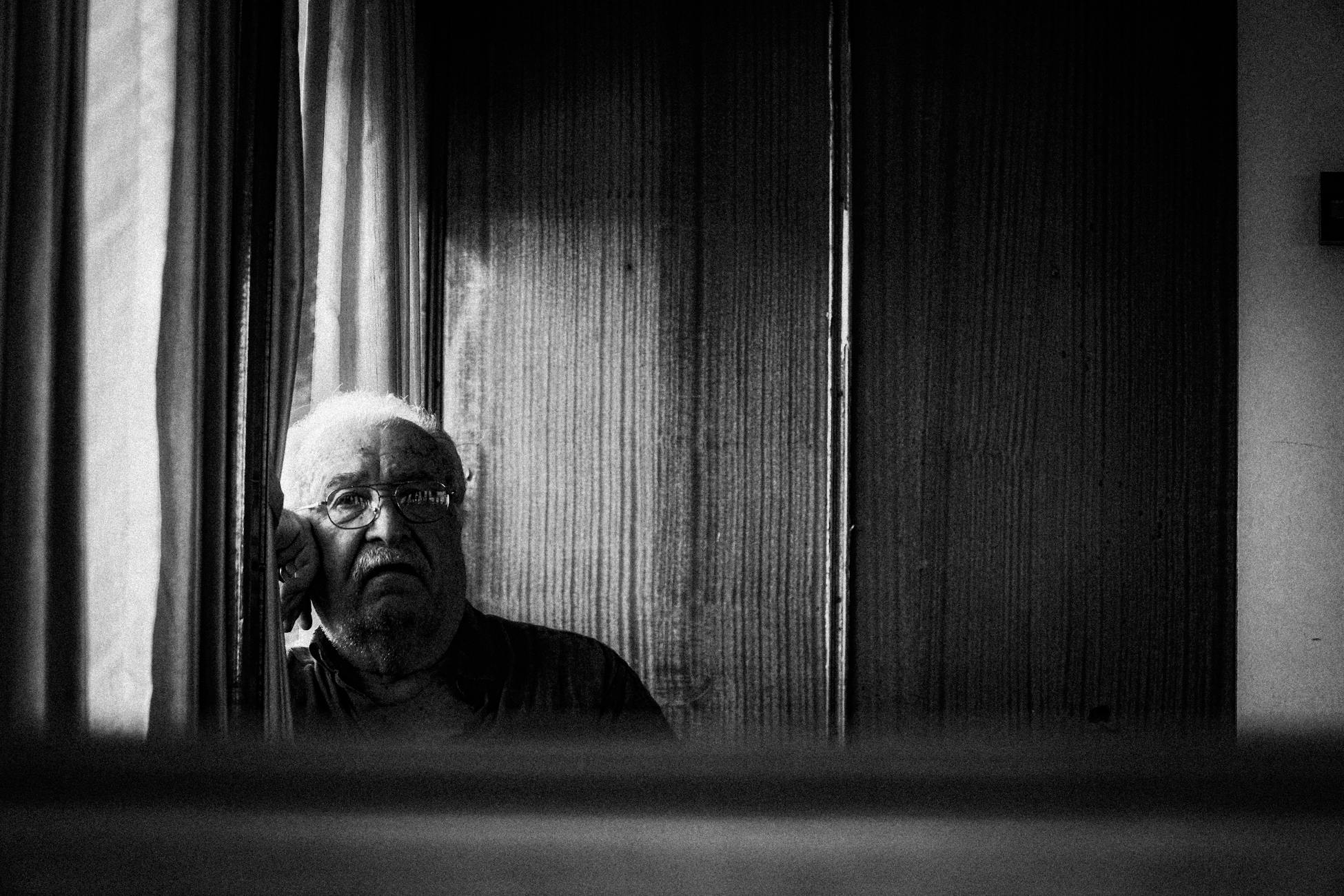
So the flinch arrives. Not because love is absent. Because love is present, and presence is where the old data lives. Recent neuroscience adds another layer to this picture. Research identified distinct dopamine receptor roles in the brain region governing approach versus avoidance behavior. The findings suggest that the decision to move toward something rewarding or retreat from something threatening isn't a single toggle. It's two competing systems, each with its own receptor pathway. In adults with early adverse experiences, those systems may fire simultaneously. The approach impulse says go. The avoidance impulse says danger. The result looks, from the outside, like ambivalence. From the inside, it feels like being torn in half.
The Performance of Wanting
People who carry this pattern become extraordinarily skilled at something that looks identical to intimacy but operates on entirely different machinery. They learn the choreography. They say the right things. They ask thoughtful questions and remember birthdays and show up when someone is in crisis. They can perform closeness with stunning precision.
But performance and presence are different animals.
I've watched people like this at dinner parties. Generous, warm, deeply attuned to the emotional temperature of the room. They read every micro-expression. They know when someone's glass is empty. They know when someone needs to be drawn into conversation. And at the end of the night, they go home and feel the specific exhaustion of having been emotionally intelligent without ever being known.
They wanted connection the entire evening. They also ensured, through a thousand invisible maneuvers, that no one got close enough to offer it.
That paradox, craving company while engineering distance, confuses the people who love them. Partners often describe feeling disconnected despite physical proximity. Friends describe a warmth that never quite lands. The person themselves may not even recognize the pattern. They just know they're tired in a way that socializing shouldn't produce.
The Body Remembers a Different Story
The conventional wisdom about healing from childhood loneliness goes roughly like this: find safe people, practice vulnerability, build corrective experiences. Good advice on paper. Almost impossible to execute when your threat detection system categorizes safe people as the most dangerous kind.
This sounds clean on paper. It isn't.
What actually happens is more recursive. The lonely child, now adult, finds someone trustworthy. The trustworthy person extends warmth. The warmth activates old wiring. The old wiring says: the last time it felt like this, you were seven, and the warmth disappeared, and you were not equipped to survive its absence. So the adult does something. Cancels plans, picks a fight, goes quiet for three days, floods with sudden inexplicable irritation at a partner who has done nothing wrong.
Research on attachment and childhood trauma has consistently linked early adverse experiences with adult patterns of well-being and relational distress, finding that trauma in childhood doesn't just create memories. It calibrates the nervous system's baseline assumptions about what closeness means. The adult may intellectually understand that their partner is safe. The body is operating on older, deeper information.

And the body's information carries more weight than the intellect's reassurance. Every time.
The Specific Loneliness of Being Reached For
There's a version of loneliness that only surfaces when someone is actively trying to love you. It's a cruel design. The person across the table is saying I'm here, I see you, I'm not going anywhere, and something inside hears all of that and translates it into a countdown. How long before this reverses? How much of myself do I risk on the assumption that it won't?
People who grew up with very little affection often become experts at giving what they can't receive. They pour love outward, toward children, partners, friends, with the fluency of someone who studied the subject obsessively from the outside. They know exactly what tenderness looks like. They can manufacture it on demand. Receiving it is the part that breaks the system.
A compliment lands wrong. An unexpected gift produces anxiety instead of pleasure. A partner's declaration of love triggers a scan for exits, not because the love isn't believed, but because belief itself feels like a vulnerability the nervous system hasn't approved.
The loneliest moment isn't being alone. The loneliest moment is watching someone offer exactly what you've wanted for decades and feeling your own hand refuse to take it.
What the Flinch Actually Protects
The flinch is not a malfunction. That's the part most people misunderstand, including the people who carry it. The flinch was, at some earlier point in time, a working solution. A child who learned that closeness preceded loss, or that vulnerability preceded humiliation, developed a rapid-response system: detect intimacy, brace for impact. In that original context, the response was intelligent. Possibly life-saving, emotionally speaking.
The problem is that the system doesn't update automatically. It doesn't check the date. It doesn't run the new person's credentials. It fires on pattern recognition alone, and the pattern, someone is getting close, matches the old data with perfect fidelity.
I sat with this question for months before recording a video about how we use "specialness" as armor against connection—how telling ourselves we're fundamentally different keeps us safe from intimacy, but also keeps us lonely in ways that echo all the way back to childhood.
So the adult flinches at love from a trustworthy person in 2025 using software installed in 1989. The software worked then. It malfunctions now. But uninstalling it requires something the software itself actively prevents: sustained vulnerability.
That's the trap. The thing that would help is the thing the system identifies as threat.
Recent findings have even linked childhood loneliness to physical health outcomes decades later. A 2025 report described how loneliness in childhood elevates the risk of serious conditions in adulthood, suggesting that the body keeps a ledger of isolation that extends far beyond the emotional. The flinch is the nervous system's attempt to avoid adding new entries to that ledger, even when the current chapter is safe.
Living Alongside the Flinch
Greta didn't tell me her story because she'd solved it. She told me because she'd stopped trying to solve it and started trying to live alongside it instead.
She lets the flinch arrive. She notices it the way you notice a car alarm in the distance, registering the sound without assuming the car is being stolen. She doesn't punish herself for it. She doesn't pretend it isn't there. She tells her husband, sometimes, my hand tightened, it's not about you, and he nods, and they keep eating.
That's not a cure. A cure implies the drawer gets reorganized, intimacy properly sorted from danger, everything filed in its correct place. What Greta describes is more like learning to open the drawer knowing the sharp things are still in there, reaching past them carefully, and sometimes getting nicked. Accepting the nick. Not always letting it stop the reaching.
For people who wanted connection in theory but found the actuality terrifying, the work doesn't look like becoming fearless. Whether the flinch ever truly quiets is a question Greta can't answer, and neither can I. Some bodies carry their first lessons to the end. Some learn, late, that the evidence has shifted. Most, I suspect, live somewhere in between, reaching and bracing in the same motion, never quite sure which impulse will win on a given night.
Greta reaches. Her hand tightens. Sometimes it loosens, sometimes it doesn't. Her husband's palm stays warm either way. The flinch arrives, and arrives, and arrives, and whether it is getting quieter or whether she has simply gotten better at sitting next to it, she can't say. She isn't sure it matters. She isn't sure anything more is coming.