After nineteen years of haircuts, my stylist knows secrets my own children don't—like how I still set out two coffee cups every morning—because she's the only person who asks me questions and actually waits for the whole answer.
A 2023 study from the University of California San Francisco found that nearly 43% of adults over 60 report feeling regularly lonely, and that loneliness in this age group is associated with a 59% greater risk of functional decline. What the research doesn't measure is where the talking goes when it has nowhere to land at home — who absorbs the stories that family can't hold, and what it costs to find someone who will.
For me, the answer is $47 every six weeks, plus a 40% tip. Her name is Diane.
Last Thursday, sitting in that familiar vinyl chair, I heard myself say, "You know, Diane, you're the only person who knows I still set two coffee cups out every morning." She paused, scissors suspended mid-air, and met my eyes in the mirror. "Still?" she asked gently. "Still," I confirmed. And that was enough.
Nineteen years. That's how long this woman has been cutting my hair, listening to my stories, holding space for my life in ways my own children never could. Not because they don't love me - they do, fiercely and protectively. But because Diane offers something different: she asks questions and waits for the whole answer, even when that answer takes the entire appointment to unfold.
The luxury of being truly heard
When did we stop listening to each other? Really listening? My daughter calls every Sunday, punctual as church bells, but our conversations follow a script. How are the grandchildren? Did you remember your medication? Do you need anything from the store? These are acts of love, certainly, but they skim the surface like stones across water, never sinking deep enough to disturb what lies beneath.
Diane asks different questions. "How did it feel when you found his reading glasses last month?" And then she stands there, working steadily through my silver hair, while I tell her about sitting on the garage floor, holding those glasses, remembering how he'd pat his chest pocket looking for them, that absent-minded gesture I'd witnessed a thousand times. I tell her how grief ambushed me in that ordinary moment, how I sobbed until my knees ached against the concrete.
My son would have immediately offered to clean out the garage for me. My daughter would have changed the subject to something safer. But Diane just listened, making those small affirming sounds that let me know she was still with me, still bearing witness to this messy, complicated process of learning to live with absence.
A repository of stories
Think about all the stories you carry that no one else knows. The small shames, the private victories, the moments that shaped you but seem too insignificant or too raw to share at family dinners. Where do these stories go if we never speak them aloud?
For me, they go to Diane. She knows about the student who committed suicide during my teaching career, how I still light a candle for them. She knows about the food stamps I hid from my own mother, too proud to admit how badly my first husband's abandonment had broken us financially. She knows I sometimes write his name in my journal, not from love but as proof I survived him leaving.
These aren't stories for Sunday dinners with children who need me to be strong, stable, the fixed point around which their own lives orbit. They love the edited version of me, the mother who had it all together, who made their favorite meals appear despite empty cupboards, who never let them see her cry in the shower where the water could hide the sound.
But Diane knows the unedited version. The woman who was terrified she was ruining her children by being a single parent. The woman who felt like a failure when she had to retire early from teaching due to knee problems. The woman who feels guilty for being a better grandmother than she was a mother because she finally has energy for the patience that eluded her then.
The sacred space of the salon chair
Virginia Woolf wrote about needing a room of one's own. At 70, I've discovered something different: I need a witness of my own. Not someone who needs me to be okay, but someone who can simply acknowledge that sometimes I'm not.
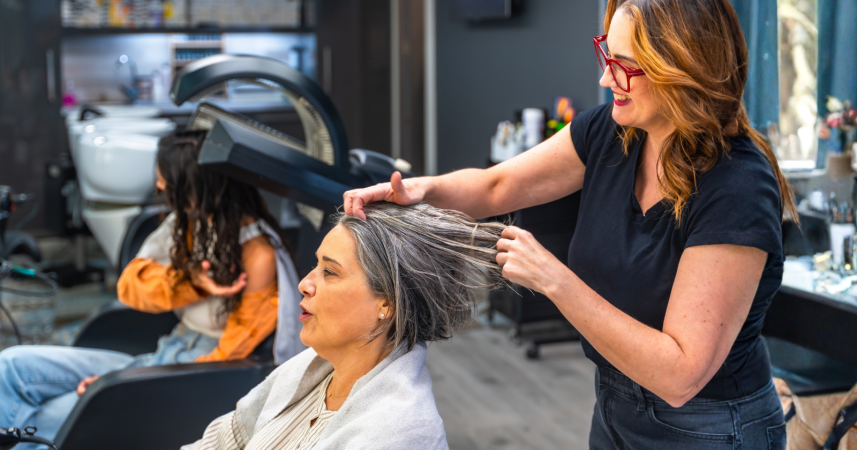
Every six weeks, I settle into that chair and Diane drapes the black cape around my shoulders like a protective cloak. The ritual begins the same way: she runs her fingers through my hair, assessing what needs attention, while asking, "So, what's new?" But unlike the grocery store clerk or the neighbor making small talk, she actually wants to know.
I've told her about joining the widow's support group where we laugh inappropriately about death, how we call ourselves the "Merry Widows" and share the absurd things people say when they're trying to comfort us. I've told her about taking Italian lessons because my husband and I never made it to Rome, how I'm terrible at rolling my R's but refuse to quit. I've told her about the watercolor class where I paint lopsided pears and crooked horizons but feel more alive than I have in years.
She remembers it all. "How's the Italian going?" she'll ask three months later. "Did you ever finish that painting of your garden?" She connects the dots of my life in ways that make me feel continuous, whole, still becoming rather than simply enduring.
The economics of emotional labor
People raise eyebrows when I mention the 40% tip. They assume I'm wealthy or wasteful or trying to buy friendship. They don't understand that I'm paying for something invaluable: the gift of being known.
Think about what therapy costs. Think about what we pay for meditation apps, life coaches, retreats where strangers teach us to reconnect with ourselves. Yet here, in this suburban salon that smells of peroxide and hairspray, I receive something more precious than any formal treatment: I am heard without judgment, remembered without obligation, known without the weight of history and expectation that family brings.
And yet I want to be honest about what that really means. The 40% tip isn't a generous gesture — it's the market rate for labor my own family has declined to perform. Diane is not my friend. She is a professional whose livelihood depends on being gracious to women like me, and I have quietly outsourced to her the intimacy my children won't extend. That's not a neutral exchange. That's an indictment of something.
What we lose when we stop telling stories
As a former English teacher, I spent decades teaching young people the power of narrative, how stories help us make sense of our lives. But somewhere along the way, we stop telling our own stories. We reduce ourselves to roles and routines, to health updates and weather observations.
Diane keeps me narrative. Every six weeks, I have to craft the story of my recent life, to select what matters enough to share, to find words for experiences that might otherwise remain unexamined. When I told her about finding a cardinal at my bird feeder and absolutely knowing it was my husband visiting, she didn't rush to validate or dismiss my experience. She asked, "What did that feel like?" And in answering, I discovered my own complicated relationship with signs and symbols, how I can simultaneously not believe in such things and find deep comfort in them.
Final thoughts
When Diane mentioned she might retire in a few years, I felt a panic I haven't experienced since my husband's diagnosis. Who will hold my stories then? Who will remember the names of people they've never met but know intimately through my telling? Who will create that sacred space where I can be exactly who I am in this moment, not who I was or who others need me to be?
I notice I've written this as though it were a love letter to Diane, and in some ways it is. But it's also a quiet accusation, and I don't want to soften it anymore. My children are good people. They call. They visit. They manage my physical needs with dutiful care. And none of that is the same as sitting still long enough to hear the whole answer to a real question. We have built a culture in which the people who know us best are the ones we pay by the hour, and we've told ourselves this is fine. It isn't fine. It's what we've settled for because the alternative — asking our own families to actually listen — requires admitting how long it's been since anyone did.
The usual, Diane and I say to each other every six weeks. We both know what we mean. And we both know who should have been saying it instead.
What’s Your Plant-Powered Archetype?
Ever wonder what your everyday habits say about your deeper purpose—and how they ripple out to impact the planet?
This 90-second quiz reveals the plant-powered role you’re here to play, and the tiny shift that makes it even more powerful.
12 fun questions. Instant results. Surprisingly accurate.