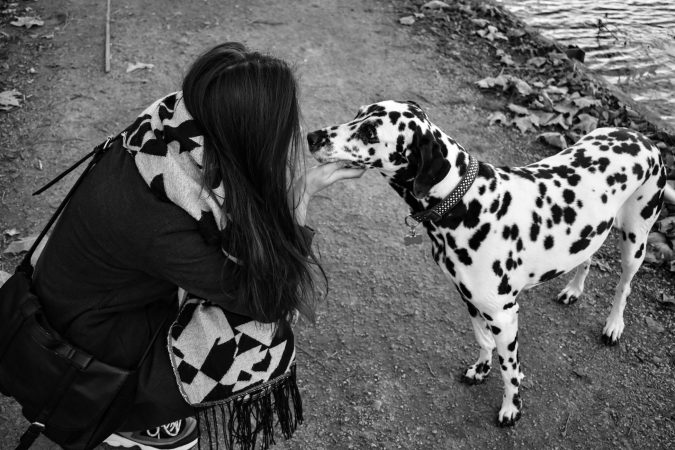
The dog who loves you isn't offering something humans can't — it's offering something humans won't: transparent terms you can actually fulfill.
The dog at your feet is running a cost-benefit analysis, and you're winning it. That's the part nobody says out loud. We've wrapped the human-canine bond in the softest possible language, unconditional love, pure devotion, soulmate energy, because the truth is less flattering to us and more flattering to the dog. Dogs love according to conditions. Very specific ones. The reason so many people describe their relationship with a dog as healing is that, for possibly the first time in their lives, they are meeting the conditions of love without having to distort themselves to do it.
Most people believe the dog is the miracle. The dog is not the miracle. The miracle is that the terms of the contract are finally legible.
Consider what the dog actually requires: be present, be predictable, provide food, provide shelter, come home. That's most of it. There are refinements. Don't startle them, don't betray them, don't disappear for a week without warning. But the core ask is stunningly achievable. Compare that to the conditions a human partner, parent, or friend puts on love, conditions that are usually never stated and often impossible to meet because they keep moving. Be successful, but not intimidating. Be vulnerable, but not needy. Be ambitious, but available. Be yourself, but a better version. The dog does not care about any of this. The dog cares whether you came back.
I've been thinking about this since I watched a friend sob into the fur of a rescue mutt she'd had for three weeks. She'd recently come out of a marriage where she'd been told, in increasingly creative ways, that she was too much and not enough simultaneously. The dog, she told me, asked for nothing she couldn't give. She kept repeating that phrase. Nothing she couldn't give. That was the whole thing.
The attachment science is less romantic than the marketing
Research studying canine attachment has mapped what dogs actually respond to, and the findings complicate the unconditional-love narrative considerably. In a review of attachment styles in dogs and cats, psychologists describe dogs as forming bonds that mirror human attachment categories: secure, anxious, avoidant. Which means dogs, like us, are shaped by how reliably their needs get met. Research suggests that a dog raised with inconsistency may become an anxious dog, while a dog raised with neglect may become avoidant. A dog raised with steady, predictable care tends to become the creature we mythologize as unconditionally loving.
That last dog isn't loving you unconditionally. That dog is loving you because you met the conditions so consistently that the love became automatic. There's a difference, and it matters.
The reason it matters is that it gives us a map. Humans are not magic at love, and neither are dogs. Both species respond to reliable presence, respectful treatment, and the absence of cruelty. The reason the dog relationship feels transcendent is that we actually do these things for dogs. We walk them. We feed them on schedule. We greet them when we come home. We don't ghost them for three weeks and then act wounded when they seem distant. We show up.
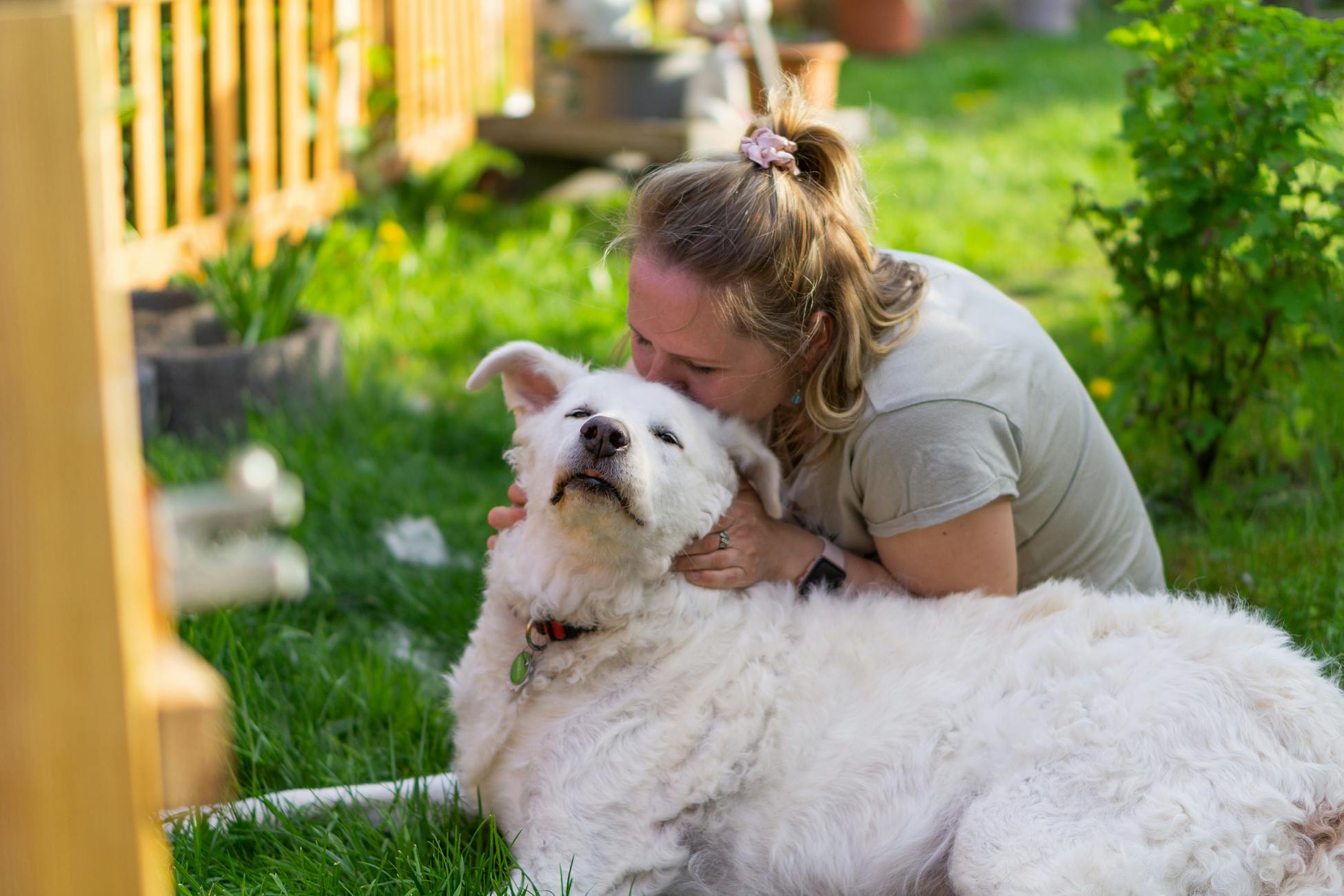
Why this feels like healing and not just pet ownership
There's a body of work on animal-assisted therapy that tries to explain why dogs specifically seem to do something therapeutic that, say, a really consistent roommate does not. A survey of the pet-human bond literature notes that the animal was non-judgmental, required nothing performative, and offered predictable physical comfort. That's the whole formula.
The National Academies have convened working groups on human-animal interactions in research environments, and research indicates that the effect on human stress markers is worth studying systematically. Studies suggest that blood pressure drops, cortisol drops, and people in the company of friendly dogs report feeling calmer, less scrutinized, more able to breathe.
The therapeutic piece isn't that the dog provides something the human is incapable of providing. It's that the dog provides it without the contaminating layer of social performance. You can be boring around the dog. You can be ugly, failing, unemployed, or in the middle of a bad year, and the dog's behavior toward you does not shift. Not because the dog has transcended judgment. Dogs judge plenty, ask any mail carrier. It's because the dog's criteria are so different from the criteria you've been graded on your whole life.
The conditions, listed plainly
Here is what the dog is actually asking of you, translated into language that makes the transaction visible:
Come home. Not always. Just eventually, and with some predictability. The dog needs to be able to trust that absence ends. Feed me on a rhythm. The rhythm matters more than the food, within reason. Predictability regulates the nervous system, theirs and, it turns out, yours. Don't hurt me on purpose. Accidental knees to the face during play are forgivable. Intentional cruelty breaks the bond in ways that studies of canine trust suggest may never fully repair. Let me be near you. Not constantly. Just access. A dog who is locked in another room most of the day is a dog whose primary need is going unmet, regardless of how expensive the food is.
Notice me sometimes. Eye contact. A hand on the head. The bonding behaviors dogs initiate, leaning, following, the soft eye, appear to function as reciprocal signals. They need the loop closed.
That's essentially the list. Look at it. Now imagine trying to write the equivalent list for what your mother wants from you, or your partner, or your boss. You couldn't. The list would be endless, contradictory, and several items would be unknowable even to the person making the demands.
The self-flattery baked into the unconditional love story
The story we tell about dogs flatters us. If the dog's love is unconditional, then we don't have to examine whether we're actually being loveable. We can be cruel, neglectful, absent, and still claim the dog's devotion as proof of our fundamental goodness. The unconditional frame lets us off the hook.
The conditional frame does the opposite. It says: the dog loves you because you are, in this narrow and specific domain, meeting a creature's needs with consistency. You are succeeding at something. That success is not evidence of your cosmic worth. It's evidence that when the conditions are achievable, you can meet them. Which raises an uncomfortable and useful question about the other relationships in your life. Are the conditions actually achievable there? Or have you been set up to fail by conditions that were never articulated, or that kept changing, or that were designed to be unmeetable so that someone else could maintain the upper hand?
I think this is the real reason people describe dog love as healing. Not because it's pure. Because it's fair. The terms are on the table. The terms are doable. When you meet them, the love appears. When you fail to meet them, forget a walk, skip a meal, disappear, the love doesn't vanish, but the dog registers the cost and adjusts. This is what a functional relationship looks like. Most of us have never had one with another human.
What the healing is actually healing
When people say the dog saved them, they rarely mean the dog performed some specific rescue. They mean the dog introduced them to a relational dynamic they did not previously know was possible. Needs stated clearly. Needs met. Reciprocal warmth as the predictable output. A closed feedback loop where effort produces connection and neglect produces distance, without punishment, without silent treatment, without the elaborate games of human intimacy where you're supposed to guess what someone needs and are penalized for guessing wrong.
For people coming out of families or marriages where love was weaponized, withheld as punishment, bestowed as reward, never quite predictable, the dog is often the first experience of a relationship that operates on clean mechanics. Writers on this site have noted that people who chose dogs over other forms of companionship are often telling a partial truth about unconditional love, and the fuller truth has more to do with not being required to distort themselves. The distortion is the thing people are escaping. The conditional love of a dog does not require distortion. It requires showing up.
There's related work on how people talk to their animals, full conversations, updates on the day, secrets, and the finding that this behavior isn't eccentric but reflects having found a relationship that offers presence without performance. That word, performance, is the key. Human love so often requires a show. The dog does not require the show.
The uncomfortable takeaway
If dog love is conditional, and those conditions are achievable, and meeting them produces a relationship people describe as the most nourishing of their lives, then maybe the question worth sitting with isn't about the dog at all. It's about the conditions you've been asked to meet elsewhere, and whether anyone ever told you what they were.
The dog is operating a simpler system, transparently. That's most of what there is to say about it. The rest is something each person works out quietly, on their own time, often with a warm body asleep across their feet.