The sandwich generation faces an invisible shift: millions of American adults discover they're now their parents' caregiver not through crisis, but through quiet, ordinary moments that fundamentally change everything.
The font on the menu was too small. My mother said it casually, the way you'd ask someone to pass the salt, and I said sure, and I read the specials out loud in a voice that tried very hard to sound normal. Then I sat in my car in the parking lot afterward and stared at the steering wheel for a long time without knowing why.
That's where it starts. Not with a diagnosis. Not with a 2 a.m. phone call. With a menu.
There is a specific grief that sneaks up on adult children when the caregiving relationship inverts, and it arrives in moments that don't have language built around them. The sandwich generation (adults simultaneously raising children and caring for aging parents) has grown large enough that HR departments now track caregiving benefits. But the data doesn't capture what it actually feels like. The way your throat tightens when your mother hands you the menu and says it's fine, she just forgot her glasses, when you both know that's not the whole story.
The conventional wisdom gets the timing wrong
We're told, culturally, that the hard part of watching parents age is the medical crisis. The hospital. The decision about assisted living. These are the moments that get language built around them: support groups, casseroles, condolence cards.
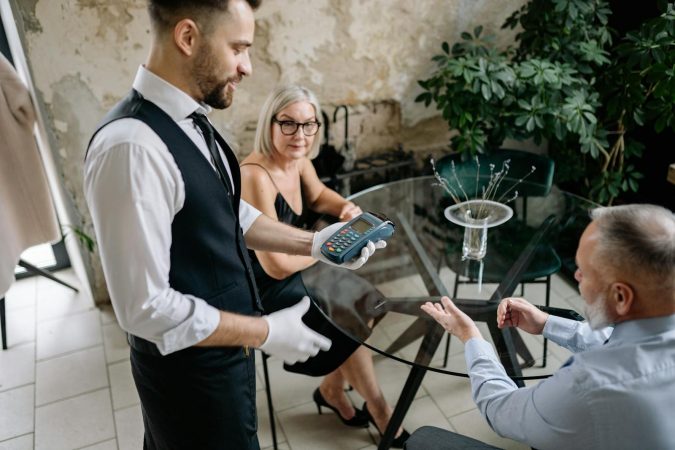
What doesn't get language is the slow, granular shift that happens years earlier. The first time your father asks you how to change a setting on his phone and there's a flicker of embarrassment in his voice. The first time your mother lets you pay for dinner without fighting you for the check. The first time you realize you've started speaking to them more slowly, and you hate yourself a little for it.
These aren't emergencies. They're recalibrations. And they accumulate faster than most people can metabolize them.
Why small moments hit harder than big ones
Psychologists who study role reversal in families have a term for what happens when caregiving inverts between parent and child. Parentification, a concept developed in family therapy, typically refers to children forced into adult roles too early. But the structural dynamic (the child providing care the parent once provided) shows up again in midlife, often with a psychological weight people underestimate because it seems more age-appropriate.
Here's what gets missed: the body remembers the original hierarchy. You can be 42, a parent yourself, a manager at work, fully adult by every external measure, and still feel a quiet disorientation when you have to explain to your father how a pharmacy app works. The disorientation isn't about competence. It's about the rearrangement of a pattern that was laid down in you before you had words.
Big moments come with scripts. The surgery. The move. Small moments have no scripts. Which is why they leak.
The body keeps the score, and the research proves it
The statistics on midlife caregiving are grim and getting grimmer. A recent Mayo Clinic study published in Mayo Clinic Proceedings found that women caregiving more than 15 hours a week have significantly increased odds of experiencing moderate to severe menopause symptoms. Of the 4,295 midlife women studied, 50.4% of those caregiving 15+ hours weekly reported moderate or worse menopause symptoms, compared to 34.1% of those caregiving less than 5 hours.
Let that sit for a second. The act of caring for your parent is physically rewriting your symptom burden during one of the most biologically demanding transitions of your adult life.
Dr. Stephanie Faubion, the study's lead investigator, noted that women in midlife are often simultaneously navigating careers, menopause, and significant caregiving responsibilities for aging parents, partners, or children with special needs. Co-investigator Dr. Ekta Kapoor pointed out that despite how commonly menopause and caregiving intersect, their reciprocal influence had never been studied until now.
This is the kind of statistic that should be on a billboard, and instead it's buried in a medical journal.
The financial dimension compounds the physical one. Forbes reported in early 2025 that sandwich generation adults often experience significant financial and emotional strain. The grief here is subtle. It's the moment you start quietly adjusting your own retirement projections because you know you'll be helping cover your mother's caregiver. It's watching your parents move from being the financial backstop of your life to being another line item.
And there's a version of this grief that's specifically acute for children of immigrants, which I'll admit shapes how I see this. My parents ran a restaurant for 23 years. The idea that they would ever need anything from me, financially or otherwise, was structurally unthinkable in the family I grew up in. Roles were fixed. They provided, I received. The first time a parent asks for help with something simple, like a ride to a doctor's appointment, something in the family mythology shifts, and you can feel the shift even if no one names it.
The double grief most people don't recognize
There's a difference between missing someone and missing the version of yourself that existed when they were still around, and this is the loss that makes anticipatory caregiving grief so disorienting.
You're not just grieving your parent. You're grieving the child-of-that-parent that you get to be. The version of you who could still call and complain and expect comfort. The version who didn't have to modulate her voice. The version who hadn't yet started noticing the tremor in her father's hands. Both losses arrive simultaneously. Most people only have language for one.

What small moments actually look like
When I was still practicing as a clinician, I watched dozens of clients in their late twenties and thirties try to describe what was happening with their parents, and many would apologize for the seeming smallness of their examples. The examples weren't stupid. They were precise. The mother who used to drive anywhere and now avoids highways. The father who used to fix everything in the house and now calls the handyman. The parent who used to host Thanksgiving and now accepts being hosted. The parent who used to win every argument and now concedes because it's easier. The parent who used to remember everyone's birthday and now writes them on a list. None of these are medical events. All of them are data points. And your nervous system catalogs them whether you want it to or not.
Some people respond to this accumulation by over-functioning. They become the family coordinator, the medical advocate, the one who knows the medications. This has its own psychology, documented in research on adult children whose parents faced ongoing challenges. The caregiving role can feel like a way to preserve love when love itself has become more complicated.
Others respond by withdrawing. Not out of cruelty, but out of preservation. Some of the people I know who've stepped back from intense family enmeshment have done so because they gave up on auditions, not love. The role-reversal phase can reignite every unresolved dynamic from childhood, and some people simply can't do both at the same time. The caregiving and the psychological excavation are two full-time jobs.
Of the two, over-functioning tends to do more damage. It looks responsible from the outside, which is part of the problem. The person who withdraws usually knows they're withdrawing. The person who over-functions often doesn't notice what it's costing them until the cost is already paid.
What actually helps
I'm wary of wellness writing that wraps up grief with a bow, so take this lightly. But there are a few things the research and the clinical work point toward.
First: naming the small moments out loud. Not in a dramatic way. Just acknowledging when something was difficult rather than minimizing your reaction.
Second: understanding that caregiving is now considered by researchers a legitimate social determinant of health. The Mayo Clinic team explicitly argued that caregiver status should be documented in medical records and considered for its exacerbatory effects on other conditions. If you're in the middle of this and your body is falling apart, you're not weak. You're inside a documented phenomenon.
Third: talk to other people in it. A recent Newsday profile of sandwich-generation caregivers described the emotional and financial strain as something that intensifies in isolation. It does. The single most protective factor appears to be having people who get it.
Fourth, and this is the one I keep coming back to in my own life: don't outsource the emotional work to the logistics. It's easy to pour yourself into coordinating appointments and managing medications because logistics feel controllable. Grief doesn't. But the logistics will not metabolize the grief for you. At some point, usually in the car, usually alone, it finds you anyway.
The part that stays with you
My mother taught me how to cook almost everything I know how to make, and she taught me almost nothing about how to feel my feelings out loud. This is not a complaint. It's an observation about what one generation hands down and what another generation has to figure out on their own.
Watching her get older is teaching me the thing she couldn't teach me. Caregiving, even the anticipatory, early, mostly-invisible kind, forces an emotional vocabulary into existence whether you want it or not. You have to name what's happening. To her. To you. To the relationship.
I don't know what to do with that yet. The grief is real. The Mayo Clinic data is real. The new conversations with my parents, the ones the old hierarchy wouldn't have allowed, those are real too. None of it resolves. I read the menu to my mother. She put her hand on my arm. I drove home. I still don't know what any of it means.