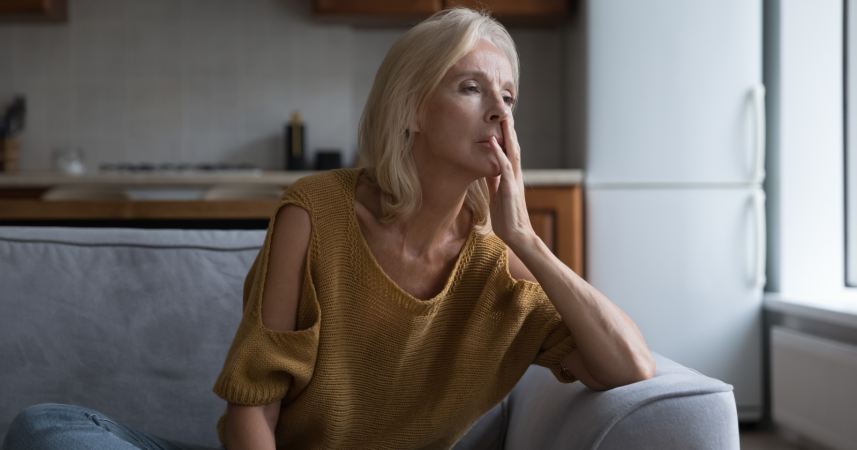
When she stood in her mother's closet three weeks after the funeral and caught her reflection in the mirror, she realized she wasn't just mourning her mother — she was mourning the 70-year-old daughter she could no longer be.
When I found myself standing in my mother's closet three weeks after her funeral, I wasn't looking for anything in particular. My sisters had already taken the jewelry and photo albums. I was just standing there, breathing in the faint scent of her lavender soap, when I caught sight of myself in her full-length mirror. For a moment, I didn't recognize the woman staring back. She looked older, certainly, but it was more than that. She looked like someone who had forgotten something essential about herself, like she'd misplaced a piece of her identity along with her car keys.
That's when it hit me: I wasn't just grieving my mother. I was grieving the daughter I had been for seventy years.
The double loss we don't talk about
Have you ever noticed how we prepare for death but not for the identity shift that follows? We make wills, discuss funeral arrangements, even plan what to do with the house. But nobody mentions that when you lose a parent, you lose the version of yourself that existed as their child. It's a peculiar kind of erasure that happens regardless of your age.
I've been thinking about this since that day in her closet. When my mother died, everyone said the expected things: "She lived a good, long life." "At least she's not suffering anymore." All true. All completely missing the point of what I was actually experiencing.
The grief felt split, like I was attending two funerals simultaneously. One for my mother, the woman who survived the Depression and taught me to darn socks and make gravy without lumps. Another for the girl I had been in her presence, the one who still called every Sunday evening, who saved funny stories from my week just to make her laugh, who could still be scolded for not wearing a coat in March.
Why grief refuses to follow rules
Michael J. Formica, M.S., M.A., Ed.M., a psychotherapist and writer, puts it perfectly: "We often think of grief as a straight line. Grief is, in fact, more of a spiral, continuously cycling us through a myriad range of emotions."
That spiral has taken me through unexpected territories. Some mornings I wake up and my first thought is to call her about something trivial, like the cardinal that's been attacking my kitchen window. Then I remember she's gone, and I grieve her absence. But immediately after, I grieve something else: the person who had someone to call about cardinals. The daughter who could still seek her mother's opinion, even when I didn't necessarily need it.
And honestly, it's the second grief that cuts deeper.
During my thirty-two years teaching high school English, I watched countless students grapple with identity in their essays. They'd write about finding themselves, losing themselves, recreating themselves. I'd mark their papers with encouraging notes about self-discovery. Now I understand they were onto something I hadn't fully grasped: we exist differently in relationship to different people, and when those people leave, those versions of ourselves go with them.
The selves we lose along the way
My mother held my history in a way no one else can. She remembered the girl who was terrified of thunderstorms, who once tried to adopt every stray cat in the neighborhood, who cried for three days when the Challenger exploded. My children know me as their mother. My late husband knew me as his wife. But my mother knew me before I became any of those things, when I was just becoming. There's something about being known from the beginning that can't be replicated. My sisters have their own memories, but memory is individual, colored by our unique relationship with the person we're remembering. The mother I knew was different from the mother they knew, just as the daughter I was to her was different from the daughters they were. I don't say this to diminish their grief. I say it because no one else's remembering can fill the specific gap left by the person who watched you become yourself from the very start.
In one of my previous posts, I wrote about the challenge of redefining yourself after widowhood. But this is different. When my husband died from Parkinson's, I had to learn to be myself without being his wife. When my mother died, I had to learn to be myself without being anyone's daughter. The first felt like losing my present and future. The second felt like losing my past and the foundation it provided.
When identity and loss intertwine
Anthony D. Smith, LMHC, a licensed mental health counselor, observed something crucial: "Grief isn't only about death. People actually need to grieve lost opportunities, lost abilities, and even a lost sense of identity."
This rings especially true when grieving a parent. Last week, I was making my mother's potato soup, the one she learned from her mother. As I diced the onions exactly the way she taught me, I realized I wasn't just keeping her memory alive. I was trying to keep alive the version of myself who learned at her elbow, who was proud to finally get her approval on the consistency of the broth.
These small moments of recognition come at unexpected times. Folding fitted sheets her way. Automatically saving bread bags for reasons I can't articulate. Deadheading roses at precisely the angle she demonstrated forty years ago. In these gestures, I find both comfort and sorrow. Comfort because she continues through these learned behaviors. Sorrow because I can no longer be the daughter showing her mother what she remembered from their lessons together.
The inheritance we don't expect
What surprises me most is how this double grief has made me reconsider my relationship with my own children. When I call my daughter Grace on Sundays, I hear myself becoming my mother, asking the same questions about the grandchildren, offering the same types of unsolicited advice. But I also hear my daughter being the daughter I was, patiently listening, sharing selected pieces of her life, protecting me from worries she thinks I can't handle.
Sometimes I want to tell her: "I know what you're doing. I did it too." But I don't, because this dance between adult children and aging parents is sacred in its own way. She needs to be the protective daughter right now, just as I needed to be that for my mother. Someday, she'll stand where I'm standing, missing not just me but the version of herself that existed as my daughter.
My son Daniel called yesterday, asking for advice about his teenage daughter. As we talked, I could hear the relief in his voice at still having a parent to consult. I wonder if he realizes that when he calls me for parenting advice, he allows me to still be somebody's child in a way, passing on what was passed to me. It's a kind of generational echo that only works while we're here to sustain it.
Final thoughts
If you're grieving a parent, or if you will be someday, know this: it's okay to mourn both losses. It's okay to grieve the parent who is gone and the child you can no longer be. These aren't separate griefs competing for your attention. They're intertwined, each informing and deepening the other.
The woman in my mother's mirror that day wasn't diminished, though she felt that way. She was transformed, carrying forward both the mother she lost and the daughter she had been. Some days that carrying feels impossibly heavy. Other days, I keep waiting for it to feel like something else — like wisdom, maybe, or acceptance. I'm not sure it does. The spiral of grief continues, taking me through familiar emotions in unfamiliar combinations, and I haven't found a way to let it move through me without it leaving marks. I don't know if the double grief proves anything about the relationship, or teaches anything worth learning. I only know it's here, and that some mornings I still reach for the phone before I remember there's no one on the other end who knew me first.
If You Were a Healing Herb, Which Would You Be?
Each herb holds a unique kind of magic — soothing, awakening, grounding, or clarifying.
This 9-question quiz reveals the healing plant that mirrors your energy right now and what it says about your natural rhythm.
✨ Instant results. Deeply insightful.
Marlene Martin
Marlene Martin is a retired high school English teacher who spent 38 years in the classroom before discovering plant-based eating in her late sixties. When her daughter first introduced her to the idea of removing animal products from her diet, Marlene was skeptical. But curiosity won out over habit, and what started as a reluctant experiment became a genuine transformation in how she thinks about food, health, and aging.
At VegOut, Marlene writes about nutrition, wellness, and the experience of embracing new ways of eating later in life. She brings a teacher’s instinct for clarity and patience to topics that can feel overwhelming, especially for readers who are just beginning to explore plant-based living. Her writing is informed by personal experience, careful research, and a belief that it is never too late to change.
Marlene lives in Portland, Oregon, where she spends her mornings reading research papers, her afternoons tending a modest vegetable garden, and her evenings knitting while listening to audiobooks. She has three adult children and two grandchildren who keep her honest about staying current.
More Articles by Marlene