Slow eating trains your brain to tolerate discomfort in pauses. That same tolerance shapes how you handle pressure, conflict, and uncertainty in every other part of your life.
The speed at which you eat dinner tonight will probably predict how you handle the next difficult conversation you walk into. Not because chewing activates some secret brain pathway, and not because slowing down gives your gut bacteria time to send wisdom signals to your prefrontal cortex. The connection is simpler, and harder to fake: people who can sit with a plate of food without rushing through it have practiced, meal after meal, the skill of tolerating a pause. And that skill transfers.
The obvious objection here is that slow eating is just a personality trait. Calm people eat calmly. Patient people make patient decisions. Correlation, not causation, and we should all move on. That's a fair read, and it's partially true. But it misses something. Personality isn't fixed, and behavioral patterns in one domain have a documented tendency to bleed into others. The way you practice being in any repeated, daily activity shapes the way you show up for activities that happen less often but carry more weight. Eating is just the most frequent rehearsal space most of us have.
The rehearsal you don't realize you're running
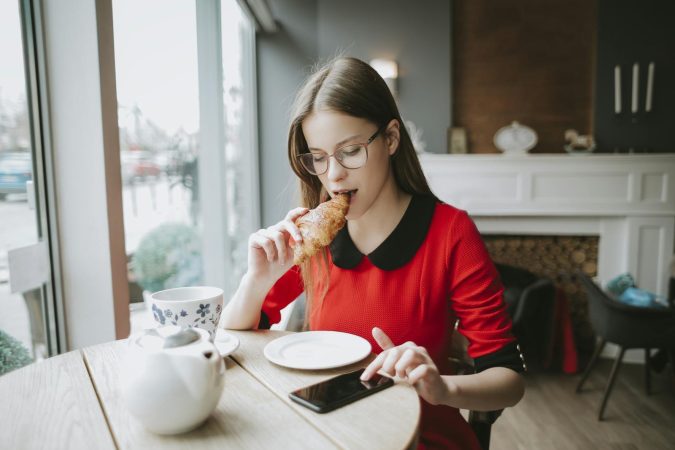
Think about what happens when you eat quickly. The fork is loaded before the current bite is swallowed. Your eyes are on your phone, or on the next task, or scanning the room for the check. The meal becomes a problem to solve rather than an experience to have. There's nothing morally wrong with this. But it is a pattern, and patterns become defaults.
There's a well-known observation, often attributed to Viktor Frankl, about the space between stimulus and response. Whether or not he said those exact words, the mechanism behind the idea still holds. As Psychology Today explains, even brief pauses can reduce emotional reactivity and allow the brain's executive functions to engage. Instead of reacting out of fear, habit, or urgency, you gain access to values, perspective, and long-term thinking.
A meal eaten slowly is a pause practiced three times a day. That's roughly a thousand rehearsals a year where you sit in the middle of an experience without trying to rush past it. The food is in front of you. You're not done yet. You're fine with that.
Now compare that to the moment a colleague says something that stings in a meeting, or a partner raises a topic you've been avoiding, or a job offer lands in your inbox and your gut screams "say yes before it disappears." The people who handle those moments well aren't necessarily smarter. They're just more comfortable in the gap between stimulus and response, because they've been living in small gaps all along.
Executive function is a muscle, not a gift
The brain science behind this is less poetic but equally useful. Executive function, the set of skills covering impulse control, planning, attention shifting, and problem-solving, isn't a trait you either have or don't. It develops through practice and erodes through neglect. Research on executive function delays across neurodevelopmental conditions confirms that these capacities predict outcomes across nearly every domain of life: occupational, social, academic, and mental health. The underlying principle applies broadly: the more you practice controlling impulses and sustaining attention in low-stakes settings, the more available those skills become when the stakes rise.
What "strategic pauses" actually look like in daily life
I find it useful to distinguish between a "decision pause" and a "life pause." A decision pause is tactical and brief. It might last seconds, minutes, or days, depending on what's at stake. Its purpose is to interrupt autopilot. You use it when responding to a heated email, accepting a new role, making a major purchase, or reacting to unexpected criticism.
A life pause is longer. It happens during periods of disruption: a layoff, a breakup, a death in the family, the strange vacuum after a child leaves home. These pauses are uncomfortable because they unsettle identity and routine. But they're also where the most meaningful growth tends to happen, if you can resist the urge to fill them immediately with activity.
Most people understand life pauses in theory. We all nod at the idea that you shouldn't make big decisions while grieving, or that you should sleep on important choices. The problem is practice. When you haven't built the habit of tolerating pauses at the smallest, most mundane level, the big pauses feel unbearable. You rush to fill them with the first available option, the next familiar thing, the quickest path back to a sense of normalcy.
And this is where the dinner table comes back into frame. If the simplest daily act of sitting with food feels like something to get through rather than be in, the bigger pauses won't feel any different. They'll just feel like larger problems demanding faster solutions.
The speed-to-regret pipeline
I've been thinking about this connection since my three years at CollectionDesign, a sustainable fashion startup in Brooklyn. The culture there was built on urgency as a virtue, and the meal habits reflected it perfectly. Lunch was something inhaled at desks in seven minutes, barely tasted, treated as an obstacle between one task and the next. And the pattern didn't stay at the lunch table. Design decisions, supply chain pivots, product launches — everything moved at that same breathless, fork-already-loaded pace. When the founders hit a fundamental disagreement over whether to prioritize profit or impact, the kind of tension that needed patience, long conversations, and a willingness to sit in discomfort, they handled it the same way they handled a sandwich: rushed through it, barely registering what they were consuming. The company fractured. They reacted. They didn't pause. Sometimes I wonder what would have happened if anyone in that office had ever just sat with a meal long enough to practice tolerating the in-between.
That experience left me permanently suspicious of urgency as a value. Speed is a tool. Urgency is often a disguise for discomfort. And the people I've watched make the clearest decisions, both in business and in their personal lives, tend to share one quality: they're not afraid of the space between knowing something needs to happen and actually doing it.
When we skip pauses during major transitions, we default to decisions that preserve identity rather than promote growth. We accept the next familiar option, say yes to avoid discomfort, or act quickly to relieve uncertainty. The irony is that refusing to pause usually costs more time and energy than pausing intentionally would have.
This is not about mindfulness branding
I want to be careful here, because "eat slowly" is the kind of advice that sounds like it belongs on a lavender-scented Instagram tile next to a matcha latte. The wellness industry has turned mindful eating into an aesthetic, complete with branded chopsticks and $40 ceramic bowls designed to "slow your pace." That's fine, but it obscures the real point.
The point isn't to perform slowness. The point is to build a tolerance for not having the next thing yet. To sit in the middle of an experience that has a clear end, your plate will be empty eventually, and practice not sprinting toward that end. The bowl doesn't matter. The willingness to stay in the gap does.
Research on habit tracking suggests that behavioral patterns built in one domain can influence self-regulation in others. The mechanism is transfer: when you practice a skill repeatedly in a low-stakes context, that skill becomes more accessible in high-stakes situations. Eating is just an unusually good practice ground because it happens so frequently and requires so little setup.
There's also something to be said for the metabolic side. Research reported by TIME has found that slow eaters may actually burn more calories during the process of eating, a phenomenon related to the thermic effect of food. But even that physical benefit is secondary to the behavioral one. The calorie difference is marginal. The decision-making difference compounds over years.
Small tolerances, big consequences
Here's what I keep coming back to: the decisions that drain us most are rarely the dramatic ones. They're the small, repeated choices we make under low-grade pressure. What to eat, how to respond, whether to act now or wait. The big decisions, the career moves and relocations and relationship commitments, get most of the attention. But they're shaped by the thousands of micro-decisions that came before them.
If your daily micro-decisions are all made in a rush, your big decisions will carry the same momentum. Speed becomes a default, not a choice. And defaults are hard to override when the stakes rise.
The reverse is also true. If your daily rhythms include moments of genuine pause, even small ones, even just the twenty minutes it takes to eat a meal without multitasking, those pauses build a different kind of default. A tolerance for uncertainty. A comfort with the in-between.
This connects to something broader about how kitchen habits reveal cognitive patterns we don't always notice. The way you relate to food, cooking, and the physical act of eating says more about your relationship to control, patience, and trust than most people give it credit for.
The invitation that doesn't require a purchase
None of this requires a meditation app or a weekend retreat. It doesn't require a special plate or a specific cuisine. It requires something much cheaper and much harder: the willingness to sit with your food for a few more minutes than feels comfortable, and to notice what happens in the gap.
Maybe you'll notice that the urge to check your phone is almost physical. Maybe you'll notice that the food actually tastes like something when you're paying attention. Maybe you'll notice that the discomfort of not doing anything else fades after about ninety seconds.
And then maybe, weeks or months later, you'll notice something else. A difficult conversation where you didn't jump to defend yourself. A job decision where you gave yourself a week instead of an hour. A moment where someone asked you a question and you said, genuinely, "Let me think about that," and meant it.
The pause won't look like the meal. But it will feel familiar. You've been there before, sitting with something unfinished, and you know it turns out fine.
That's the whole skill. And dinner tonight is as good a place as any to start practicing it. Not because one slow meal will transform the way you think, but because the next difficult decision you face won't announce itself in advance. It will arrive suddenly, dressed as an email or a conversation or a silence that demands to be filled. And in that moment, you won't rise to the level of your intentions. You'll fall to the level of your most practiced habits. So practice the pause. Tonight, with whatever's on your plate, give yourself permission to not be done yet. The food will still be there. And so, eventually, will the clarity.
What’s Your Plant-Powered Archetype?
Ever wonder what your everyday habits say about your deeper purpose—and how they ripple out to impact the planet?
This 90-second quiz reveals the plant-powered role you’re here to play, and the tiny shift that makes it even more powerful.
12 fun questions. Instant results. Surprisingly accurate.