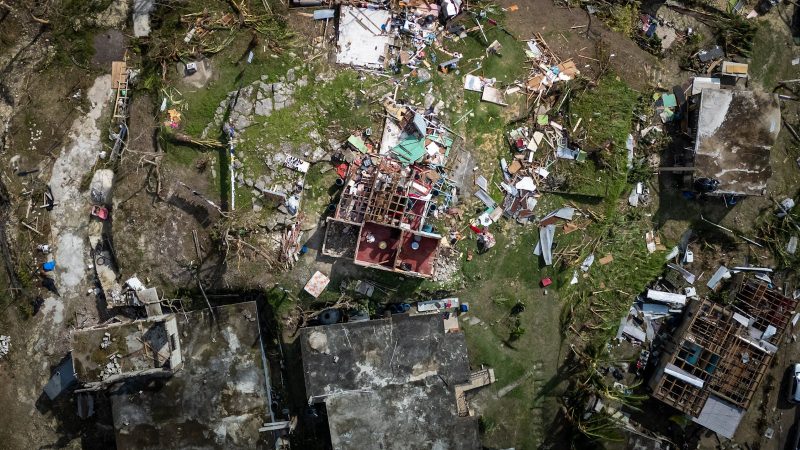
Hurricane Helene didn't just destroy barns and crops across Appalachia — it stripped away topsoil that took centuries to form. More than 18 months later, farmers and scientists are still scrambling to figure out how to bring it back, with almost no research to guide them.
Will Runion was standing at the edge of what used to be a hay pasture. It was the evening of September 27, 2024, and the Nolichucky River had just retreated from his 736-acre cattle and hay operation in northeast Tennessee, pulling back from a rampage that had swollen the waterway to roughly 1,200 feet wide. Nearly ten times its normal size. Trees had snapped in the current. Neighbors' barns and roofs had floated past. Now, staring at his fields in the fading light, Runion found a third of his land unrecognizable. The flood had gouged two holes the size of football fields into his pastures, each about 12 feet deep. Other sections lay buried under up to 8 feet of sand and silt.
"You've got several feet of beach sand sitting on top of what used to be some of the best bottomland in the county," Runion told me. "You can't grow a thing in it. It won't hold water, it won't hold fertilizer. It just sits there."
Hurricane Helene didn't just flatten barns and drown cattle across southern Appalachia. It stole something far harder to replace: the soil itself. More than 18 months after the storm dumped up to 30 inches of rain on the region in September 2024, thousands of farmers are still grappling with fields that were either scoured down to bedrock or buried under feet of sterile sand. And the scientists they've turned to for help are largely working without a playbook.
The conventional narrative around hurricane recovery focuses on rebuilding structures and replanting crops. Insurance adjusters tally damaged equipment, FEMA dispatches cleanup crews, and within a season or two, the assumption goes, farms bounce back. But that framing misses what may be the most lasting consequence of Helene's inland devastation. The topsoil that took centuries to form was destroyed, and no quick fix exists for that.
In North Carolina alone, Helene caused an estimated $4.9 billion in damage to the state's agriculture sector. Tennessee's agricultural losses were estimated at $1.3 billion. Those numbers capture property and crop losses. They don't fully account for the slow, grinding challenge of coaxing life back into ground that has been fundamentally altered. And it's worth asking what a dollar figure even means when the thing that's been lost operates on a geological timescale.
A Problem No One Has Solved Before
Runion sent drone footage to Forbes Walker, an environmental soil specialist with University of Tennessee Extension, and asked a simple question: How do you fix this?
"I looked at those images and my first thought was, honestly, I don't know," Walker told me. "I've studied soils my entire career and I'd never seen agricultural land transformed like that. You're not talking about a damaged field. You're talking about a field that doesn't exist anymore."
The rich, nutrient-dense layer that sits at the surface of agricultural land is typically less than a foot thick. It is the product of millennia of geological and biological processes. Rock weathers into fragments. Dead plants and animals decompose into organic matter. Microorganisms colonize the mix, driving nutrient cycles and stimulating growth. Worms and beetles aerate it. That process can take decades or centuries. Sand, which is what Helene deposited across wide swaths of farmland, has almost none of those properties. It lacks organic matter. It can't hold water or nutrients.
Stephanie Kulesza, a nutrient and soil scientist at North Carolina State University, put it bluntly: "What was deposited is not soil. It's geological material. It doesn't have the biological community, the organic matter, the structure that makes soil function. You're essentially starting from zero, and zero takes a very long time to become something a plant can use."
Some farms fared even worse than Runion's. At least one of his neighbors saw fields stripped all the way down to bedrock. The topsoil wasn't buried. It was gone.
For farmers who had spent years managing their land — adjusting pH with lime, controlling weeds, and maintaining fertility through careful fertilizer programs — the loss was both economic and personal. "Those soils were my life's work," Runion said. "My daddy's life's work before me. You can't just order that off a truck."
Science Without a Roadmap
Here is where the story gets uncomfortable. When Helene hit, the scientists tasked with advising farmers on soil recovery discovered a significant gap in the research. There was no established protocol for dealing with flood-damaged agricultural soils in Appalachia, where storms of this magnitude had been historically rare.
"We had nothing," Kulesza said. "No fact sheet, no bulletin, no set of recommendations we could hand a farmer and say, here, do this. We were learning alongside them."
Walker described the academic literature on flood-damaged soils as "thin." While scattered case studies exist, few systematic investigations have examined what actually works to rehabilitate farmland after catastrophic flooding. It's a gap that seems almost designed to persist. The events are infrequent enough to avoid sustained research attention, but devastating enough to reshape entire agricultural communities when they do arrive.
This isn't just an Appalachian problem. When atmospheric rivers caused devastating floods in the Pacific Northwest and southwestern British Columbia in 2021, Aimé Messiga, a Canadian soil research scientist at the Aggasiz Research and Development Centre, found a similar gap. His detailed review of existing research concluded there was limited long-term monitoring, little understanding of how floods affect nutrient levels and microbial communities in soil, and real uncertainty about what the actual agricultural impacts are.
"To predict what happens, you need decades of data collected across multiple flood events," Messiga told me. "Those data don't exist. We are always studying the last disaster, never preparing for the next one."
Field research remains rare because funding is scarce, and in the U.S., the Trump administration has cut spending on climate-related research. Messiga argued that these events are not random occurrences but part of a predictable pattern that will continue.
The Experiments Underway
Without established guidance, Runion's farm has become a kind of living laboratory. Walker and his students established four experiments across roughly 300 test plots on Runion's land. They're testing how different soil amendments, including hay, wood chips, poultry litter, a charcoal product called biochar, and Triple 19 (a common fertilizer with equal parts nitrogen, phosphorus, and potassium), affect the growth of wheat and fescue grasses in the degraded soil.
Early results showed some promise. Some plots remained bare while others produced tufts of green. "We've got a few plots where things are actually growing," Walker said. "Not thriving. Growing. That distinction matters, but it's a start."
But the work is slow. After the storm, Runion spent from October through April removing debris, bulldozing sand off fields, filling holes, and grading uneven terrain. FEMA crews removed and shredded downed trees. He received close to $1 million in state and federal aid, but said he could have easily spent all of it on equipment replacement, cleanup labor, fertilizer, and fuel alone.
By June 2025, he managed to mow the fields that hadn't flooded and put up enough hay bales to feed his herd of 125 cattle. He couldn't produce enough to sell. In a normal year, hay sales accounted for about a third of the farm's income.
Facing a multi-year recovery on his flooded acreage, Runion accelerated plans for an agritourism campground on his property. He chose a new site about 450 feet upland from the river and began clearing space for 45 camping sites, with longer-term plans for a music venue, hiking trails, and event hosting.
A Pattern That Keeps Repeating
Runion's story is specific. The pattern behind it is not. Since 1980, 45 flooding events in the U.S. have each caused more than $1 billion in damages, and more than half of those occurred in the past 15 years. In 2024, flooding in the upper Midwest drowned crops. Repeated events in central California damaged agricultural operations from winter 2022 through spring 2023. Mississippi River flooding in 2019 reduced crop planting by millions of acres.
Research from the U.S. National Science Foundation projects that so-called 100-year storms will become three times more likely and 20 percent more severe over the next 50 years. A separate study found that rainfall associated with Helene was 10 percent heavier because of human-caused climate change.
Historical precedent offers a sobering timeline for recovery. When the Missouri River flooded parts of the Upper Midwest in 2011, fields were submerged under up to 20 feet of water for months. When it receded, some areas were covered in 2 to 20 feet of sand. Others had washed-out holes up to 70 feet deep. John Wilson, a now-retired agricultural expert who worked in hard-hit Burt County, Nebraska, described the aftermath as looking like the surface of the moon.
Wilson led teams that sampled soil and helped farmers rebuild. He found that nitrogen and organic matter levels were low in flooded soils, and fertility suffered when farmers planted. Over about five years, fertility generally improved, but not everywhere, and not evenly.
Five years. For a small Appalachian farm operating on thin margins, that's not just a setback. It's a question of survival. How many of these operations can absorb half a decade of diminished productivity and come out the other side intact?
What Comes Next
The uncomfortable truth about soil loss is that it resists the kind of dramatic, photogenic recovery narratives that typically follow natural disasters. There's no ribbon-cutting moment. No before-and-after photo that captures the slow return of microbial life to a sand-covered field.
What exists instead is a patchwork of individual experiments, limited funding, and farmers making decisions based on intuition as much as evidence. Walker's test plots on Runion's farm represent one of the few structured attempts to build the kind of data that might help future flood victims.
The region's geography makes it especially vulnerable. Appalachian farms tend to be small and situated on flood-prone bottomland because it's flat and fertile. The same features that made these valleys productive for generations now make them targets for the intensified storms that climate change is producing. That's the kind of irony that doesn't land as clever. It just sits there, like the sand on Runion's fields.
Scientists studying these events increasingly warn against treating them as anomalies. Messiga's point is worth sitting with: these floods are not random, and they will keep happening. The question is whether the research and infrastructure to deal with their consequences will develop fast enough to matter.
For Runion, the answer has to be more practical than that. He's building campsites, running soil experiments with Walker, and stretching his aid money as far as it will go. The farm is still there. The soil is another story.