American farmers bet on solar. Then Trump changed the rules.
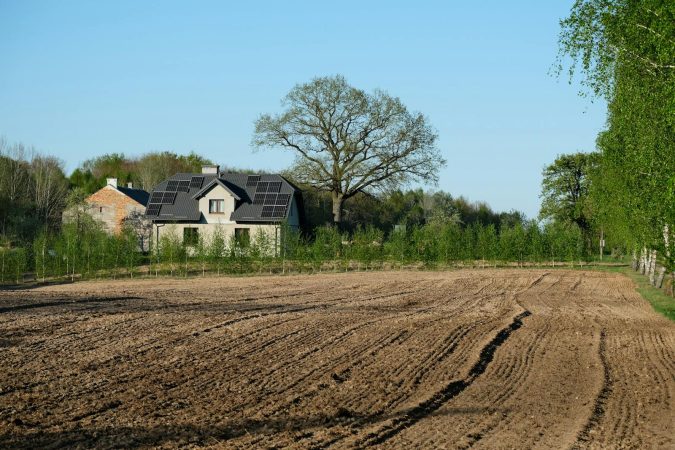
Daniel Bell, a Kentucky sheep farmer, wanted to put solar on a new barn far from existing power lines. He applied for a federal cost-sharing grant through the USDA's Rural Energy for America Program, the kind of straightforward investment that had helped thousands of farmers cut energy costs over the past two decades. Then the program froze. The project became unworkable. Bell has since pivoted to building temporary barns on land owned by a commercial solar operation where he already grazes his sheep to manage vegetation under the panels.
Bell told Grist that his motivation has been about gaining freedom and control over his operations. Not ideology, not climate politics, just the math of running a farm.
He's not alone. Federal support for solar energy on American farms has effectively stopped. The USDA has not awarded rural energy grants through its flagship program in months, and Congress has compressed the timeline for commercial solar tax credits, leading developers to walk away from projects worth millions. Farmers in Kentucky, Maryland, New York, and Iowa, many of them operating on razor-thin margins, had built business plans around federal cost-sharing that made solar economically rational. Those plans are now in limbo.
The conventional read on rural renewables has always been that they're a blue-state preoccupation. The actual picture is messier. An analysis by Grist and the Associated Press of USDA Rural Development data and project filings with the Energy Information Administration found the collapse touches every level of the industry, from large commercial developers to individual family farms trying to heat a barn.
What actually changed
Two federal mechanisms drove the last decade of solar growth on agricultural land. The first is the Rural Energy for America Program, known as REAP, which issues grants and loans to farmers and small rural businesses for renewable energy and efficiency projects. The second is the federal investment tax credit for commercial clean energy projects, originally enacted under the Energy Policy Act of 2005 and extended multiple times since.
REAP has funded more than 19,000 grants totaling over $1.8 billion since its creation nearly two decades ago, according to advocacy groups tracking the program. The Inflation Reduction Act supercharged the program starting in fiscal year 2023, and for most of its history it enjoyed bipartisan support. A 2023 Environmental Law and Policy Center report documented REAP awards reaching every corner of the country, including deep-red farm states.
Then came two blows in quick succession after Trump took office in January 2025. In March 2025, USDA announced a formal suspension of all REAP grant awards while it rewrites regulations to comply with a Trump executive order. Loan guarantees technically remained available, but analysis found no new loan agreements have been awarded this fiscal year either.
Months later, Congress passed President Trump's tax bill, resetting the commercial solar tax credit timeline in reverse: projects must now be under construction by July 2026 and placed in service by the end of 2027 to remain eligible. Biden's 2022 climate law had extended the credit through 2032. The combined effect was a grant freeze and a compressed tax credit window hitting the farm solar pipeline from both ends simultaneously.
The numbers behind the freeze
At least 126 solar projects proposed since the start of 2024 are stuck awaiting regulatory approval, each located near or on agricultural land. Together they would supply roughly 20 gigawatts of electricity, enough to power about 4.5 million homes, according to industry estimates.
The developer response has split cleanly in two. Bogdan Micu, CEO of the German developer Alpin Sun, said his company walked away from about 1,000 megawatts of projects in the U.S. Northeast representing roughly $6 million in investment, unable to speed up permitting and construction to meet the new deadlines. RIC Energy North America is making the opposite bet: CEO Jon Rappe said the company is sprinting to advance every project in its pipeline of about 150 developments, most sited on fallow land, hayfields, or former farmland. But Rappe acknowledged that after this generation of projects, the next round likely won't happen without renewed federal action. Walk away now or sprint and hope. Those are the options the compressed timeline leaves.
What it looks like on a family farm
Elisa Lane, a flower and fruit farmer in Hampstead, Maryland, had been awarded a $30,576 REAP grant in 2024 to install solar panels on a farm whose energy bills were running around $500 a month. In February 2025 she learned the grant was frozen with no explanation. Her full installation cost $70,000, and for months she worried she'd be on the hook for the entire amount. Think about what that uncertainty does to a person who already lives by the weather, the soil, the market. You add one more variable and the whole year starts to feel provisional.
In March, USDA invited grantees to voluntarily revise their proposals to remove certain diversity, equity, inclusion, and climate-related requirements from the previous administration. Lane, advised by a local USDA representative to proceed without revising, kept her original proposal. Her panels went up in August. In September, more than half a year after the initial freeze, she received a reimbursement check covering roughly half the project cost.
Lane described the experience as months of uncertainty that disrupted her ability to plan and invest in other parts of the operation. She wants to focus on running her farm business. The same thing Bell wants in Kentucky, the same thing every farmer caught in this freeze wants. Cheaper power is cheaper power, and the rural solar conversation has often been miscast as an ideological one when for most operators it's a balance-sheet decision. A farm runs on multi-year time. Seed orders, equipment loans, soil amendments, the slow arithmetic of what a barn will cost to heat five winters from now. Policy that changes in months interrupts a kind of planning the rest of the economy rarely sees.
Who profits from the rollback
The political narrative around cutting REAP has framed it as trimming wasteful climate spending. The economic reality is harder to square with that story. Solar is now one of the cheapest forms of energy available, and REAP's cost-sharing model was designed to let farmers capture that price advantage without taking on debt they couldn't service.
Robert Bonnie, the former USDA undersecretary for farm production and conservation under Biden, said that pulling back the program hits rural communities directly. In agricultural states like Iowa and Texas, he argued, renewables matter not only for power generation and clean energy but also for farmers' financial health. Reducing support, he said, would be highly problematic for the rural communities the program was designed to serve.
Some congressional Republicans had begun questioning REAP's grant structure before the 2024 election, but the program had been broadly popular in farm states for most of its history. The beneficiaries of the rollback are less obvious than the losers: utility incumbents and fossil fuel interests that compete with distributed solar for rural customer load.
What comes next
A USDA spokesperson said the suspension of REAP grant awards is temporary, though no timeline was provided for reopening the program. The agency said it is focusing on program integrity and ensuring alignment with current Administration policies while reviewing regulations.
For farmers already in the pipeline, outcomes are uneven. Some, like Lane, eventually got paid. Others, like Bell, rewrote their plans around commercial operators. Many applicants whose proposals were in process when the freeze hit simply have no project.
For commercial developers, the July 2026 construction deadline is the forcing function. Projects that can break ground in time may still pencil out. Those that can't are being shelved or sold. State-level programs are trying to fill some of the gap. New York's Statewide Solar for All initiative, for example, lets low-income residents subscribe to community solar arrays for monthly utility credits, but state money can't replicate the scale of federal tax credits.
The scoreboard, for now, runs like this. 126 projects in regulatory limbo. Roughly 20 gigawatts of proposed capacity, equivalent to about 4.5 million homes of electricity, waiting on approvals that have no published timeline. At least 1,000 megawatts already abandoned by a single developer, carrying $6 million in sunk investment with it. One pipeline of roughly 150 projects racing a July 2026 construction deadline and a December 2027 in-service deadline to preserve a tax credit that, under prior law, would have run through 2032.
Historically, grant programs that enter extended regulatory review lose applicants the longer the freeze runs. Farmers reallocate capital, developers redeploy crews, permits lapse, interconnection queue positions get forfeited. REAP has been suspended since March. Lane's reimbursement arrived in September, roughly seven months after her grant was frozen, and covered about half of a $70,000 installation. That is the better outcome in this dataset.
What's left is a pipeline running on two clocks: a federal one measured in executive orders and regulatory rewrites, and a farm one measured in planting seasons and loan amortization. The projects that survive the gap between them will be the ones whose economics hold without federal support, or the ones whose developers can outlast the review. Everything else depends on whether a future Congress extends the credit, as every Congress since George W. Bush's has done.
What’s Your Plant-Powered Archetype?
Ever wonder what your everyday habits say about your deeper purpose—and how they ripple out to impact the planet?
This 90-second quiz reveals the plant-powered role you’re here to play, and the tiny shift that makes it even more powerful.
12 fun questions. Instant results. Surprisingly accurate.