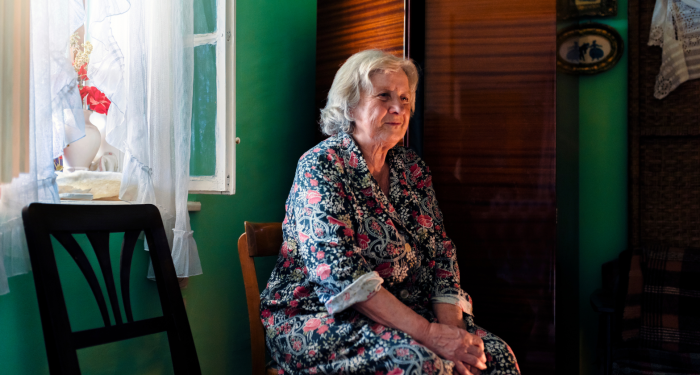
At 70, standing in the doorway of my childhood home after my mother's funeral, I discovered why that familiar threshold could make my body simultaneously relax into safety and tense with old fears—a paradox my former students understood instinctively when they'd return to my classroom years later, unconsciously raising their hands to speak even as successful adults.
I returned to my childhood home last Tuesday to sort through boxes my brother had stacked in the basement. The kitchen still smelled like cinnamon and old wood, even though no one had baked there in years. My hands found the light switch without thinking, muscle memory from thousands of midnight water trips.
At 70, having taught high school English for 32 years and raised two children of my own, I've stopped pretending these visits are simple. The body knows this threshold as both sanctuary and battlefield. It's the place where I'd run to after school, breathless with stories, and where I'd later stood listening to my parents' marriage dissolve behind closed doors.
Standing in that kitchen, I was simultaneously the seven-year-old who'd helped my mother roll pie crust and the 28-year-old who'd sat at that same table signing divorce papers while my toddlers napped upstairs. Both versions of me existed in that space. Contradictions don't cancel each other out. They layer, like sediment, creating the geography of who we become.
When memory lives in the walls
What happens when we return to our childhood homes? According to Psychology Today, returning to one's childhood home can evoke a mix of nostalgia and discomfort, as individuals confront the contrast between their past and present selves, leading to complex emotional responses. This isn't just psychological theory. It's something I've witnessed countless times, both in myself and in the hundreds of students I taught who would return to visit years after graduation.
One former student, now a surgeon, laughed nervously when she caught herself raising her hand to speak during a visit to my classroom. The space held her teenage self hostage, even as her adult self performed complex surgeries. Our bodies remember what our minds try to organize into neat narratives. The contradiction isn't a flaw in our processing. It's the truth of having lived.
The architecture of anxiety and safety
My daughter, now 42, recently confessed something that stopped me cold. She still feels anxious when she visits my home, even though she knows I'm not the exhausted, overwhelmed single mother I was during her childhood. "Mom," she said, "I know you're different now. I know I'm different. But this house remembers us as we were."
Dr. Brett Biller, a licensed child and parenting psychologist, explains that "Parents who experience anxiety and do not work to explore and manage their thoughts and feelings around their anxiety enhance the likelihood that their children will adopt similar anxious ways through modeling." What Dr. Biller's observation doesn't fully capture is how these patterns live not just in our behaviors but in the very spaces where they were learned.
The dining room where we gathered for Sunday dinners was also where family explosions occurred, where silence stretched like pulled taffy until someone finally asked to be excused. That table, which I now have in my own home, holds both the warmth of belonging and the chill of judgment. When my grandchildren sit around it for holiday meals, I watch them create their own sedimentary layers of memory.
The brain's dual programming
Have you ever noticed how your voice changes when you call your parents? Or how your posture shifts the moment you cross your childhood home's threshold? This isn't regression. It's your brain running multiple programs simultaneously.
"The brain begins to link uncertainty with danger, even when no immediate threat is present," researchers have noted. This linking happens in childhood, when our neural pathways are still forming, when home is the entire world. Every interaction, every raised voice, every moment of comfort or fear gets coded into our understanding of what safety means.
I think about my eight-year-old granddaughter navigating her own home with complex awareness. She knows where comfort lives (her reading nook), where tension lurks (the corner where arguments echo), where safety and threat blur. She's already learning that home is not one thing but many, that security and anxiety can share the same address.
Why contradictory feelings persist
After my second husband died following years of Parkinson's disease, I considered selling my house. It held too much. His slow decline, the hospital equipment that transformed our living spaces, the modifications that marked his body's betrayals. But it also held decades of morning coffee together, the garden we planted that still blooms every spring, countless moments of quiet joy.
"Over time, a home that should offer safety and stability may begin to feel unpredictable," as noted in research on how conflict shapes our inner worlds. Here's what I've learned: unpredictability isn't always negative. Sometimes it's simply the truth that homes, like people, contain multitudes.
We keep trying to resolve these contradictions, and that's the mistake. Dr. Lira de la Rosa observes that "Children who receive messages that emotions are inconvenient or unwelcome may learn to suppress vulnerability." The real work isn't suppression or resolution. It's capacity. Learning to hold multiple truths without requiring them to settle into a single verdict.
The spaces that shaped us
My students understood something about simultaneity that adults often forget in our desire for clean narratives. They knew their bedrooms could be sanctuaries and prisons. They knew their kitchen tables could host both nourishment and judgment. They lived the contradiction daily, unable to escape to simplified memories.
I once wrote about the challenge of finding purpose after loss, but I realize now that purpose itself is often contradictory, especially when it comes to understanding our origins. Research from Santa Clara University reveals that experiences of returning to childhood homes are often driven by a desire to reconnect with one's past, establish a link between past and present identities, and address unresolved psychological issues. But the premise of that research assumes resolution is the goal. I'm not sure it is. Carrying the unresolved, acknowledging it without forcing it to conclude, may be the closest thing to resolution we get.
"The absence of safety often hides in plain sight," and nowhere is this truer than in childhood homes that appeared normal from the outside. My father, a mailman who knew everyone in town, taught me about kindness and community. He also had his struggles. My mother's creativity as a seamstress taught me that beauty could emerge from scraps. She also retreated into depressions that left us navigating her absence while she remained physically present.
What our bodies remember
When I had to clean out my parents' house, my son Daniel helped me sort through everything. At one point, he held up a wooden spoon and said, "I can't tell if this makes me feel loved or terrified." We both laughed, but it wasn't really funny. That spoon had stirred comfort food and been waved as a threat. It was, like everything in that house, a multitude.
According to research on memory and place, Psychology Today notes that revisiting familiar places from one's past can trigger vivid recollections of long-forgotten memories, highlighting the strong connection between locations and personal recollections. But "trigger" suggests something sudden. What I've found is that these recollections live in us always. The physical space simply gives them permission to surface.
"In a critical one, they hesitate, scanning for a safe answer before speaking." This observation about how children navigate different types of homes resonates deeply. Even now, decades later, I catch myself scanning, calculating, adjusting. Not because my current reality demands it, but because my body learned this dance young and never forgot the steps.
Final thoughts
The boxes from my brother are still in my hallway. I haven't opened most of them. I keep telling myself I'll get to it this weekend, then next, then after the holidays.
Last night I went downstairs for water and stopped in the kitchen doorway. For no reason I could name, I was listening for something. My mother's voice, maybe, or the particular creak of the back stairs in the house I grew up in. Neither came. What came instead was my own breathing, and the low hum of the refrigerator, and the recognition that I had been standing there longer than I meant to.
I turned off the light and went back to bed.
If You Were a Healing Herb, Which Would You Be?
Each herb holds a unique kind of magic — soothing, awakening, grounding, or clarifying.
This 9-question quiz reveals the healing plant that mirrors your energy right now and what it says about your natural rhythm.
✨ Instant results. Deeply insightful.
Marlene Martin
Marlene Martin is a retired high school English teacher who spent 38 years in the classroom before discovering plant-based eating in her late sixties. When her daughter first introduced her to the idea of removing animal products from her diet, Marlene was skeptical. But curiosity won out over habit, and what started as a reluctant experiment became a genuine transformation in how she thinks about food, health, and aging.
At VegOut, Marlene writes about nutrition, wellness, and the experience of embracing new ways of eating later in life. She brings a teacher’s instinct for clarity and patience to topics that can feel overwhelming, especially for readers who are just beginning to explore plant-based living. Her writing is informed by personal experience, careful research, and a belief that it is never too late to change.
Marlene lives in Portland, Oregon, where she spends her mornings reading research papers, her afternoons tending a modest vegetable garden, and her evenings knitting while listening to audiobooks. She has three adult children and two grandchildren who keep her honest about staying current.
More Articles by Marlene