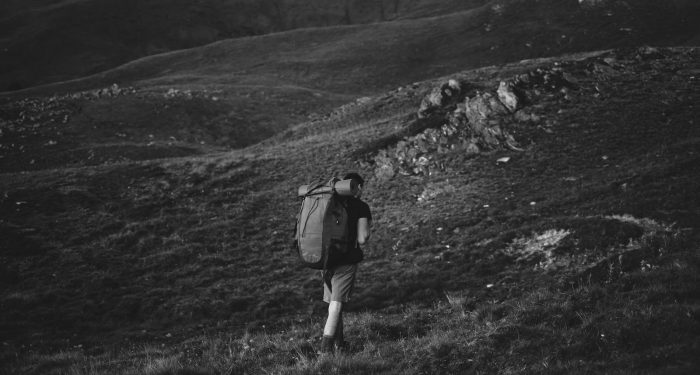
They mastered the art of handling everything life throws at them, except the terrifying possibility that someone might actually want to carry some of the weight.
Everyone loves the story of the self-made person until they meet one. We're admirable from a distance and exhausting up close. We're the friends who will drive four hours to help you move but won't let you carry a single box into our own apartment. We're the colleagues everyone relies on and no one actually knows.
I used to think this was a personality. Turns out it's a symptom.
The clearest way I've found to describe it: I once stood on the shoulder of I-95 at midnight with a dead car, scrolled through every contact in my phone, and called a tow truck. Not because no one would have come. Because asking felt like a language I'd never learned to speak.
Last month, a friend asked me to watch her kids for an afternoon. Simple enough. But when her four-year-old asked me to help tie his shoes, something strange happened. I watched him struggle with the laces, his small fingers fumbling, and I found myself saying, "Keep trying, you've almost got it." The words came out automatically, like muscle memory. His mother would have knelt down and helped immediately. I couldn't bring myself to do it. I stood there watching this child fight with his shoelaces, remembering my own fingers at that age, alone in the hallway before school, figuring it out because no one else was there to show me.
That's when I understood something about myself and about everyone else I know who grew up the same way. We weren't taught independence. We defaulted to it. When you're seven years old setting your own alarm because no one else will wake you up, when you're making your own lunch because the kitchen is empty and silent in the morning, when you're walking yourself to school in the rain because there's no one to drive you, you don't think about character building. You think about survival.
I've filled 47 notebooks with reflections over the years, and this pattern shows up everywhere. The girl who did her own laundry at eight becomes the woman who renovates her entire house alone, never calling a contractor. The boy who cooked his own dinners at ten becomes the man who starts three businesses without a single partner or investor. We look so capable from the outside. People admire our self-sufficiency. They shouldn't.
Here's what they don't see: we can navigate any crisis except the one that requires us to hand over the keys to someone else. We can solve any problem except the one that needs us to say, "I can't do this alone." We can weather any storm except the gentle rain of someone trying to take care of us.
A colleague once told me I was the most competent person she knew. We were working late on a quarterly review, and she watched me troubleshoot a broken CMS, coordinate with three departments, and rewrite an entire presentation in two hours. "Nothing rattles you," she said. I smiled and kept working, but inside I was thinking about how rattled I get when someone offers to pick me up from the airport. How my chest tightens when a friend says, "Let me handle that for you." How I literally cannot hand over a task without doing it myself first, just to make sure it's done right.
This isn't strength. It's adaptation. When you raise yourself, you develop a very specific kind of competence. You become an expert at reading situations, at anticipating problems, at creating backup plans for your backup plans. You learn to trust your own judgment above all else because for years, it was the only judgment available. You become fluent in the language of self-reliance because it was the only language spoken in your childhood home.
I discovered trail running at 28 as a way to cope with work stress, and there's something about those solo miles that makes perfect sense to me. Twenty to thirty miles a week, just me and the trail. No running partner to coordinate with. No one else's pace to match. No conversation required. Just the steady rhythm of my own feet, my own breath, my own decision about which path to take when the trail forks.
But last year, I twisted my ankle six miles from the trailhead. Not badly, but enough that walking hurt. I sat on a rock for twenty minutes, planning how I'd limp back alone. A runner stopped and offered help. "I'm fine," I said automatically. She looked at my swollen ankle and sat down next to me anyway. "I'll wait with you," she said. "Just in case." We sat there in silence for ten minutes before I finally let her help me stand, let her walk slowly beside me for six miles, let her drive me to urgent care.
That small surrender felt like failure and relief all at once.
The truth is, we self-raised children grow into adults who can handle anything except vulnerability. We can manage complex projects but not the simple act of delegation. We can give excellent advice but can't ask for it ourselves. We can be there for everyone else's crisis but disappear when we're the ones falling apart.
I left a six-figure salary at 37 to pursue writing, and everyone called me brave. But the brave thing would have been asking for support during the transition, admitting I was scared, letting someone else carry some of the weight of that decision. Instead, I planned everything meticulously, saved for three years, created multiple income streams before leaving. I made it look easy because looking easy is what we do. We perform competence like it's our job, because for us, it always has been.
The friend whose child I was watching came back that afternoon to find her son still struggling with his shoes. "Why didn't you help him?" she asked, genuinely puzzled. I couldn't explain that helping felt foreign, that watching him figure it out alone felt natural, that part of me believed he'd be better for it. Because that's the story we tell ourselves, isn't it? That we're better for it. That all that early independence made us strong. It didn't. It made us efficient, which isn't the same thing, and I've spent enough years conflating the two to know the difference costs you something I'm not sure you ever get back.
We're islands, capable of anything except building bridges to the mainland. We're the ones who show up for everyone else but vanish when we need something. We're the ones with spotless homes and chaotic inner lives. We're the ones who seem so put together that no one thinks to ask if we need anything, and we're too well-trained in self-sufficiency to tell them if they did.
I know all this. I've known it for years. Knowing hasn't changed much.
Last week a friend offered to bring me soup when I was sick. I said I was fine. I wasn't fine. I hung up, made myself tea, answered three emails, and told myself I'd do it differently next time. I've been telling myself that for a while now. The child who made their own lunch and set their own alarm, who walked to school alone and figured out the world in silence — she did what she had to do. The adult version of her is still doing it. Still, probably, tomorrow.