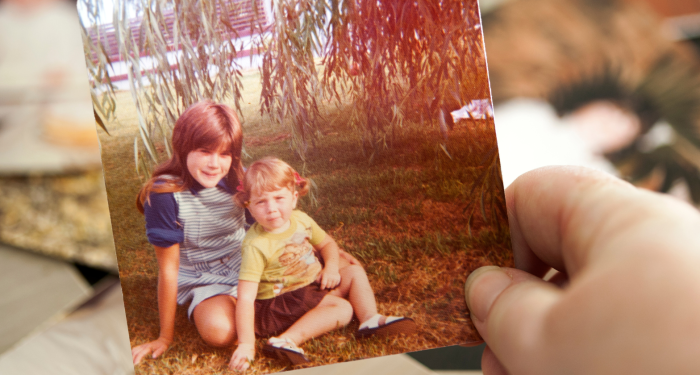
In the margins of her mother's 1978 datebook, between orthodontist appointments and grocery lists, she discovered the blueprint of a generation of women who built the infrastructure of American family life while having no language to calculate what it cost them—a silence their daughters inherited along with the impossible burden of holding everything together.
In 1980, the average American woman could expect to spend 17 years caring for a dependent child and 18 years helping a dependent parent — 35 years of caregiving across a lifetime, according to The Subcommittee on Human Services of the U.S. House of Representatives Select Committee on Aging. That statistic rarely appears in histories of the era. What appears instead are yellowed datebooks like the one I found last week in my attic, sorting through boxes that hadn't been opened since my mother passed. Every square inch of her 1978 planner was filled with precise handwriting: orthodontist appointments, PTA meetings, work shifts as a seamstress, Dad's bowling league, grocery lists squeezed into margins. I was holding a map of invisible labor, a document of what it took to keep five people's lives running smoothly while nobody noticed the conductor.
She worked as a seamstress and still had dinner on the table at 6 PM sharp. She never missed a school play, always knew where everyone's library books were, and could stretch a pot roast to feed unexpected guests. But when I asked her once how she managed it all, she just shrugged and said, "You just do." That was the language of her generation: you just do. No examination, no complaint, no vocabulary for the bone-deep exhaustion that lived behind her careful smile. The data confirms what her datebook already showed — the labor was staggering — but no dataset captures what it actually felt like to live inside those numbers.
The weight of holding it all together
I think about my mother often when I watch my daughter juggling her career and children, armed with terms like "mental load" and "default parent" that we never had. The words help her explain what she's experiencing, but they don't make the weight any lighter. She still texts me at midnight, wondering if she remembered to sign the permission slip, still carries the family calendar in her head, still knows exactly how many minutes it takes to get from soccer practice to piano lessons with a grocery stop in between.
What strikes me most is how little has changed in the actual labor, despite all our new language. The Health Policy Institute notes that "In 1989, women accounted for almost three-fourths of informal caregivers compared to slightly more than two-thirds today." Those numbers represent millions of women who were simultaneously working, raising children, and caring for aging parents, all without a framework to even discuss what that triple burden meant.
My friend Carol and I sometimes laugh about how we managed in those years, though the laughter has an edge to it. She raised three boys alone after her husband died, working double shifts while her mother watched the kids. "I don't remember entire years," she told me recently. "Just the feeling of running, always running, and never catching up." We didn't have terms like "caregiver burnout" or "sandwich generation." We had coffee at 5 AM and the stubborn determination to make it through another day.
The infrastructure we built in silence
The systems we created were remarkable in their complexity. I remember watching my neighbor Marie orchestrate her household like a military operation: color-coded schedules on the refrigerator, meals prepped on Sunday for the entire week, a network of other mothers who traded babysitting duties with the precision of international diplomacy. She worked as a secretary, cared for her mother-in-law who had dementia, and raised four children. When her husband lost his job, she simply added more hours, more juggling, more silent sacrifice.
What we couldn't articulate was the cost. The migraines that came from clenching our jaws through another school meeting where we were the only mother who worked. The guilty 3 AM thoughts about whether our children would remember the bedtime stories we were too tired to read. The dreams we buried so deep we forgot we'd ever had them.
What inheritance looks like
My granddaughter recently asked me why I never pursued my master's degree, and I found myself unable to explain the impossibility of it in a way she could understand. How do you describe a world where taking evening classes meant choosing between education and being there when your children needed help with homework? Where "having it all" meant having all the responsibility with none of the support?
I see my daughter struggling with this inheritance. She has flexible work arrangements and a husband who shares household duties, advantages I never dreamed of. Yet she still carries the mental calendar, still feels the guilt when work conflicts with school events, still lies awake calculating whether they can afford summer camp. The infrastructure has evolved, but its weight remains on familiar shoulders.
Breaking the silence, keeping the structure
What's different now is that we're talking about it. My daughter's friends share articles about emotional labor over wine. They have therapists who validate their exhaustion. They can name what's happening to them, even if they can't change it. When she calls me, overwhelmed and crying, I don't tell her to just push through. I tell her it's okay to be angry, to be tired, to want more than survival.
But I think the new language has become its own burden, and I'm less convinced it represents the progress we want it to be. Now women are expected to advocate for themselves while still maintaining everything, to lean in while holding everyone up, to practice self-care while caring for everyone else. The vocabulary of empowerment has become another task on an endless list. My mother had no words for what was happening to her, and that was a kind of damage. My daughter has all the words and still can't put anything down. I'm not sure which is worse, but I suspect that having the language without having the structural change is its own form of cruelty — more sophisticated, maybe, but no kinder.
Sometimes progress looks like this: small shifts that matter enormously to those living them but appear insignificant from the outside. My daughter can work from home when her kids are sick. Her husband knows how to braid their daughter's hair. These aren't revolutionary changes, but they're changes my mother couldn't have imagined.
The conversations we're finally having
At my book club last month, we spent three hours discussing not the novel we'd read, but our mothers. Every woman there had a story about watching their mother manage impossible circumstances with grace that looked effortless but cost everything. We talked about finding antidepressant prescriptions from the 1970s hidden in jewelry boxes, about mothers who went back to school at fifty, about the dreams deferred so long they fossilized.
One friend shared how her mother, at eighty-five, finally admitted she'd wanted to be an architect. She'd drawn house plans on grocery bags while her children slept, hidden them in cookbook pages, never shown anyone. The infrastructure of her family's life was built on the burial of her own blueprints. We sat with that image in silence because sometimes silence says more than all our new words ever could.
What we're inheriting isn't just the trauma or the silencing. It's also the incredible strength, the ability to create stability from chaos, the knowledge that we can survive what seems unsurvivable. When I watch my daughter comfort her crying toddler while simultaneously cooking dinner and answering work emails, I see my mother's hands in her movements, my grandmother's determination in her eyes.
And I don't know whether to be proud of that or heartbroken by it. The strength is real. So is the fact that she needs it for the same reasons my mother did. We have the words now. We have the research, the articles, the shared vocabulary. What I can't figure out — what none of us seem able to figure out — is whether naming the weight has brought us any closer to setting it down, or whether we've just gotten better at describing the shape of something we still can't put anywhere.