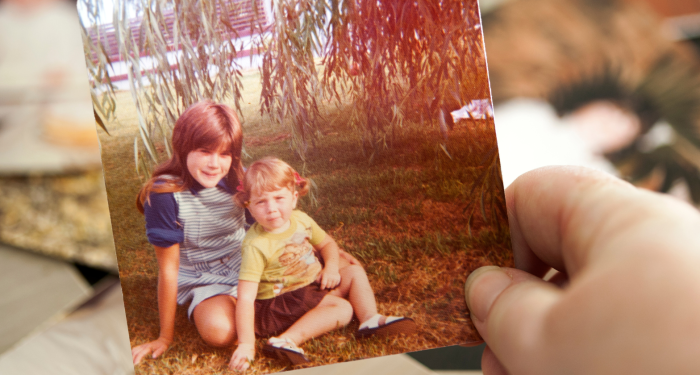
Walking into my childhood home at 44, I watch myself transform into my twelve-year-old self in exactly ninety seconds — the same nervous deference, the same careful emotional management, the same outdated survival strategies clicking into place like muscle memory I can't override.
Picture this: You're a grown adult. You pay your own bills, make your own decisions, maybe even give advice to others. Then you walk through your childhood home's front door and boom - you're twelve again.
The transformation is almost instant. Your posture changes. Your voice shifts. You find yourself asking permission for things you'd never think twice about in your own space.
Sound familiar?
This peculiar time warp isn't just about nostalgia or family dynamics. It's about how deeply our environments shape us, and more importantly, how understanding this phenomenon can help us navigate not just family visits, but all the spaces and relationships in our lives.
Why we become different people in different places
Behavioral scientists call this "context-dependent behavior," and it's more powerful than most of us realize. Our brains are constantly making associations between environments and behaviors, filing away patterns that helped us survive and thrive in specific settings.
When I walk into my parents' house in Sacramento, my brain doesn't just remember the layout of the rooms. It remembers the entire behavioral blueprint I developed there - the careful navigation of moods, the unspoken rules, the version of myself that worked in that ecosystem.
Think about how differently you act in a library versus a concert venue. Or how your personality shifts between a job interview and drinks with old friends. These aren't fake versions of you. They're all real, just optimized for different contexts.
The childhood home effect is particularly intense because those patterns were formed during our most impressionable years. We spent thousands of hours rehearsing those behaviors, embedding them so deeply that they can resurface decades later, triggered by something as simple as the smell of the hallway or the sound of the garage door opening.
The ninety-second transformation
Here's what fascinates me most: the speed of the change. Ninety seconds. That's all it takes for years of adult development to temporarily dissolve.
In those ninety seconds, your brain is doing something remarkable. It's recognizing patterns - the lighting, the sounds, the spatial arrangement - and automatically loading the behavioral program it associates with this environment. It's like your brain has a preset labeled "parents' house" and it just hits play.
This isn't weakness or regression. It's efficiency. Your brain is trying to help you by quickly adapting to an environment using proven strategies from the past.
But here's the thing: those strategies were developed by a younger you. They were designed for survival and acceptance in a family system where you had limited power and needed different tools than you do now.
Breaking free without breaking away
So how do we interrupt this pattern without avoiding our families altogether?
First, recognize that awareness itself is powerful. Once you notice the transformation happening, you can start to observe it rather than just experience it. You become the scientist studying your own behavior rather than just the subject.
I started paying attention to the physical sensations. The slight tension in my shoulders when I reach for the door handle. The way my breathing changes. The mental checklist that starts running - who's in what mood, what topics to avoid, what role I need to play.
Physical anchors can help too. I wear a watch I bought myself as an adult - something that didn't exist in my childhood home. It's a small reminder that time has passed, that I'm not who I was.
Some people find that arriving differently helps. Park in a different spot. Enter through a different door if possible. Bring something that represents your current life - a book you're reading, music you're into now. These small disruptions can help your brain recognize that this is a new scene, not a rerun.
The gift of understanding patterns
What if this automatic reversion isn't something to fight but something to learn from?
Those ninety seconds are showing you something profound about how you were shaped. Every adaptation you made, every careful management of atmosphere, every moment of deference - these were intelligent responses to your environment. You developed these strategies because they worked.
Understanding this has changed how I see not just my family visits but my entire psychology. When I notice myself falling into old patterns anywhere - at work, in relationships, in new situations - I can ask myself: What environment originally shaped this response? Is it still serving me?
My grandmother, who raised four kids on a teacher's salary and still volunteers at the food bank every Saturday, once told me that every house has its own gravity. Some pull you down, some lift you up, but they all pull. The trick isn't to resist the pull entirely but to understand it, to know where your feet are even as you feel the force.
Creating new patterns in old spaces
Here's something I've been experimenting with: instead of trying to maintain my "adult self" in my parents' house, I'm working on creating a hybrid version. Someone who acknowledges the history of that space while also bringing in elements of who I've become.
During our Thanksgiving gathering this year, I noticed myself starting the familiar dance - the careful monitoring, the old deferent patterns. But then I remembered: I'm 44. I've lived more years outside this house than in it.
So I tried something different. Instead of managing everyone else's atmosphere, I focused on managing my own. When my grandmother made her special vegan side dish just for me (bless her), I didn't minimize it or apologize for the extra effort. I just said thank you and meant it.
Small shifts, but significant ones. You don't have to revolutionize every family gathering. Sometimes growth looks like being younger you for eighty seconds instead of ninety.
Wrapping up
That ninety-second transformation when we enter our childhood homes? It's not a bug, it's a feature. It shows us how adaptable we are, how deeply we can learn, how thoroughly an environment can shape us.
The goal isn't to never feel that shift again. It's to recognize it, understand it, and gradually create space for the person you've become alongside the person you were.
Next time you walk into a space that transforms you - whether it's your parents' house, your old school, or even your office - pay attention to those ninety seconds. Notice what changes. Notice what stays the same. Notice that you're noticing.
Because here's the truth: every environment is still shaping you. The difference now is that you're conscious of it. And consciousness, as I've learned from both behavioral science and family dinners, is where choice begins.
The house that made you doesn't have to be the house that defines you. But understanding how thoroughly it shaped you? That's where real self-awareness starts.
If You Were a Healing Herb, Which Would You Be?
Each herb holds a unique kind of magic — soothing, awakening, grounding, or clarifying.
This 9-question quiz reveals the healing plant that mirrors your energy right now and what it says about your natural rhythm.
✨ Instant results. Deeply insightful.

Jordan Cooper
Jordan Cooper is a food and culture writer based in Venice Beach, California. Before turning to writing full-time, he spent nearly two decades working in restaurants, first as a line cook, then front of house, eventually managing small independent venues around Los Angeles. That experience gave him an understanding of food culture that goes beyond recipes and trends, into the economics, labor, and community dynamics that shape what ends up on people’s plates.
At VegOut, Jordan covers food culture, nightlife, music, and the broader cultural forces influencing how and why people eat. His writing connects the dots between what is happening in kitchens and what is happening in neighborhoods, bringing a ground-level perspective that comes from years of working in the industry rather than observing it from the outside.
When he is not writing, Jordan can be found at live music shows, exploring LA’s sprawling food scene, or cooking elaborate meals for friends. He believes the best food writing should make you understand something about people, not just about ingredients.
More Articles by Jordan