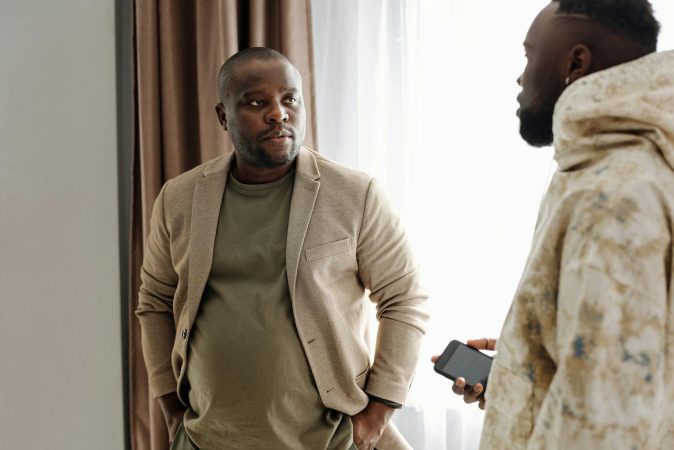
Two people can sit across from each other for an hour, talk only about feelings, and walk away more alone than when they started.
Researchers who study conversation have a name for what most of us are doing when we think we're listening. They call it shift response — the move where someone redirects an exchange toward themselves instead of staying with what the other person just said. And yet the shift response tends to dominate everyday conversation — the move where someone redirects an exchange toward themselves instead of staying with what the other person just said. The support response, where the listener actually stays put, is rarer than most people assume. The strange thing is that almost everyone, when asked, believes they do the second one.
I think about this whenever I catch myself in a conversation doing the exact thing I know I shouldn't. Someone is telling me about a real struggle — something vulnerable, something that matters — and before they've finished, I've already launched into my own version of the same experience. I'm running my own track. They nod politely. They let me finish. Then they change the subject. And I realize, with a slight sting of self-awareness, that I haven't actually heard a single thing they said. I received the emotional package, glanced at the label, and immediately handed them one of mine in return.
Moments like that have become a kind of personal benchmark.
I notice the same pattern constantly now. In coffee shops, in podcasts, in the texts my friends send each other, in the conversations I have with people I love. Two people exchanging feelings like trading cards. Look at mine. Now look at yours. Now we'll both put them away and call this intimacy.
The conventional wisdom is that we're living through a golden age of emotional literacy. People talk about anxiety, attachment styles, boundaries, nervous systems. Therapy language has migrated from the consulting room into group chats and first dates. The assumption is that all this fluency must be producing deeper connection, because we finally have the words.
What I've found is closer to the opposite. The vocabulary has expanded faster than the capacity. We can name what we feel with surgical precision and still not be heard, because the person across from us is busy queuing up their own diagnosis. The cards keep changing hands. Nobody is reading them.
The mechanics of the trade
Watch a conversation like this carefully and you'll see the pattern. Person A says something vulnerable. Person B does not ask a question. Person B does not sit with what was said. Person B reaches into their own pocket and pulls out a matching response about how the same thing happened to them, and the conversation pivots before the first disclosure has finished landing.
This isn't malice. Most people doing it believe they're connecting. The matching card feels like solidarity, like saying they understand because they've been there. But there's a sleight of hand inside it. The original speaker doesn't get acknowledged; they get matched. Their experience becomes a prompt for someone else's monologue. By the end, both people have spoken. Neither has been received.
Active listening, the kind where you actually slow down, reflect what you heard, and check whether you got it right, turns out to be rarer and more effortful than people assume. Most of what passes for listening is actually waiting. The brain is composing while the other person is still talking. The response is half-built before the disclosure is complete. I think about this often, partly because I used to be very good at the trade. During my years as a management consultant, I was paid partly to perform attentiveness. I learned early that the appearance of listening was a currency. Nod at the right moment. Mirror the right phrase. Produce a personal anecdote that signals you've understood. None of it required me to actually receive what someone had given me. It required me to keep the conversation moving.
Therapy language as a closing door
The trade has gotten more sophisticated in recent years because the cards themselves have improved. People used to swap clichés like "hang in there" or "everything happens for a reason." Now they use clinical language about things being activating or they notice avoidant patterns or they honor their capacity right now. The vocabulary is better. The reception is the same.
I've come to think this is one reason therapy language can function as a wall rather than a window. The terms have a closing quality to them. When someone says "that's a boundary for me," the conversation ends. When someone says "I'm dysregulated," you're not supposed to follow up. The words sound like disclosure but they're actually exits. Beautifully phrased, fully sanctioned, impossible to argue with.
A psychologist writing in Forbes in 2025 described empathy traps that flatten relationships rather than deepen them. Situations where the performance of understanding crowds out the harder work of actually understanding. Both people leave feeling they did the emotional thing. Neither leaves feeling met.
What being received actually looks like
I had an experience not long ago that clarified this for me. A friend was telling me something about their work — something I had no personal experience with, no matching card to play. I noticed I was uncomfortable. I had nothing to offer. So I asked a question. Then another. Then I sat there and let them keep going.
They talked for a long time. I said maybe twenty words the entire stretch. When they finally stopped, they looked at me like I'd done something strange, then told me they hadn't realized how badly they needed someone to just listen.
That's when I understood. Being received isn't about the listener producing the right words. It's about the listener producing fewer words. Most of what people need when they hand you a feeling is for you to hold it long enough that they can hear themselves think. The matching card interrupts that. It pulls the feeling back out of the air before the speaker has finished examining it.
The Greater Good Science Center at Berkeley has written about how vulnerability requires reception to actually function. Disclosure into a void or into a swap doesn't produce the connection it's supposed to. The act of being witnessed is what does the work. Without witnessing, you've just performed a feeling at someone.
Why we trade instead of receive
I don't think people do this because they're shallow. I think they do it because actually receiving someone's feeling is harder than producing one of your own. Reception requires you to tolerate not knowing what to say. It requires you to sit with discomfort that isn't yours, without immediately translating it into something familiar. It requires, briefly, that you become small in the conversation while someone else takes up space. Most of us were not raised for this. We were raised to produce. Answers, opinions, contributions, evidence that we were paying attention. Silence reads as failure. "I don't know what to say" reads as inadequate. So we reach for the matching card because it's the move that proves we were there, that we relate, that we have something to contribute. The irony is that the contribution is exactly what breaks the connection.
Building Ideapod over the years, and later co-creating The Vessel with Rudá Iandê, I kept running into this tension. We wanted to create spaces where people could share ideas and experiences authentically. But even in communities designed for genuine exchange, the trading-card dynamic crept in. Someone would post something raw and real, and the responses would be walls of "me too" stories that inadvertently buried the original voice. The intention was solidarity. The effect was displacement.
I think the way through is surprisingly simple, though not easy. It starts with noticing the impulse to match. When someone hands you a feeling and your hand automatically reaches for your own pocket, you pause. You stay with theirs. You ask what it was like. You tolerate the discomfort of having nothing to add. You let the silence do the work that your matching card was going to interrupt.
This isn't a technique. It's a reorientation. It means accepting that sometimes the most generous thing you can do in a conversation is disappear from it for a while. Let the other person take up the whole frame. Resist the urge to prove you understand by producing evidence, and instead prove it by staying put.
The cards will always be there. We'll always have feelings to trade. But the moments that actually change something — the ones people remember years later — are the ones where someone handed over a feeling and the other person simply held it. No swap. No match. Just reception. And in that silence, something that had been circling finally landed.