
Recent surveys suggest approximately one in six Americans report feeling lonely on a regular basis, a number that gets cited constantly in conversations about isolation, screen time, and the supposed collapse of social life. What that statistic rarely accounts for is the difference between being alone and feeling alone.
The conventional read on the person eating dinner by themselves at a restaurant, no phone in hand, no book propped against the water glass, is that something has gone wrong. They got stood up. They're between things. They're sad. That read is almost always wrong.
The argument here is simple: the solo diner who doesn't reach for a screen isn't lonely or socially stunted. They've arrived at something most people are still working toward—a self that no longer requires a witness to feel real. Everything else in this piece is in service of that claim.
What the research actually says about solitude
Psychologist Robert Coplan at Carleton University has spent years studying solitude, arguing that most people aren't getting enough time alone with themselves. In an interview with WHYY, he discussed how even 15 minutes a day of intentional alone time can strengthen a person's relationship with themselves. He's careful to separate this kind of intentional solitude from loneliness, which involves real feelings of isolation and disconnection.
The framing matters. Solitude is a state of being. Loneliness is a state of suffering. They look identical from the outside and feel nothing alike from the inside. Voluntary solitude tracks with psychological well-being. Loneliness tracks with unmet need. One is a meal. The other is hunger.
The witness problem
Humans use other people as mirrors, constantly checking the reflection. For most of life, that's a developmental necessity. A child learns who they are partly by watching adults respond to them. A teenager builds a self in the gaze of peers. A young adult tests identities against the audience of friends, partners, colleagues.
At some point, though, the mirror becomes optional.
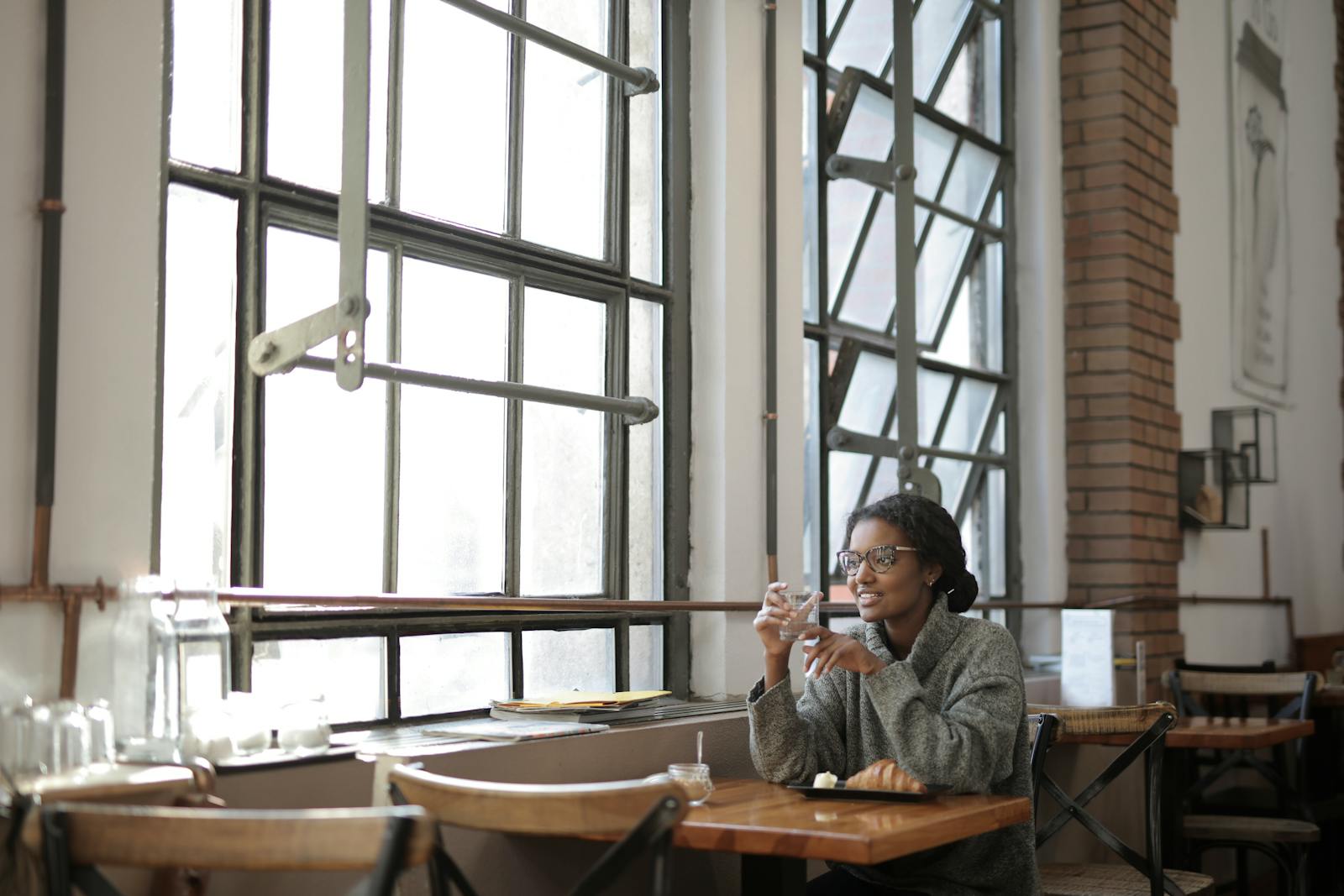
Picture the woman at the corner two-top on a Tuesday night. She orders a glass of wine, then the cacio e pepe. She looks at the room while she waits—not anxiously scanning, just looking. When the food arrives she eats it. When she's done she pays. Her phone stays in her bag the whole time. She has, in some quiet way, finished the project of needing to be seen. She is not performing dinner. She is having one.
That's not a small thing. It's closer to what self-actualization describes—the point at which a person's sense of self stabilizes enough that it stops requiring constant external reinforcement. A Psychology Today essay on the framework notes that self-actualized people tend to be comfortable with solitude precisely because their identity isn't a thing they have to keep proving.
Why the phone changes everything
The phone is what makes solo dining legible as a psychological event rather than just a logistical one. Twenty years ago, the person eating alone had a newspaper, a paperback, or the wall. Now they have an infinite scroll designed by some of the most sophisticated behavioral engineers on earth to make sure the moment never gets boring.
Reaching for it is the default. Not reaching for it is a choice.
And research on what compulsive phone use correlates with is unflattering. Problematic smartphone dependence tracks closely with social anxiety, particularly in younger women. The phone, in those cases, isn't a tool. It's a shield against the discomfort of being perceived.
That reframes the diner-with-phone and the diner-without-phone in interesting ways. The man hunched over Instagram between bites of his burger isn't necessarily relaxed. He might be using the screen the way a nervous public speaker uses a podium, something to grip so the hands stop shaking. The person without the phone has either made peace with being looked at or stopped noticing whether they are.
The self that no longer needs an audience
Eating is the most basic thing every animal does. Dressing it up in social ritual is a human invention, useful and pleasant, but not strictly necessary for the eating itself to matter.
The solo diner without a phone has, in some sense, reclaimed the meal as a meal. It doesn't need to be photographed. It doesn't need to be witnessed by a friend or filtered through a story. It just needs to be eaten.
That sounds simple. It is not.
What gets in the way
Most people don't arrive at comfortable solo dining by accident. They get there by working through a stack of inherited assumptions about what eating alone says about them.
Some of those assumptions are gendered. Women, in particular, often report feeling watched in public spaces in ways that make solo dining feel exposing rather than freeing. Some are generational. Some are tied to identity narratives—the story a 42-year-old man tells himself about how he's "not the kind of guy who eats at a bar alone," even though he can't quite remember where he picked that idea up.
The concept of self-concept inertia helps explain why people remain stuck in old patterns not because they want to but because the self-image attached to those patterns has hardened. The person who has spent thirty years believing they're not the kind of person who eats alone will find a thousand reasons to never test the assumption.
Breaking the assumption is less about courage and more about boredom. At some point, the cost of maintaining the story exceeds the cost of changing it.
The loneliness counterargument worth taking seriously
None of this is an argument that solitude is universally good or that loneliness is overblown. It isn't. Loneliness is a real public health concern with documented physiological consequences, including, per a study tracking more than 10,000 older adults across seven years, measurably worse baseline memory performance.
The point isn't that being alone is good and being with people is bad. The point is that the relationship between aloneness and well-being depends entirely on whether the aloneness is chosen.

A person who eats alone because they have no one to eat with, and feels that absence as a wound, is in a different psychological position than a person who eats alone because they prefer their own company tonight. They might be sitting at identical tables.
What this looks like in practice
The marker of psychological maturity isn't the ability to eat alone. It's the ability to eat alone without needing the meal to mean anything about you.
The person who has to post a photo of their solo dinner with a caption about self-love hasn't quite gotten there yet. They're still using the meal as evidence, still building a case for an audience. That's fine. It's a step.
The person who eats the meal, pays the check, and walks out without ever feeling the need to document or perform or explain it has reached something quieter. The meal was just dinner. The version of them who ate it didn't need anyone else's confirmation that they were there.
The cultural piece
There's a reason solo dining without a phone reads as remarkable in 2026 and would have read as completely unremarkable in 1986. The technology changed faster than the social norms did. The expectation that every spare minute be filled, optimized, or broadcast is recent, and it's worth noticing how much of it has been engineered rather than chosen.
The people building the platforms aren't accidentally creating environments where stillness feels unbearable. That's the product. Restlessness is monetizable. Peace is not.
Choosing to sit with a meal, unaccompanied and unmediated, is a small refusal of that system. Not a revolutionary one. Not a moral one. Just a refusal.
What the table teaches
The goal isn't to fix loneliness by maximizing social contact. The goal is to develop a self that can be alone without that aloneness curdling into loneliness. People who can be alone tend to be better company. People who can't tend to be lonelier in rooms full of friends.
The restaurant table is a small laboratory for all of this. One chair. One plate. One person. No witness required.
The person who can sit there comfortably has answered a question most people are still asking. They've found out, quietly and without fanfare, that they exist whether anyone is watching or not.