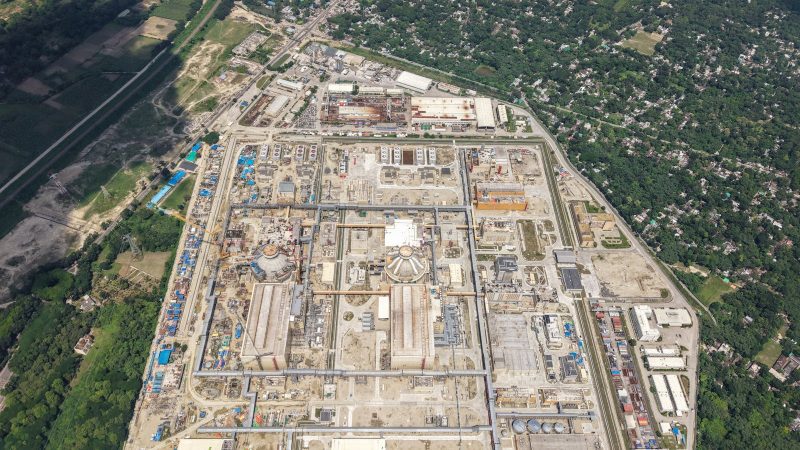
Georgia's Plant Vogtle expansion finished in 2024 at $36.8 billion, the most expensive power project in U.S. history. Two years on, its lessons are shaping a national debate over the nuclear revival.
In Georgia, the country's most expensive power project in history just came online, and the households paying for it are still living with the consequences. Plant Vogtle's $36.8 billion expansion is the case study many conversations about the nuclear revival do not lead with. Inside Climate News reports that two years after the new reactors came online, Georgia ratepayers are still paying — and how they are paying is shaping how other states think about nuclear.
The conventional pitch for nuclear is straightforward: carbon-free baseload power that can run around the clock. Vogtle complicates that pitch.
The two new reactors, Units 3 and 4, increased Georgia Power's capacity by just over 7 percent. Residential and small commercial rates, meanwhile, have climbed by more than 20 percent, according to a watchdog report cited by Inside Climate News.
The project finished in 2024, seven years late, at more than double its original $14 billion budget. Construction was disrupted by Westinghouse's 2017 bankruptcy, faulty components and defects in parts built offsite.
But the more revealing number is what landed on customer bills. Inside Climate News reports that between 2009 and 2024, Georgia Power customers paid a monthly construction surcharge that added up to more than $1,000 for some households. That fee ended when the reactors entered service. The cost recovery did not. Regulators later approved base rate increases of about $15 per month for a typical residential customer to recover remaining costs over decades.
Kim Scott, executive director of Georgia WAND, has criticized Georgia regulators for failing to protect ratepayers from runaway costs. “The biggest failure was not the construction — it was the failure to protect ratepayers,” she told Inside Climate News. Her argument is that ordinary Georgians were left paying through higher bills after regulators had multiple chances to intervene.
The distributional impact is the part that makes the story larger than one expensive energy project. As Vogtle-related rate increases took effect, Inside Climate News reports that disconnections among Georgia Power customers rose, with Black households disproportionately affected. For a household already living close to the edge, a $15 monthly base-rate increase is not just a line item. It is another pressure point in a budget that may already be stretched thin.
That is why Vogtle has become more than an engineering story. It is a ratepayer story. It raises a question that every clean-energy transition has to answer honestly: when a project overruns by billions, who carries the risk?
Nuclear industry advocates argue that subsequent reactor builds will benefit from lessons learned at Vogtle, following typical infrastructure cost curves. Advocates also point to China, where nuclear construction costs have been significantly lower than in recent U.S. projects and more than 30 reactors are under construction.
Critics like Patty Durand, founder of Georgians for Affordable Energy, remain skeptical that future nuclear projects will be more affordable. The comparison she draws is blunt: Units 3 and 4 added just over 2 gigawatts of capacity, while Texas added more than 40 gigawatts of solar in the same period for roughly $50 billion, according to Inside Climate News.
The timing matters because more than a dozen states are reconsidering nuclear to meet climate goals and rising demand from electrification and data centers. New England governors have agreed to explore advanced nuclear energy as part of a regional strategy. New York Gov. Kathy Hochul has directed agencies to plan expanded nuclear development. Illinois, New Jersey and West Virginia have moved to lift longstanding restrictions on new nuclear construction.
That is the context in which Vogtle keeps getting cited. For a publication focused on conscious living, the lesson is not that nuclear is simply bad or good. It is that the people least able to absorb a rate hike rarely sit at the table when regulators decide whether to keep writing checks.
Decarbonization that ignores who pays is not just an energy strategy. It is a transfer.