

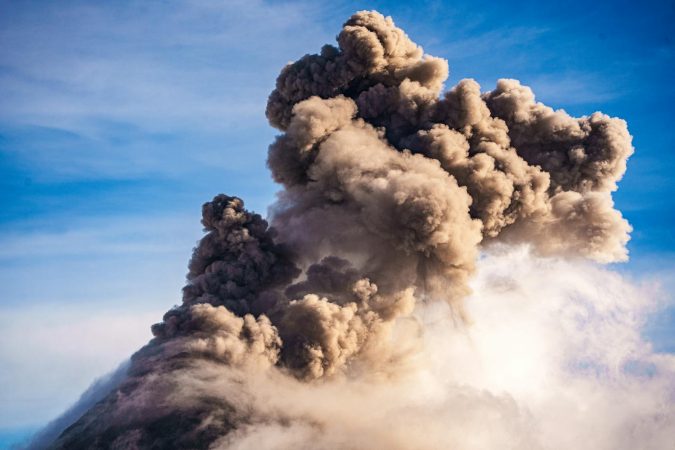
The 2022 Hunga Tonga eruption triggered an unexpected atmospheric reaction that destroyed methane in the stratosphere for over a week — a discovery that could rewrite global methane budgets and reshape the conversation around climate intervention.
A volcano did something climate scientists did not expect to see so clearly from space. When the underwater Hunga Tonga-Hunga Ha'apai volcano erupted in January 2022, its plume did not just disturb the stratosphere. It appears to have helped break down some of the methane it released.
In a new Nature Communications study, researchers used satellite observations of formaldehyde, a short-lived chemical fingerprint of methane oxidation, to track what happened inside the volcanic plume. Their conclusion was striking: particles in the plume helped produce reactive chlorine chemistry that oxidized methane high in the atmosphere.
The conventional story about volcanic eruptions is usually told through sulfur dioxide, sulfate aerosols, short-term atmospheric disruption, and longer-term cooling effects. Methane removal was not the obvious headline. But the Tonga plume appears to have briefly functioned as a natural methane scrubber, and scientists noticed because a satellite caught unusually high formaldehyde in a place where it should not have persisted.
What the satellites caught
Formaldehyde does not hang around for long in the atmosphere. It typically survives for only a few hours. So when researchers tracking the plume from the South Pacific saw elevated formaldehyde lasting far longer than expected, the signal pointed to one explanation: something inside the cloud was continuously producing fresh formaldehyde.
The study links that production to methane oxidation. The eruption appears to have injected methane into the stratosphere, and the plume then helped break some of it down as it drifted.
The researchers reported the highest formaldehyde enhancement ever recorded in the stratosphere, reaching up to 12 parts per billion at about 30 kilometers altitude. They estimated methane oxidation at 900 ± 220 tons per day, with a peak rate on January 16, 2022.
The chemistry, briefly
The mechanism comes down to chlorine. In the Tonga plume, volcanic particles, seawater-derived material, sunlight, and high aerosol surface area created conditions where reactive chlorine could form and attack methane molecules. Formaldehyde was one of the byproducts.
The researchers also pointed to a possible role for iron photochemistry in volcanic ash, similar to chemistry previously observed when mineral dust mixes with sea spray. That part matters because it raises a bigger atmospheric question: if dust, salt, sunlight, and trace metals can drive methane oxidation in the right conditions, Tonga may not be the only place where this kind of chemistry matters.
Still, the study does not prove that ordinary dust events are already removing methane at a climate-changing scale. It shows that satellite formaldehyde observations can reveal methane oxidation in a plume, and that the Tonga eruption created an unusually clear natural test case.
Why this matters for the climate math
Methane is the climate problem people often understand less well than carbon dioxide. Over a 20-year window, it traps roughly 80 times more heat than CO2, and it is responsible for about a third of the warming the world is experiencing today. The difference is time. Methane breaks down within about a decade, while carbon dioxide can shape the climate for centuries or longer.
That is why methane sits at the center of serious near-term climate strategy: livestock policy, oil and gas leak detection, landfill capture, and rice cultivation reform. Cutting methane emissions now can produce climate benefits much faster than cutting carbon dioxide alone.
The Tonga finding adds a wrinkle to that picture. If some atmospheric particles are removing more methane than current models fully account for, the global methane budget may need refinement. That could mean natural systems are doing more cleanup work than scientists thought. It could also mean emissions are higher than current accounting suggests, with atmospheric chemistry masking part of the true scale.
The geoengineering question nobody can avoid
Once scientists identify a natural process that can pull methane out of the air, the next question is obvious and uncomfortable: should humans try to copy it?
The satellite method used in the Tonga study gives researchers something valuable: a measurable signal for methane oxidation in the atmosphere. That matters because one of the long-standing problems with atmospheric intervention ideas is verification. It is hard to claim methane is being removed if there is no reliable way to track the chemistry in real time.
But the harder conversation is whether deliberately creating chlorine-releasing aerosol chemistry in the atmosphere would be wise. Reactive chlorine in the stratosphere is associated with ozone chemistry, and the history of the ozone hole is a warning about unintended consequences. Different molecules and conditions matter, but the broader lesson still applies: an atmospheric “emergency brake” can create its own risks.
The bigger picture this finding sits inside
The Tonga study lands in a stretch of climate research that keeps surfacing the same theme: the systems scientists study are sensitive, complex, and still capable of surprising them. Separate research documented a steady weakening of the Atlantic Meridional Overturning Circulation across nearly two decades of seafloor measurements, according to the University of Miami's Rosenstiel School. Other new findings show hidden channels under Antarctic ice shelves trapping warm water and amplifying local melt by an order of magnitude in modeled conditions, a process current climate models may not fully capture.
None of these studies is about the same mechanism. Together, they tell a coherent story: the climate system contains processes that can buffer warming, amplify it, or complicate the accounting. Scientific uncertainty is not a reason to ignore the math. It is a reason to keep improving it.
For people trying to make better choices in their own lives, the Tonga finding does not change the daily calculus. Cutting methane at the source, through food systems, energy systems, leak detection, and waste reduction, is still cheaper, safer, and more certain than hoping someone figures out how to mimic a volcanic plume. The cow math has not changed. Livestock emissions remain substantial whether or not the stratosphere occasionally helps.
What happens next
The concrete next step is to test whether the same satellite-based formaldehyde method can detect methane oxidation in smaller dust events, including Saharan plumes over the Atlantic. If researchers find similar chemistry outside rare volcanic eruptions, methane models may need to account for a natural sink that has been underestimated.
For now, the takeaway is narrower and stranger. A volcano erupted under the South Pacific, threw a cloud into the stratosphere, and appears to have helped break down some of the methane it released. Scientists noticed because formaldehyde should not have been there for so long. The atmosphere, it turns out, still has ways to surprise us.