My mum raised me and my brothers with the rules she'd been given, and we turned out fine. But there are a handful I've quietly let go of as a father of my own.
I'm a first-time father in my late 30s. My daughter is nearly one. My mum, who is now a grandmother for the first time, has been generous with her advice from the other side of the world, and almost always patient when I haven't taken it.
She raised me and my brothers in the 80s and 90s with the rules she'd been given, and we all turned out reasonably okay.
But there are a handful of things she swore by that I've quietly let go of in this first year of being a father. None of them are dramatic. None of them mean I think she got it wrong. They're just the small assumptions about parenting that I've decided don't fit how I want to raise my daughter.
Talking to other parents my age, I've noticed most of us have a list like this. Here's mine.
"Don't pick her up every time she cries"
This was the first one I let go. My mum's generation was told that responding to every cry would create a clingy, demanding child. The fear was the long term, that you'd spend the next ten years undoing the habit of picking her up.
I don't believe this anymore. I pick my daughter up almost every time she cries, especially in this first year. She isn't manipulating me. She's a baby. She doesn't have the equipment for manipulation yet.
What I've noticed, against the prediction, is that she settles more easily, not less. Knowing she'll be responded to seems to make her less anxious about whether she will be.
I might revisit this when she's three and starting to use crying as a tool. For now, the answer is to pick her up.
"Clean your plate"
I won't be doing this one.
My mum grew up with parents who had lived through war and rationing. Food was not to be wasted. Clean your plate was a moral position, not just a rule. I understand why she said it to us.
But I don't want my daughter to learn that her hunger is something to be overridden. The skill I want her to keep is the one almost everyone loses, which is the ability to stop eating when she's full. So when she pushes the food away, I let her push it away. Even when there's still food on the plate.
This one is harder than I expected. I notice myself wanting to encourage one more bite. I think that part is mine, not hers.
"Don't be too soft as a father"
The model I grew up around was the friendly but slightly distant dad. Mum did the comforting. Dad did the rules.
I've found I don't want to do this. I'm the one she comes to when she's sleepy. I sing to her at night. I cry sometimes when she does. I don't think this makes me less of a father. If anything, it makes me feel more like one.
There's still a place for me to set limits as she grows. But the idea that emotional softness is the mother's job, and the father's job is somewhere else, doesn't sit right with me. I'd rather she grows up knowing that men are allowed to be soft, especially with the people they love.
"Don't praise her too much or she'll get a big head"
This one is gentler, but I've still let it go.
The fear behind it is real. Children who are praised for everything do sometimes grow up with a thin sense of self, easily wounded, dependent on validation. I don't disagree with that.
But what I've noticed is that the alternative my mum's generation often defaulted to wasn't "praise her accurately." It was "don't praise her at all." A lot of people I know my age grew up unsure whether their parents thought they were any good at anything. I'd rather my daughter occasionally hear too much than too little.
So I tell her she's done well when she's done well. I tell her I'm proud of her. I tell her I love watching her figure things out. None of it has made her arrogant yet, and she's nearly one, so we have time.
"Don't make a fuss over feelings"
In the world my mum grew up in, the right response to a difficult emotion was to get on with it. Make a cup of tea. Have a shower. Don't dwell.
There's wisdom in that, and I haven't thrown it out entirely. The capacity to keep going, to not let every feeling derail your day, is worth keeping.
But I want my daughter to be able to name what she's feeling. I want her to be able to say "I'm sad" or "I'm scared" or "I'm angry" before she's an adult trying to work it out for the first time. Most of the men in my family didn't get to do this until much later than they should have, and it cost them.
So when she's upset, I try to name the feeling for her, even though she can't say it back yet. "You're a bit frustrated." "That made you sad." It feels strange in the moment. I'm sure it will feel less strange when she can answer.
"Children should fit around adult life"
This was the operating assumption of my childhood, and most of my friends'. The world was the adults' world. Children were welcome in it as long as they adapted.
I've found, as a father, that the trade is more two-way than that.
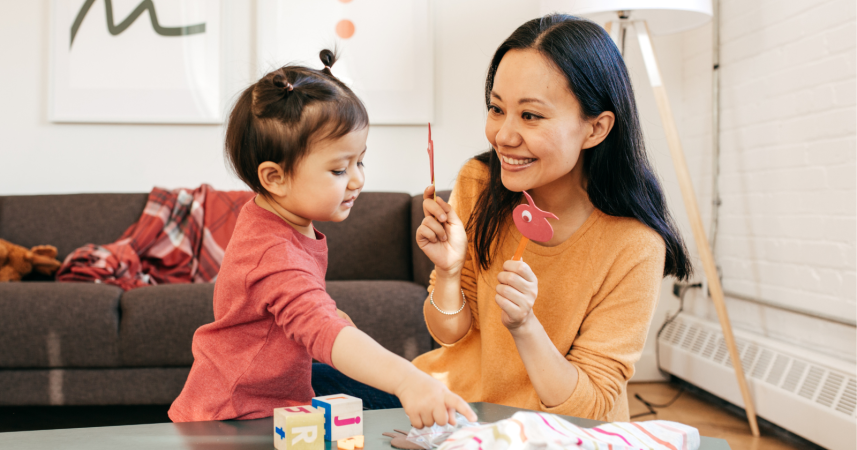
I do still ask my daughter to come into my world, sometimes. I take her to cafés. I bring her along to meet my friends. I expect her to spend time being patient while my wife and I have a conversation she isn't part of.
But I also try to spend a chunk of every day in her world, on the floor, at her pace, doing whatever she wants to do. I didn't grow up watching either of my parents do that, and I don't blame them. Their generation, in their part of the world, didn't. But I think the children who grow up with adults willing to spend time in their world end up trusting those adults more. That's the bet I'm making.
What I think my mum would say
If she read this, my mum would probably say two things. The first is that she did what she could with what she knew. That's fair. The second is that she found her own quiet departures from what her own mother swore by. That's also fair.
The second one is the bit I hope my daughter inherits. Not any of my specific choices, since she'll probably look at my parenting in thirty years and let go of plenty of it. I hope she does.