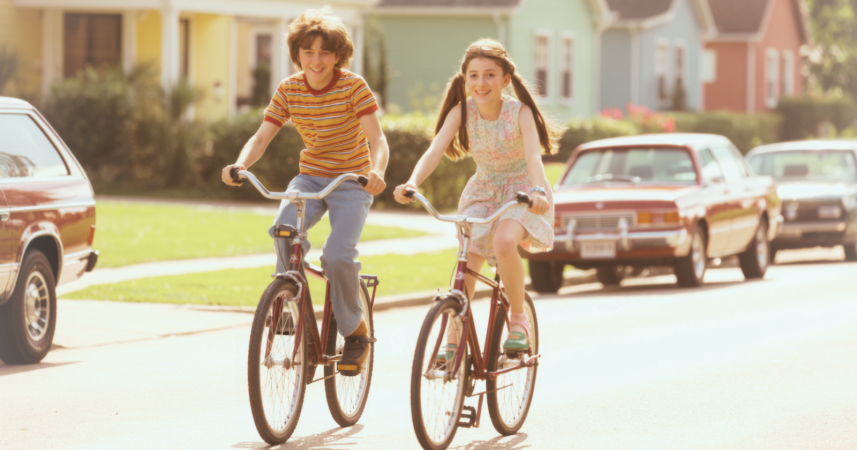
I see my grandchildren now, scheduled and supervised, and I worry about what they're missing. Yes, they're safer in measurable ways. They'll probably never know the panic of being truly lost or the specific pain of wiping out on gravel because you took that corner too fast.
The pedals. That's what I remember first — the rubber grip of them under my bare feet when I'd lost a flip-flop somewhere back by the creek and didn't care enough to go looking. Legs pumping, chain ticking, the long light of a Pennsylvania August stretched thin across the blacktop.
I was ten. I was racing the streetlights home, and I was losing.
My mother had handed me a peanut butter sandwich that morning and that was the whole of it. No cell phone check-ins. No GPS tracking. No predetermined routes. Just me, my bike, and the radical notion that a child could be trusted to navigate the world and return home safely.
When children owned the daylight hours
Helen Dodd, a professor of child psychology, has written about the steady contraction of childhood range — the observation that we are more protective, and grant less freedom, than the generations before us did.
Back in my Pennsylvania town, every kid I knew had their own territory mapped out by sunset. We had our secret shortcuts through the Millers' backyard (they never minded), the creek where we caught tadpoles in mason jars, the abandoned lot where we built forts from scrap wood and imagination. We settled our own disputes, usually badly but instructively. We learned which dogs were actually friendly despite their barking, which neighbors would let you use their hose on a hot day, and how to fix a chain that had come off your bike using nothing but determination and a stick.
The competence we developed wasn't just about knowing our way around town. We were learning to read situations. To trust our instincts. To solve problems without an adult immediately swooping in with solutions. When I got lost once trying to find a new route to the library, I didn't panic. I retraced my path, asked for directions at the gas station, and made it home only slightly late for dinner. My parents' response? "Well, now you know that way doesn't work."
The invisible classroom of unsupervised play
Can you remember the last time you saw a group of children organizing their own game in the street? Not at a scheduled playdate or a supervised sports practice, but just kids being kids, making up rules as they went along?
During those long summers, we were constantly negotiating, creating, and adapting. A simple game of hide-and-seek could evolve into an elaborate spy mission. Four kids with bikes became a gang of explorers discovering new continents — really just the next neighborhood over, but still. We learned leadership by taking turns being "it" or team captain. We learned fairness by experiencing its absence and deciding we didn't like how that felt. We learned consequences when we stayed out past the streetlights and faced whatever punishment awaited at home. None of that was on a syllabus. None of it could have been.
Researchers have noted that between the 1960s and the early 2000's, the percentage of children who regularly walked or cycled to school fell from almost 50% to a mere 15%. Those numbers tell a story about more than just transportation. They speak to a fundamental reorganization of childhood itself.
The skills I developed during those unsupervised hours served me throughout my teaching career. When faced with a classroom of teenagers, I understood group dynamics because I'd lived them. I knew how to read a room because I'd learned to sense when the older kids at the park were in a mood to include us younger ones or when we should make ourselves scarce. That intuition, developed through countless unstructured interactions, became invaluable.
Trust as a form of teaching
What did our parents know that we seem to have forgotten? Or perhaps the better question is: what did they not know that we can't unknow?
They didn't have twenty-four-hour news cycles featuring every child abduction across the country. They didn't have social media amplifying every parent's worst fears and judgments. They had their own communities, their own networks of watching eyes — the mail carrier who knew every kid by name, the shop owners who'd call your mother if you were causing trouble, the unspoken agreement among neighbors that all children were everyone's responsibility.
But it was more than just the absence of modern anxieties. There was a belief, perhaps unconscious, that children needed to practice being human beings while the stakes were still relatively low. A scraped knee teaches you to be more careful. Getting lost teaches you to pay attention to landmarks. Having to work out a dispute with friends teaches you negotiation and compromise. You cannot simulate this. You cannot schedule it.
I remember the summer day when a group of us discovered an injured bird. No adults were around to tell us what to do. We debated fiercely — should we try to help it? Leave it alone? Find someone's parent? In the end, we created a little shelter for it with a shoebox and some grass, left water in a bottle cap, and agreed to check on it later. The bird was gone when we returned, hopefully recovered and flown away, though we never knew for sure. But that experience of collective problem-solving, of caring for something vulnerable without an adult directing our every move — that stayed with me.
The courage that comes from capability
Those summers of freedom deposited something in my inner bank account that I've drawn on my entire life.
I see my grandchildren now — scheduled, supervised, tracked by apps — and I don't think the trade was worth it. Yes, they are safer in measurable ways. But measurable safety is not the only measure. They may never know the panic of being truly lost, which means they may never know the quiet, private pride of finding their own way back. They may never wipe out on gravel because they took a corner too fast, which means they may never learn, in their own bones, that bodies heal and mistakes are survivable. Something has been traded away, and I don't think we got fair value for it.
I try, when I can, to give them tastes of that freedom. I let them play in the backyard without checking on them every five minutes. Small, perhaps. It is not the same thing. I know that.
Final thoughts
Those long, unsupervised days taught us to be observant, resourceful, and resilient in ways that no structured activity ever could. They taught us that the world was ours to explore, that we were capable of navigating it, and that home would be there when the streetlights called us back.
I don't know how to give that back to a child now. I'm not sure anyone does. The streets are the same streets; the light still goes gold at the end of an August afternoon. But the agreement that used to hold all of it together — the watching eyes, the unlocked doors, the mothers who assumed someone else's mother was keeping half an eye — that's gone, and I don't see it coming back.
Maybe what we lost wasn't childhood. Maybe it was the village that made that kind of childhood possible.