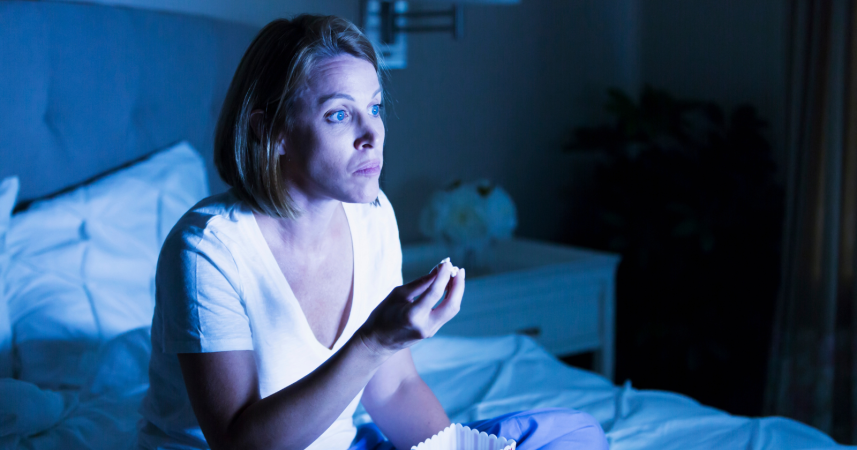
If you're someone who needs the TV on, you're not broken. You're coping. But it might be worth asking what you'd hear if you gave the silence five minutes. Not to torture yourself. Just to listen.
The house goes quiet. The dishes are done. Your partner's breathing has slowed. And then it starts.
The thing you said at lunch that came out wrong. Tomorrow's meeting you're not prepared for. That text you should have sent last week. The silence isn't peaceful. It's a courtroom, and you're both the defendant and the prosecutor.
So you reach for the remote. Not because you're lazy. Not because you're addicted to screens. Because right now, a rerun of a show you've seen four times feels safer than whatever your brain is about to serve up.
Sound familiar?
The silence isn't empty, it's full
Here's what most people don't realize. When external noise disappears, your brain doesn't just go quiet with it. It does the opposite.
Neuroscience research shows that when stimuli drop away, a network in your brain called the Default Mode Network (DMN) fires up. This is the part responsible for self-referential thinking. Replaying the past, simulating the future, evaluating who you are and whether you're measuring up.
For some people, that's fine. A little gentle reflection before sleep.
For ruminators? It's an ambush.
A University of Strasbourg study found that racing thoughts at bedtime predicted insomnia severity more than general worry or rumination alone. It's not that you're thinking. It's that your thoughts are sprinting, and you can't get off the track.
The TV isn't noise, it's a shield
Have you ever wondered why it's always the same show? Why people don't fall asleep to new, gripping dramas but to sitcoms they've watched a dozen times?
Cleveland Clinic psychologist Dr. Chivonna Childs notes that over half of Americans likely fall asleep with the TV on, and describes it as soothing, almost like white noise.
Basically, the TV gives your brain something external to latch onto, suppressing that self-focused loop the DMN loves so much.
Experiential avoidance is the deeper layer
This is where it gets interesting.
There's a concept in psychology called experiential avoidance. It's the habitual unwillingness to sit with uncomfortable internal experiences, whether that's anxiety, sadness, shame, or just a vague sense of dread you can't quite name.
The remote isn't turning on entertainment. It's turning off introspection.
What are people outrunning? Usually unprocessed stress. Low-grade anxiety that hums all day without ever getting addressed. Sometimes it's the gap between who you are and who you thought you'd be by now. That one tends to get louder after 40.
What the habit is really telling you
"Between stimulus and response there is a space. In that space is our freedom to choose." Viktor Frankl said that, and it's relevant here.
The TV habit isn't the problem. It's a symptom. A signal. It's your brain telling you that something needs processing and it hasn't found a daytime outlet for it.
Professor of psychiatry, Dr. Aric Prather, calls rumination the number one sleep killer, and his recommendation is surprisingly simple. Schedule "worry time" during the day. Fifteen minutes where you actually sit with the things you've been deferring. Write them down if it helps. Let the deferred feelings have somewhere to go before bedtime.
The path to sleeping without the TV isn't about discipline or willpower. It's about giving your unprocessed feelings a place to land before the lights go out.
That might look like journaling. It might look like a walk. For me, it's often an afternoon photography walk around Venice Beach.
A Sleep Foundation poll found that 72.6% of U.S. adults watch TV before bed, climbing to 81.6% among adults 54 and older. That's not a character flaw in three-quarters of the population. That's a society-wide signal that most of us haven't figured out what to do with the space between our last distraction and sleep.
The bottom line
The TV was never the villain here. And the silence was never really the enemy either.
The real story is about what lives in that gap between your last distraction and the moment you close your eyes. The replayed conversations, the unspoken things, the low hum of anxiety that never quite got addressed during daylight hours.
If you're someone who needs the TV on, you're not broken. You're coping. But it might be worth asking what you'd hear if you gave the silence five minutes. Not to torture yourself. Just to listen.
Sometimes the things your brain has been trying to tell you all day are worth hearing.
What’s Your Plant-Powered Archetype?
Ever wonder what your everyday habits say about your deeper purpose—and how they ripple out to impact the planet?
This 90-second quiz reveals the plant-powered role you’re here to play, and the tiny shift that makes it even more powerful.
12 fun questions. Instant results. Surprisingly accurate.