
It's not loneliness. It's what happens when you finally stop needing a witness to enjoy your own life.
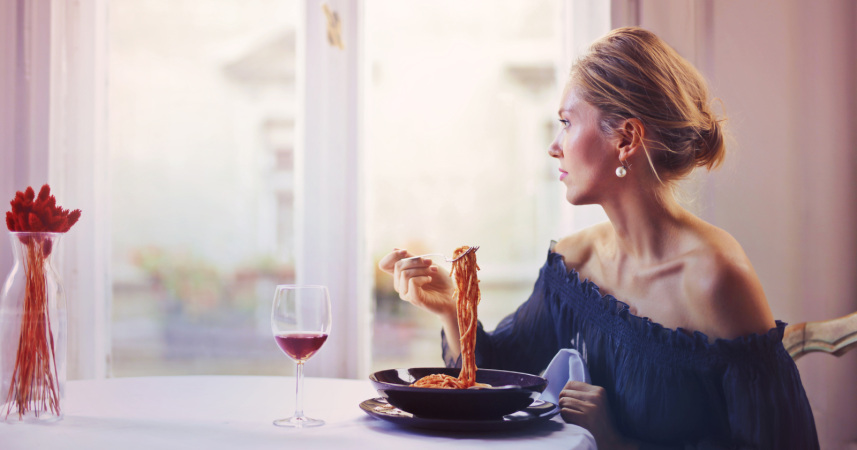
Last Thursday night I walked into a little Vietnamese place near the Saigon River, sat down at a table for one, ordered a bowl of bun bo Hue, and read a book on my phone for forty-five minutes.
No one joined me. No one was supposed to. And not once did I glance around the room wondering if someone was judging the guy eating by himself.
I'm 37. A decade ago, I would have felt weird about this. I might have ordered takeaway instead, or scrolled through my contacts looking for someone to rope in. Not because I actually wanted company, but because eating alone in public felt like wearing a sign that said "nobody wants to be around this person."
That discomfort was never about the food. It was about the performance.
Why eating alone used to feel so uncomfortable
Psychologists have a name for that nagging feeling that everyone is watching you. It's called the spotlight effect, and it describes our tendency to massively overestimate how much attention other people are paying to us. Research by Gilovich, Medvec, and Savitsky found that we consistently believe our actions and appearance are far more noticeable than they actually are.
For many people, especially when they’re younger, this bias can run hot. You're still building an identity, still sorting out who you are by measuring yourself against the room. The idea of sitting alone with a plate of pasta while couples and friend groups laugh around you feels like a small social failure, even though absolutely no one at those other tables is thinking about you at all.
It's a kind of theatre. You perform togetherness to signal that you belong, that you're liked, that your life is full. And it's exhausting in a way you don't even notice until you stop doing it.
What changes with age
Stanford psychologist Laura Carstensen’s socioemotional selectivity theory suggests that as people get older and their sense of remaining time changes, they tend to become more selective, prioritizing emotionally meaningful experiences over social expansion or approval-seeking. One everyday way this can show up is a reduced need to manage how we appear to strangers.
This doesn't happen overnight. It's a slow turning down of the volume on other people's imagined opinions. You stop curating your life for an audience that, frankly, was never watching that closely to begin with.
Eating alone at a restaurant is one of the clearest, most mundane expressions of this shift. It's a person saying, through nothing more than a quiet Tuesday dinner, "I don't need a witness to enjoy this."
Solitude chosen freely is a different thing entirely
Here's where it gets interesting. A 2021 study published in the International Journal of Environmental Research and Public Health looked at solo dining among South Korean university students and found that the psychological impact depended almost entirely on whether the person chose to eat alone. When solo dining was connected to voluntary, self-determined solitude, satisfaction with the experience was higher. When eating alone felt forced or unwanted, the picture looked much more negative.
Researchers in a separate study published in PLOS ONE found something similar. Dispositional autonomy, meaning the tendency to act from genuine self-interest rather than external pressure, consistently predicted whether someone would actually enjoy their time alone. It wasn't about being introverted. It was about being free.
This is the distinction most people miss. The older person eating alone at the corner table isn’t necessarily lonely.. They've simply stopped needing permission to do something they enjoy.
The performance drops away
I think about this a lot during my morning runs along the Saigon River. There's a stretch of path where it's just me, the water, and whatever my mind decides to throw at me that day. No audience. No feedback loop. Just the experience itself.
My Buddhist practice has reinforced this over the years. In the Pali tradition, paviveka is often translated as seclusion or solitude. I’ve always understood it not as avoidance, but as the space where you stop outsourcing your inner state to the room around you.
One of the things that shifted most for me when I started applying Buddhist principles wasn't some dramatic spiritual awakening. It was a quieter realization that I'd been performing contentment for other people instead of actually experiencing it. Eating alone, walking alone, sitting alone in a cafe with nothing but a coffee and my own thoughts. These stopped feeling like things to apologize for and started feeling like small acts of honesty.
It's not about isolation
I want to be clear about something. This isn't a case for becoming a hermit or ditching your relationships. I have a wife I love, a daughter who makes me laugh every day, and a close friend in Mal who I'd happily share any meal with.
But there's a difference between choosing to eat with people because you want to and needing people at the table so you don't feel like something is wrong with you. The first is connection. The second is dependency dressed up as sociability.
Research published in Frontiers in Psychology found that solitude changes across the lifespan. In a study of more than 2,000 people, older adults reported feeling the most peaceful when alone and were less likely to describe solitude in terms of alienation. The point isn’t that being alone is automatically good. It’s that, for many people, solitude can become less threatening and more emotionally spacious with age.
The willingness to eat alone is really just a proxy for something bigger. It's the willingness to exist in public without a script, without a role, without performing the version of yourself that other people expect to see.
What the small shift actually says
When you watch someone eat alone at a restaurant and they look perfectly comfortable, you're seeing a person who has answered a question most of us spend decades avoiding: "Am I okay without an audience?"
The answer, for them, is yes.
That small shift, from needing the table to be full to being genuinely fine when it's not, says more about a person's inner life than almost any grand gesture could. It means the performance is over. It means they've stopped outsourcing their sense of self to whoever happens to be sitting across from them.
And honestly, that bowl of bun bo Hue on a quiet Tuesday night tasted better for it.