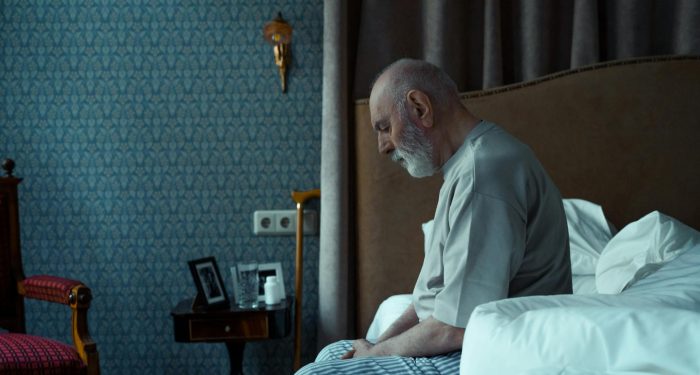


You can feel completely alone in a room full of people who love you—because they love the easygoing cartoon you handed them, not the messier person hiding behind it
We've got the lonely thing all wrong. We picture a man in a bedsit eating beans from the tin, one bulb swinging, no calls coming in. Solitary. Forgotten. The full Dickens.
But that's just being alone, and being alone is often rather nice. The loneliness that does the real damage tends to strike in crowded rooms. At the dinner table. In the bed you share. Mid-laugh, surrounded by people who'd genuinely take a bullet for you, while a small voice in the back of your skull asks, quietly, whether any of them have the faintest idea who you actually are.
The cartoon they keep cheering for
Here's the strange mechanism of it. People who love you build a little model of you in their heads. They have to. Nobody can carry the whole, contradictory, ever-shifting truth of another human about with them, so they sketch a cartoon and they love the cartoon. They love it sincerely. That's not the problem.
The problem is when the cartoon and the original drift apart, and everyone keeps applauding the drawing while you stand just behind it, waving, unwatched.
You become a role. The Funny One. The Sorted One. The One Who's Fine. And because the role is convenient and well-reviewed, nobody goes looking for the bloke playing it. Why would they? The show's a hit.
The night I got ordered for
I was about four years into a relationship when it happened, and it took the shape of a starter.
We were at dinner with another couple. The waiter came round, and before I'd opened my mouth my partner ordered for me. A lovely gesture, on paper. The kind of thing that's meant to say I know you so well I don't even need to ask.
She ordered me the scallops. Said it warmly, certain of it, the way you'd state my own birthday. And the table did that approving little murmur people do when a couple seems to operate as one smooth machine.
The thing is, I don't eat scallops. Never have. I'd told her this. More than once. It's not a grand dramatic aversion, just a quiet fact about me, roughly as fundamental as my name. And I sat there watching her describe my tastes to a table of friends with total confidence, getting it flatly wrong, and I understood in one cold drop of clarity that I'd been living with someone who was in a relationship with a man she'd invented. A nicer, simpler, scallop-eating version of me. And I'd let her, because correcting the cartoon felt rude. Felt like making a fuss over nothing.
I ate the scallops. Of course I did. I smiled and ate the wrong dinner in front of everyone, which is, if you think about it, the entire condition in miniature. Sitting at a warm table, surrounded by affection, swallowing something you didn't want so that nobody's comfortable picture of you has to wobble.
That was the loneliest meal of my life, and it had four people at the table and a candle in the middle.
Why nobody's actually the villain
I want to be careful here, because this is the bit people get wrong and turn bitter over.
She wasn't cruel. She wasn't neglectful. She'd simply stopped updating the file. And honestly, so had I about her, and about most people I claimed to know inside out. We get a working sketch of someone early on, decide it's accurate, and then quietly stop checking whether it still matches the person in front of us. We mistake familiarity for knowledge. They are not the same thing. You can be deeply familiar with a stranger you've shared a postcode with for a decade.
Psychologists have a slightly clinical phrase for a cousin of this, the "closeness-communication bias," which is just the finding that the better we think we know someone, the worse we get at actually listening to them. We assume we already know what they'll say, so we stop properly tuning in. Strangers, oddly, often listen to each other harder than spouses do. The intimacy itself becomes the static.
So nobody's the villain. Everyone's just running an old version of the software and assuming it auto-updates. It doesn't.
The part you have to own
Now for the uncomfortable confession, because it would be cheap to pin this all on other people's lazy sketching.
Half the time, you are the one hiding. I certainly was. I'd handed everyone the agreeable cartoon on purpose, because the real me underneath felt like a lot of admin to introduce. Messier. Moodier. Prone to long flat patches that don't make good dinner conversation. It was easier to be The One Who's Fine than to risk the silence after saying I wasn't.
You can't be furious at people for not knowing a man you took considerable trouble to keep hidden. That's a stitch-up of your own design. You build the wall, paint it a friendly colour, then feel abandoned that nobody's climbed it. The loneliness is real, but a decent chunk of it is self-installed.
That's the genuinely hard piece of midlife clarity. Not "they never saw me." It's "they couldn't, because I never let the lights on, and I'd half convinced myself that was their failing rather than my hiding."
What being seen actually costs
So I started doing something that felt, at first, completely deranged. I started correcting the cartoon. Out loud. In real time.
Small things, mostly. No, I don't actually like that band, I just nodded along in 2014 and it calcified into legend. No, I'm not fine this week, I'm a bit underwater, and I don't need fixing, I just didn't want to lie to you over the salad. Tiny corrections to the file. Unglamorous. Slightly embarrassing every single time.
And it turns out being known is far more uncomfortable than being adored. Adoration of the cartoon is frictionless. You get the warmth and skip the exposure. Being actually seen means somebody clocks the parts you'd rather they didn't, the pettiness and the fear and the strange opinions, and they have to decide whether to stay anyway. That's terrifying. It's also the only version where the loneliness lifts, because you can't feel unseen by someone who's looking straight at the real thing.
The cartoon can't be lonely. Only the man behind it can. Which means the only way out is to step round the front of the drawing and let yourself be looked at.
Reintroducing yourself, badly, to people you love
These days I treat it like maintenance rather than a grand reveal. You don't fix this with one tearful confession that solves everything by Christmas. You fix it in tiny instalments, by being a fraction more honest than is comfortable, over and over, until the people around you are loving an accurate picture instead of a flattering one.
It's slower and less cinematic than the films promise. Nobody runs through an airport. But it works, in the dull, real way that things actually work.
My dogs, I'll note, have never once misread me. They know exactly who I am, chiefly because their model of me is "the source of food and the warm one," and I have never felt the need to perform anything grander for them. There may be a lesson buried in that, or there may just be two animals who'd love anyone holding a bowl. I've decided not to investigate too closely.
But the people, the actual people, are worth the awkward work. So if you're reading this from inside a full, warm, loving room and feeling oddly absent from it, here's my one piece of advice. Don't go looking for new people who'll finally get you.
Go and correct the order. Tell the table you don't eat the scallops. You'll be amazed how many of them lean in, set the cartoon down, and say, after all these years, "really? I never knew that." That sentence isn't a wound. It's the door finally opening.