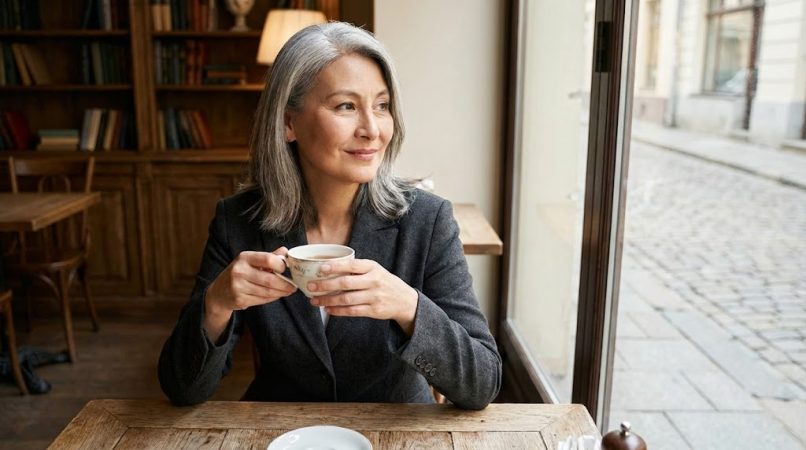
The handbag was never the point. The posture was never the point. What people respond to, without always being able to articulate why, is a woman who no longer needs the room's permission to be in it.
I once had a student, a girl of about sixteen, who apologized before every single thing she said in class. "Sorry, but I think maybe the symbolism in this chapter might possibly be about..." She was one of the sharpest readers I'd ever taught. And she kept wrapping every brilliant thought in layers of "sorry" like she was gift-wrapping something she expected to be returned. I see her sometimes when I look at women my own age still doing the same thing forty years later, still preemptively apologizing for having a thought worth saying out loud. True elegance, the kind that makes you turn and look twice, has never once come from a handbag. It comes from a woman who has finally, mercifully, stopped shrinking herself to fit the room.
The Apology Habit That Has Nothing to Do with Being Sorry
Here's what the research actually tells us.
A landmark study published in Psychological Science found that women reported offering more apologies than men, but they also reported committing more offenses — and there was no gender difference in the proportion of offenses that actually prompted those apologies.
In plain language: women aren't more sorry. They just have a lower threshold for what they think warrants an apology in the first place. They've been trained, from girlhood onward, to treat their own existence as a mild inconvenience to others.
Women with lower self-esteem may view themselves as less deserving of space or attention. They feel guilty simply for existing. Apologizing becomes a way to minimize their presence, as they might feel unworthy of imposing on others.
I recognize this pattern. I lived it for most of my thirties. After my first marriage ended, I spent years over-explaining every decision I made to anyone who asked and quite a few people who hadn't. Why I was doing it alone. Why I'd chosen this school for the kids. Why I still wore my hair that way. Somewhere in my fifties, I noticed the explaining had quietly stopped. Nobody had taken anything away from me. I'd just outgrown the need for a verdict.
Constantly apologizing can reinforce a negative self-image, further ingraining feelings of inadequacy and low self-worth. It can also impact relationships, both personal and professional, creating an imbalance where the apologizer's needs and opinions are not given the weight they deserve.
What the studies don't quite capture is how exhausting it is. Performing smallness is hard work. And it costs far more than confidence. It costs time. Years of it.
Stopping the Explanation Loop
Closely related to the apology habit is the explanation habit. The compulsion to justify our choices to anyone who raises an eyebrow. The need to make our "yes" and our "no" make sense to everyone in the room.
As one therapist puts it, "Someone seeking approval puts the power in other people's hands. They allow other people to make them feel happy, sad, guilty, and so on." Approval-seeking and people-pleasing behaviors are similar because they both involve depending on others' opinions to be happy.
When a woman in her fifties or sixties stops seeking approval for the quiet daily choices of her own life, something in her bearing shifts. It's almost architectural. She takes up space differently.
Research from the Journal of Adult Development found that identity certainty, generativity, and confident power were all experienced as more prominent in middle age than in early adulthood, and were rated even higher in the 50s than the 40s.
This is not incidental.
Identity certainty and confident power were positively related to well-being.
What the research confirms is what most women over fifty already know in their bones: the confidence that comes with age isn't a consolation prize. It's the main event. It just took a few decades to arrive.
There's a woman I volunteer with at the shelter on Tuesday afternoons. She is 63, doesn't color her hair, wears very little jewelry, and I have never once heard her explain herself to anyone. Not her opinions, not her choices, not her schedule. She listens with complete attention, says what she means without apology, and when she disagrees with something, she simply says so. Without the verbal scaffolding most of us construct around our dissent. Every single person in that room defers to her, not because she demands it, but because she has clearly already deferred to herself. That is what genuinely elegant looks like.
The Art of Letting Silence Sit
The third quality, the one that most people underestimate, is the comfort with silence. The willingness to let a pause breathe without rushing to fill it with noise or nervous laughter or an unnecessary qualifier tacked onto the end of a perfectly good sentence.
Research in social psychology consistently shows that individuals who use silence strategically are often perceived as more confident, thoughtful, and authoritative.
Most of us were never taught this. We were taught, especially as women, that silence was uncomfortable at best and rude at worst. We learned to paper over every gap in conversation.
Speakers often pause by taking brief breaks between words and utterances. While both conventional wisdom and prior research suggest that frequent pausing generates negative impressions, this work has almost exclusively focused on monologues. In contrast, in the context of conversations, pausing more frequently can actually benefit speakers.
A Wharton School paper found that pausing in conversation makes speakers seem more engaged, more helpful, and more present to their conversation partners. Silence, it turns out, is not absence. It is one of the most active things a person can do.
I learned this properly not from a study but from grief. After my husband died, I noticed that I stopped filling silences the way I used to. There was a period where I simply didn't have the energy for it. And something strange happened: people began to say I seemed calmer. Wiser, even. A few of them told me they felt genuinely heard for the first time in our friendship. I hadn't said anything new. I had just stopped rushing to say the next thing. The pause was doing the work I'd always tried to do with more words.
What Elegance Actually Signals
Over-apologizing can negatively impact a woman's career and self-esteem. A great deal has been written and discussed about women apologizing more than men.
But what I think gets lost in those conversations is the flip side.
According to sociologist Maja Jovanovic, "Excessive apologizing is a bad but ingrained habit that women need to ditch immediately."
When a woman stops over-apologizing and over-explaining, she doesn't become cold. She doesn't become difficult. She becomes, in the truest sense, legible to herself. And that self-legibility is what reads as elegant to everyone around her.
The handbag was never the point. The posture was never the point. What people respond to, without always being able to articulate why, is a woman who no longer needs the room's permission to be in it. She has stopped auditing herself in real time. She has stopped submitting her choices for review. She takes the long pause before answering not because she's uncertain, but because she is absolutely certain and in no particular hurry to prove it.
My mother used to say there are women who walk into a room and wait to be accepted, and women who walk into a room and have already accepted themselves. She was a seamstress from a small Pennsylvania town who never read a word of psychology in her life. But she had watched enough women move through enough rooms to know the difference. I think about that a lot lately, when I'm out in my garden in the early morning before the world gets loud, and I realize I have nothing I need to explain to anyone today. That quiet is not empty. It is what seventy years of lived experience finally sounds like when it stops apologizing for itself.