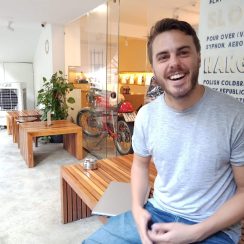


I kept telling myself the next city or the next job would be the one that finally made everything click. It took years to realize I wasn't searching. I was hiding.
I used to think that if I could just get the next thing right, everything else would settle into place.
A better job. A different city. A relationship that finally felt like home. I treated my life like a combination lock, and if I just kept spinning the dial, eventually something would click.
It never did. Or it did for a few weeks, and then the old restlessness showed up again, wearing a new outfit.
Looking back now, from a life that actually does feel settled, I can see that I wasn't chasing happiness. I was chasing movement. And those are very different things.
The logic of the next thing
There's a particular kind of person who is always optimizing. I was that person. Every few months, I'd have a new theory about what was missing. The job was too limiting. The city was too expensive, too grey, too far from the ocean. The relationship was fine but not quite right. There was always a reason.
And the reasons were often real. That's what made it so convincing. Some of the jobs were limiting. Some of the cities didn't suit me. Some of the relationships genuinely weren't going anywhere. I wasn't delusional. I was just using real problems as fuel for a pattern I couldn't see.
Because the thing about constantly moving is that it always feels like progress. You're making decisions. You're being brave. You're refusing to settle. People around you might even admire it.
Nobody pulls you aside and says, "Hey, have you considered that the problem might travel with you?"
What the busyness is covering
I think for a lot of people, constant change is a way of staying one step ahead of yourself. If you're always adjusting, adapting, rebuilding, you never have to sit with who you are when there's nothing left to fix.
That's the part I was avoiding.
Not some dark secret. Not anything dramatic. Just the ordinary, uncomfortable experience of being a person without a project. Without a plan. Without something to blame for the fact that contentment still felt slightly out of reach.
In Buddhist thinking, there's a concept called tanha, which translates loosely as craving. But it's not just craving for pleasure. It includes the craving for becoming, for being someone new, for endlessly reshaping yourself into a better version. It's the feeling that says: not this, not yet, not enough.
That was the engine running underneath everything. Not ambition. Not growth. Just a quiet refusal to be where I was.
What happened when I stopped
I didn't stop because I had some great insight. I stopped because I ran out of moves. I'd landed in Saigon for reasons that made sense at the time. I started a business with my brothers. I met my wife. And slowly, without any grand plan, I found that I'd been in the same place for longer than I'd been anywhere in years.
At first, it was uncomfortable. Not in any obvious way. Just a low hum of restlessness that I was used to drowning out with the next relocation or the next project.
But this time, there was nowhere to go. And I noticed something strange.
The person I'd been avoiding wasn't someone I needed to fix. He was just someone I hadn't spent enough time with to actually know. The version of me that existed when I wasn't performing, planning, or pivoting. The one who wakes up early and runs along the river and comes home and drinks coffee and sits with his daughter before work. The one whose life is ordinary and repetitive and, it turns out, enough.
Staying doesn't mean giving up
I want to be careful here, because I'm not saying everyone who moves a lot is running from themselves. Some people genuinely need to leave. Some people are trapped and the bravest thing they can do is go.
But there's a difference between leaving because you need to and leaving because stillness makes you nervous. I've lived both. The first feels like relief. The second feels like relief for about three weeks, and then you're back where you started, just with a different postcode.
Staying, for me, turned out to be the harder thing. It meant letting go of the idea that I was one change away from the life I wanted. It meant accepting that the life I wanted might already be happening, and I just couldn't feel it because I was always halfway out the door.
I once came across an idea that stayed with me: you don’t find peace by constantly rearranging the conditions of your life. You find it by noticing the habit of rearranging.
The person you meet
When you stop moving long enough, you meet yourself without the story. Without the ambition narrative. Without the "I'm building toward something" frame that makes everything feel temporary.
And that person is usually quieter than you expected. Less interesting, maybe. Less dramatic. But more real.
I still catch myself sometimes, eyes drifting to some new idea, some new place, some version of life that seems shinier from a distance. The craving for becoming doesn't disappear. It just gets easier to notice. And once you notice it, you can let it pass through without acting on it every time.
My daughter is nearly one now. She doesn't care what city we're in. She cares that I'm sitting on the floor with her, stacking blocks, not thinking about somewhere else. Kids are good at showing you what presence actually looks like when you strip away the philosophy.
I didn't find myself by going anywhere. I found myself by staying long enough that there was nowhere left to hide.
That sounds like it should feel limiting. It doesn't. It feels like the first time I've had solid ground under my feet.