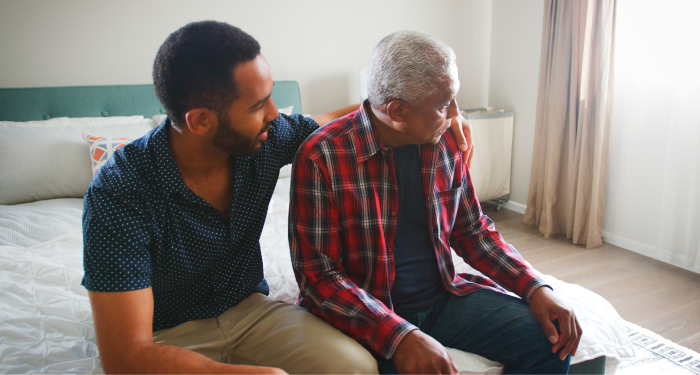
The people who soften with age and the people who harden share the same world — the difference is whether they built a self that could survive what that world did to them.
Most people assume bitterness is what happens when life treats you badly. That it's the natural residue of loss, the logical outcome of a worse hand. This assumption is almost entirely wrong.
The evidence points somewhere more uncomfortable. Two people can endure nearly identical losses. A divorce, a career that evaporated, a child who stopped calling. One of them emerges gentler, more porous to the world. The other calcifies into someone their younger self wouldn't recognize. The difference isn't what happened to them. The difference is where they stored their sense of self before the loss arrived.
I'm calling this locus of identity. It's where a person keeps their answer to the question "Who am I?" People who locate their identity inside themselves — in their values, their curiosity, their willingness to keep showing up — become kinder as the years strip things away. People who locate their identity outside themselves — in a job title, a relationship, a grievance, a body that still works — become bitter when the world inevitably takes those things back. This distinction, which extends the established psychological concept of locus of control into the domain of self-definition, explains more about how people age than circumstance ever could.
The conventional wisdom says circumstance shapes character. Good things happen to you, you become a good person. Bad things happen, and bitterness is the logical response. We tell this story because it flatters our sense of fairness. If the bitter person simply drew a worse hand, we don't have to examine the mechanism underneath. But if you pay attention — really pay attention — you'll notice people from the same households, the same economic bracket, the same communities diverge wildly in their emotional lives by midlife. Circumstance alone can't explain it. Something else is operating.
The something else is where a person located their identity.
The clock that resets to zero
I've spent over twenty years living abroad. Australia, the UK, New York, Los Angeles, Thailand, Vietnam, Singapore. In each place, the same pattern emerged: initial excitement, the slow realization that deep belonging hadn't materialized, restlessness, then a move to the next country where the cycle began again. Each move was motivated by the belief that a missing quality — ambition, balance, serenity — existed somewhere outside myself and could be acquired by changing geography.
Moving frequently resets the clock on belonging. The process of becoming someone's neighbor or regular requires years of accumulated presence that starts over with each relocation. That phrase — resets the clock to zero — haunts me because it applies to far more than geography. Every time we locate our identity in something external — a job title, a relationship, a city, a body that still works the way it used to — we are setting a clock that the world can reset without our permission. The job ends. The relationship fractures. The city changes. The body breaks down. And when that clock hits zero, we face a question: Who am I without the thing that just disappeared?
The people who become kinder with age have already answered that question, usually more than once. The people who become bitter never had to answer it — until they did, and by then the muscle for answering it had atrophied.
Internal locus, external locus
There's a concept in psychology called internal locus of control. It's the degree to which a person believes they have agency over their own life versus being at the mercy of external forces. Marcus Aurelius said it two thousand years ago: "You have power over your mind — not outside events. Realize this, and you will find strength." Research suggests that people with a strong internal locus of control tend to adapt better, experience less helplessness, and show greater psychological flexibility across the lifespan.
But I think the concept needs extending. Locus of control is about agency — whether you believe you can influence outcomes. Locus of identity is about something deeper. It's where you store your answer to the question "Who am I?" You can believe you have agency over your life and still have built your entire sense of self on a foundation the world can remove.
That's the distinction that matters most.
A person with an external locus of identity defines themselves by what has happened to them. I am the person who was abandoned. I am the person who lost the house. I am the person whose children don't visit. The events are real. The suffering is real. But the identity has been welded to the event, which means the event never fully becomes the past. It stays permanently present because it's load-bearing. Remove it and the self collapses. A person with an internal locus of identity defines themselves by something the world can't reset. Their values. Their curiosity. Their willingness to keep showing up for people even after being disappointed. The events still happened. The losses still hurt. But the self wasn't built on top of them, so when the ground shifts, the person remains standing.
This distinction explains something I've noticed over years of observing people — including myself. People who have faced genuine hardship — instability, loss, professional upheaval — split into two groups over time. The ones who soften are the ones who, somewhere along the way, learn to say: that happened to me, but it isn't me. The ones who harden are the ones who make the suffering their central organizing principle.
The accumulation problem
Belonging — the real kind, the kind that builds slowly and without spectacle — is an accumulation of shared time through ordinary moments. Weeknight dinners, knowing neighbors' names, witnessing the passage of time together. There is no shortcut. And there is a specific kind of loneliness that belongs to people who chose novelty over rootedness. And also, I'd argue, to people who chose bitterness over softening. Because bitterness is its own kind of perpetual relocation. Every time you rehearse a grievance, you move away from the present moment and back into the territory of the wound. You reset the clock on the relationships that are actually in front of you. You become, emotionally, a person who is always somewhere else.
I've seen this in people I care about. The friend who can't have a conversation without circling back to a wound from decades ago. The former colleague who achieved remarkable things but only talks about the one person who underestimated them. The wound became the address. They live there now. And every attempt to draw them into the present — into the life that is actually happening around them — gets redirected back to the grievance. The clock resets. The accumulation of new belonging never gets past the early stages because the emotional energy keeps flowing backward.
This is why bitterness and loneliness are so often found together. Not because bitter people drive others away (though they sometimes do), but because bitterness is a form of emotional relocation that prevents the accumulation of presence that belonging requires.
Where identity lives
I think about this a lot in the context of my own life. Having founded companies, having built things and watched some of them end, having moved across continents chasing something I couldn't quite name — I recognize the pattern from the inside. The periods where I was most at risk of bitterness were the periods where my identity was most entangled with something external. A company's trajectory. A city's promise. A relationship's stability.
The periods where I softened — where loss actually made me gentler rather than harder — were the periods where I'd done the quiet work of locating my identity in something the world couldn't take away. Not accomplishments, not geography, not even relationships, but something more like a commitment to staying curious and showing up honestly. That sounds abstract until you've watched the alternative play out in someone you love.
The research on locus of control suggests that internality is partly dispositional and partly learned. I suspect the same is true for locus of identity. Some people seem to arrive in the world with an innate sense that they are not reducible to what happens to them. Others have to learn it, usually the hard way, usually through loss that forces the question.
The good news is that it can be learned. The bad news is that the curriculum is loss, and the enrollment is mandatory. The only variable is whether you treat the loss as information about who you are or as information about what happened to you. That distinction — tiny in language, enormous in consequence — is what separates the people who become kinder with age from the people who become bitter.
And it has almost nothing to do with what life gave them or took away. It has to do with where they were standing when the earthquake hit — inside themselves, or on ground that was never theirs to keep.