
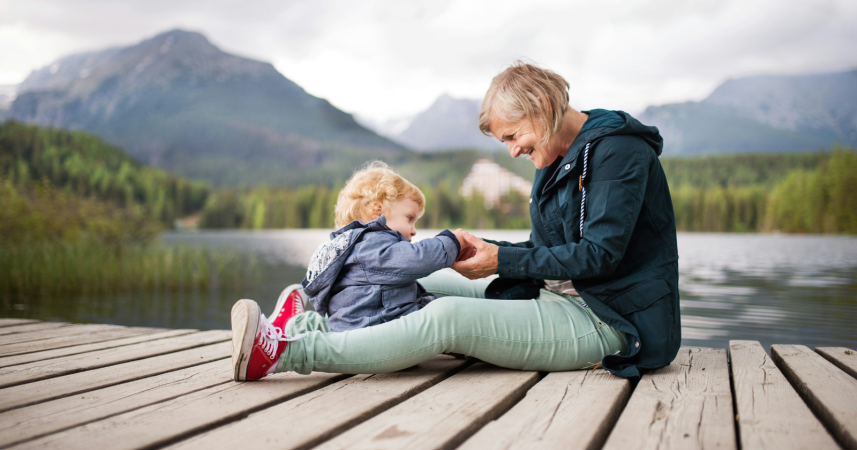
Long after the gifts are forgotten, the feeling of being seen and unhurriedly loved is what remains.
Realizing that most of what we stress over leaving behind will not be what people remember can be devastating.
Not the gifts. Not the trips you paid for or the money tucked into birthday cards. Not even the big gestures that took months of planning. What your grandchildren will carry with them, years after you are gone, are things you probably never thought to catalog. The way your house smelled. Whether you looked up from what you were doing when they walked in. The tone of your voice when you talked about their parents. The feeling of being truly, unhurriedly seen by someone older than them.
I have been thinking about this a lot lately. Maybe because I am in the season of raising small children and watching my own parents from a new angle. Maybe because becoming a mother shifted something in me about what I actually want to pass forward. Whatever the reason, the research on this keeps landing differently now.
What memory research actually tells us
Psychologists who study autobiographical memory have found that emotional experiences are encoded differently than factual ones. We do not remember events like files in a folder. We remember how things felt. The emotional residue of a moment often outlasts the specific details of what happened.
A study has found that people consistently recalled moments of genuine connection and warmth over material ones. The grandmother who sat and listened. The grandfather who taught them something patiently, without rushing off. The elder who treated them like their opinions mattered.
What children encode most deeply is relational safety. Did this person make me feel good about myself? Did they have time for me? Was I a burden or a joy to them?
Those questions get answered not through gifts, but through a hundred small daily moments.
Presence is the thing you cannot buy
I live a full life. Two working parents, a toddler, a second baby arriving soon, spinning classes squeezed into lunch hours, meals to cook, routines to protect. I understand the temptation to compensate for limited time with things. To show love through provision.
But I grew up with grandparents who were not wealthy by any stretch. What I remember about them has nothing to do with what they gave me. I remember the kitchen. The particular rhythm of how my grandmother moved around it. The way she would drop everything to sit with me. The stories she told about her own childhood, which made me feel like I was part of something longer than my own small life.
Those memories are fully intact decades later. The gifts are completely forgotten.
There is something worth sitting with there.
The stories you tell shape how they see the world
One of the most underestimated things grandparents pass on is a sense of family narrative. Who we are, where we come from, what we have survived. Research has shown that children who know their family history, including the hard parts, tend to have stronger resilience and a higher self-esteem.
This is not about performing a heroic version of your past. It is about being willing to tell the real story. The years that were hard. The decisions you regret. The things that shaped you that you never talk about at dinner.
Grandchildren remember the grandparent who spoke to them honestly. Who treated them like they could handle real information. Who bridged the gap between the world they were born into and the one that came before it.
That kind of storytelling is a gift that compounds over generations.
How you treat their parents matters more than you think
Children are watching the adults around them the way anthropologists study a new culture. Constantly, carefully, without announcing it.
The way a grandparent speaks about or to the parents says something to a child about what relationships look like. Whether love comes with conditions. Whether criticism is how people show they care. Whether it is safe to be imperfect around family.
I notice this already with my own daughter, who is not yet two. She tracks the emotional temperature of every room she enters. She notices when something is off. Children do this without being taught.
If your grandchildren watch you treat their parents with warmth and respect, that registers. If they watch you hold grudges or make cutting remarks, that registers too. You are modeling what family looks like to people who are still forming their entire understanding of the world.
Small rituals leave large imprints
Think about what you actually remember from childhood. Chances are, a significant chunk of it is ritual. The specific way a relative made tea. The Saturday morning routine. The inside joke that only existed in that house. The particular way someone said goodbye.
Rituals create a felt sense of belonging. They tell a child: this is a place you can count on. This person shows up the same way, reliably, and that sameness is a form of love.
You do not need money to build rituals. You need consistency and intention. A walk you take every visit. A game you always play. A phrase that only you two share. These small repeated moments become load-bearing parts of a child's emotional memory.
Coming from a multicultural background, I have watched how differently families around the world express continuity and connection. What is consistent across all of them is this: children thrive when they feel woven into something that has texture and history. The details differ. The need does not.
Time is the only non-renewable resource in this equation
Gifts are renewable. You can always buy another one. Time with small children, time while you are still healthy and present, time before they grow up and get busy with their own lives, that is finite.
Laura Carstensen's research on socioemotional selectivity theory shows that as people age, they naturally begin to prioritize emotionally meaningful experiences and relationships. Grandchildren offer exactly that kind of meaning. The question is whether the priority gets acted on while there is still time to act on it.
What tends to happen is that people wait. They assume there will be more time later. They default to sending things rather than showing up. And then later arrives, and the window has already shifted.
The grandchildren who feel closest to their grandparents are almost always the ones who were given unhurried time. Not lavish time. Not expensive time. Just time where they were the point.
Final thoughts
None of this is meant to create guilt. Most people give gifts because they want to show love, and that impulse is genuinely good. The gifts are not the problem. The assumption that they are enough is.
What your grandchildren will carry forward is the emotional truth of what it felt like to be around you. Whether you were interested in them. Whether you slowed down. Whether they made you laugh and you let them see it. Whether you made them feel, in the particular way that only an older person can, that they were already enough exactly as they were.
That is the inheritance that does not fit in a box. And it turns out, it is the one that lasts.