

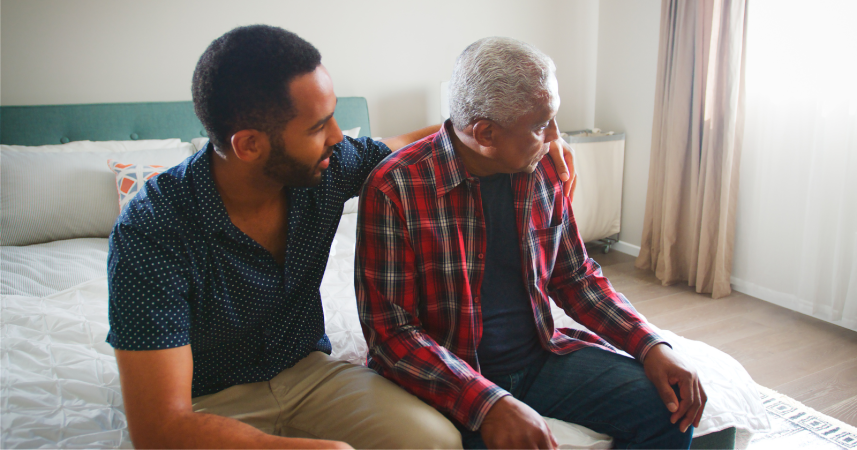
I stopped waiting for the phone call where my parents finally met me the way I needed, and something in my chest got lighter
There's a particular kind of phone call I've stopped having with my parents.
It's the call where I tell them something real about my life—a worry, a doubt, a small failure—and wait, with a hopefulness I keep not being able to extinguish, for a particular kind of response. The response I'm hoping for is hard to describe. It's not advice. It's not solutions. It's something more like being met. The sound of someone on the other end of the line shifting their weight toward you, instead of away.
I've been waiting for this response, in various forms, for about thirty years.
It mostly doesn't come. What comes instead is something kind, often well-meaning, sometimes funny, occasionally helpful. But it isn't the thing I'm reaching for. It hasn't been, in any reliable way, since I was a child.
For a long time I assumed this was a communication problem I could solve. I'd phrase things differently. I'd be clearer about what I needed. I'd ask, explicitly, for the kind of response I was after. None of it worked. The pattern wasn't about phrasing. It was about something more structural, something about who my parents are and who they're not, and the slow, exhausting work of pretending I hadn't noticed yet.
What I was actually doing, for most of my adult life, was grieving them while they were still alive. I just didn't have the words for it.
The grief that has no name
We have a lot of language for grief that follows death. We have rituals for it. We have time off work. We have casseroles delivered to the door. People who haven't called you in years send messages. The grief is acknowledged, even when it isn't fully understood.
We have almost no language for the grief that runs alongside a still-living parent. The parent is here. They love you. They will, with full sincerity, tell anyone who'll listen that you're the most important person in their world. By every external measure, there is nothing to grieve.
But internally, if you're paying attention, something is being mourned. Slowly, quietly, in the background of every interaction. You are mourning the parent they were never going to be. The one who would have noticed when you were struggling. The one who would have asked the next question. The one who would have known, without being told, that something was wrong, and held the door open without making you walk through it announcing yourself.
That parent does not exist. They were never going to exist. They were not, structurally, available in the version of your parent that walked the earth. And every time you reach for them—every phone call, every visit, every careful attempt to bring up something real—you are reaching for someone who isn't there, and a small, almost imperceptible loss happens, and the body keeps a tab.
The tab gets very long over forty years.
The exhaustion of double-holding
Here's what I think people miss when they talk about this kind of grief.
It isn't tiring because the parent is bad. In most cases, the parent isn't bad at all. The parent is doing their best. The parent loves you in the way they're capable of loving, which is often a perfectly real and valuable kind of love.
It's tiring because you have to hold two things at the same time, indefinitely, with no end date and no acknowledgment.
You hold the love. You really do love them. You're glad they're alive. You'd be devastated by their loss. The love isn't a performance.
And you hold the grief. The quiet, ongoing mourning of the version of them you needed and didn't get. The version who could have shown up differently. The version who, even now, in their seventies, isn't going to learn to do the thing you've been waiting for them to do.
Holding either one alone would be manageable. Holding both, at once, for decades, on every phone call, in every kitchen, at every Christmas, is one of the most quietly exhausting things a person can do. And nobody knows you're doing it. Your parents don't know. Your friends don't know, because you don't talk about it, because how would you start. You barely know yourself, until one day you do, and then you can't unknow it.
Why the grief has been so hard to name
I think there are a few reasons we don't talk about this.
The first is that admitting it feels disloyal. You love your parents. They tried. They did things for you. To say, even quietly, that you've been mourning them while they're alive can feel like a kind of betrayal, like you're announcing they weren't enough, when in fact they were a great deal—just not, in some specific dimension, what a particular part of you needed.
The second is that it sounds like a complaint, and we've been culturally trained to suspect adult children who complain about their parents. There's a strong narrative that says: they raised you, they fed you, they loved you, what more do you want? And the answer, which is hard to say out loud, is that you wanted to be known. Specifically, individually, accurately known. Many parents do not provide this. Many parents cannot provide this, because of how they themselves were raised. None of this makes them bad. It just doesn't dissolve the loss.
The third is that grief usually requires an event to anchor it. Death gives you a date. A divorce gives you a paper. The grief I'm describing has no event. It's been there your whole life. It accumulates without a single moment to point to. Which makes it almost impossible to talk about, because every time you try, you're describing something diffuse, something shaped like a long absence rather than a sharp loss.
What I've been doing about it
I'm not going to pretend I've fixed this. I haven't. It's not the kind of thing you fix.
What I have done, in the last couple of years, is stop pretending it isn't happening.
I've stopped trying to engineer the phone call where my parents finally meet me the way I've been waiting to be met. I've stopped phrasing things in five different ways hoping one of them will land. I've stopped, mostly, the small, hopeful experiments I was running on every visit, the ones designed to see if maybe this time, this Christmas, this conversation, the missing thing would arrive.
The missing thing is not going to arrive. Letting that be true—really true, not theoretically true—has been one of the more important quiet shifts of my life.
What's interesting is that, once I stopped reaching for what wasn't going to come, I could see more clearly what was actually there. My parents do love me. They love me the way they're able to love me. There are things they're good at giving and things they aren't, and the things they aren't good at giving are not personal failures, they're the limits of who they are. Once I stopped resenting the limits, I could appreciate the gifts more honestly.
The other thing I've done is found the missing thing elsewhere. Not as a substitute for my parents—I want to be careful about that, because I don't think other people can be substitutes—but as a corrective. There are friends in my life who can do, almost effortlessly, the thing I spent decades waiting for my parents to do. They notice when I'm off. They ask the next question. They hold the door open without making me walk through it announcing myself.
It used to make me angry that strangers could do this and my own parents couldn't. Now I think about it differently. The fact that other people can do it is proof that my needs were never unreasonable. The fact that my parents couldn't is data about them, not about me. Both things can be true. Both things have to be true, actually, for the grief to start to settle.
The acceptance that isn't really acceptance
I want to be honest about where this lands, because the self-help version of this story would end with peace and forgiveness, and I'm not sure I've arrived at either of those.
What I've arrived at is something more like a working arrangement. I love my parents. I will always love them. I will, when they die, grieve them in the conventional sense, the casseroles-at-the-door sense, with all the grief that's been accumulating quietly underneath the relationship for forty years.
And in the meantime, I will keep holding the two things. The love and the loss. The presence and the absence. The parent in front of me and the parent who was never going to exist.
It's lighter than it used to be. Naming it has helped. Not chasing the missing thing has helped. Knowing that other people can give it has, paradoxically, helped me stop demanding it from the people who can't.
The phone calls are easier now. I don't make them with the old hopefulness. I make them, instead, to talk to the people who actually answer the phone, which is my actual parents, who love me in the way they're capable of, which is a real love, which is enough on most days, which is not the love I needed as a child but is the love I have available as an adult.
That's not nothing. That's, I'm learning, almost everything.
I'm just allowed to also be sad about the part that was never going to come. That sadness doesn't make me a bad son. It makes me a man who loved his parents enough to notice the difference between who they were and who he needed them to be, and who is, finally, in his late thirties, learning to put the second one down.
The first one is still here. I'm grateful for that. I'll keep calling.