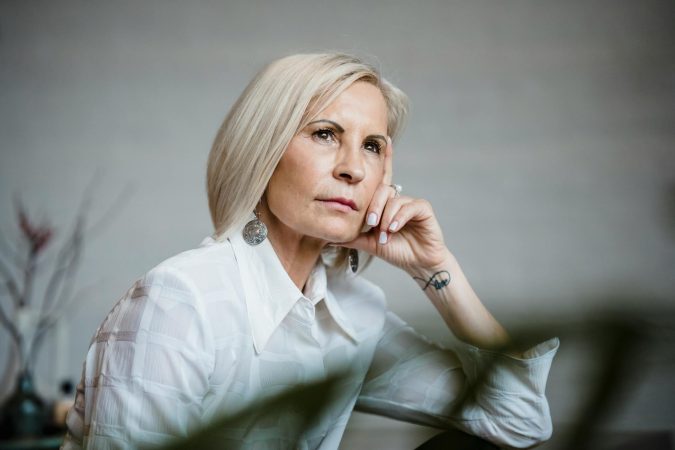
She learned to handle everything alone so well that people stopped asking if she needed anything, and now she sits in her office solving everyone else's problems while her own unopened letters pile up in the drawer marked "later."
The conference room had that particular quiet of 7 PM on a Thursday, the kind where the HVAC clicks off and you can hear someone's keyboard two offices down. I'd just finished presenting a restructuring plan I'd spent three weekends building. My managing director closed his laptop, looked at me, and said, "Honestly, I don't know how you do it. You're the strongest person on this floor."
I smiled. I said thank you. And then I went back to my office, closed the door, and sat in the dark for forty minutes because I couldn't remember the last time someone had asked if I was okay.
That was the night the word started to curdle for me. Strong. I'd been collecting that word since I was about nine, and somewhere along the way the collection had gotten heavy. If you clicked on this, you probably know the feeling. The compliment that lands like a door closing.
The birth of the "strong woman"
It usually starts young. Maybe you were the responsible older sister. Maybe your parents worked late and you learned to make dinner at eight years old. Or maybe, like me, you were labeled "gifted" in elementary school, and suddenly every struggle felt like a personal failure because smart kids don't need help, right?
Whatever the origin story, somewhere along the way, you became the person who handles things. And people noticed. They started saying it: "You're so strong." "I don't know how you do it." "Nothing ever gets to you."
At first, it felt good. Special, even. You were different from other people who fell apart, who needed support, who couldn't juggle seventeen things at once without breaking a sweat. But then something shifted.
The compliments became expectations. The recognition became responsibility. And suddenly, being strong wasn't something you were. It was something you had to be.
When strength becomes isolation
Here's what nobody tells you about being the strong one: people stop seeing you as fully human. They see you as a resource, a solution, a rock. But rocks don't need comfort. They don't need checking on.
I spent almost twenty years in institutional finance, and the patterns were remarkably consistent. The women who moved up weren't necessarily the sharpest analysts or the best closers. They were the ones who absorbed shock without transmitting it. They worked through their father's funeral, through miscarriages nobody knew about, through the bad marriages that quietly ended between earnings calls. They got called "unflappable" in performance reviews. They got called "a machine" as a compliment. I watched one senior VP deliver a presentation on the morning of her mastectomy consultation and nobody on the call knew. She told me about it six months later, laughing, because what else do you do. That was the job. The women who admitted they were struggling got reassigned. The women who didn't got promoted and developed interesting relationships with chardonnay.
I remember one particularly brutal stretch — we'd lost a major client, my team was coming apart, I was working sixteen-hour days trying to salvage the account. A colleague passed my office around ten one night, saw me still at my desk, and said, "Well, if anyone can handle this, it's you. You're unstoppable."
Unstoppable. Not "Do you need help?" Not "This must be overwhelming." Just an acknowledgment that I would figure it out, because I always did.
That night, I sat in my car in the parking garage and felt something I couldn't name. Later, I'd recognize it as the particular loneliness of being seen as invincible when you're actually just very, very tired.
The permission slip phenomenon
When someone calls you strong, they're often giving themselves permission to stop worrying about you. It's unconscious, usually. They're not trying to abandon you. But think about it: when you believe someone can handle anything, why would you offer support?
This creates a vicious cycle. You handle things alone because that's what strong people do. People see you handling things alone and assume you prefer it that way. So they leave you alone. And you get better at handling things alone because what other choice do you have?
The word "strong" becomes a kind of glass. Visible but untouchable. Admired but not actually seen.
The cost of never cracking
For years I prided myself on never crying at work. Never showing weakness. Never admitting I was struggling. My mother still introduces me as "my daughter who worked in finance," as if those decades were the achievement. She doesn't know about the therapy session where I finally cried for the first time in years and realized I'd been performing strength for so long I'd forgotten what unperformed emotion even felt like.
That moment broke something open. Or maybe it broke something free. I'd been living as if someone was keeping score, awarding points for how much I could carry without complaining. There was no scoreboard. No prize for suffering in silence. Just me, exhausted, with a perfect track record of never needing anyone.
The achievement addiction — the constant need to prove I could handle more, do more, be more — was elaborate armor. And armor is heavy. Heavy enough that you forget you're wearing it until you take it off.
Redefining what strength really means
Real strength isn't about never needing help. It's about knowing when to ask for it. It's about being vulnerable enough to admit when you're not okay, brave enough to let people see you struggle, and wise enough to accept support when it's offered.
But how do you unlearn decades of conditioning? How do you stop being the person everyone depends on and start being a person who can depend on others?
Start small. The next time someone asks how you are, tell them the truth. Not the whole truth, maybe, but something real. "Actually, it's been a tough week" instead of "Fine, thanks." When someone offers help, accept it, even if you could do it yourself. Especially if you could do it yourself.
Practice saying these words: "I'm struggling with this." "I could use some support." "I'm not okay right now." They might feel foreign in your mouth at first, like speaking a new language. Because in a way, you are.
Finding your people
Not everyone will know what to do when you stop being invincibly strong. Some people are invested in you being their rock, their problem-solver, their emotional support system. When you change the dynamic, they might resist. They might even disappear.
Let them.
The people who matter will adjust. They'll be relieved, actually, to discover you're human. They'll feel closer to you when you share your struggles, not more distant. And you'll start attracting people who see you as a whole person, not just a pillar of strength.
Conclusion
If you're tired of the word that was supposed to be a compliment and became a prison, you're not alone. Even though it feels that way. Even though you've been alone with your strength so long you've forgotten what the alternative feels like.
I don't know if saying "actually, I'm not feeling very strong right now" will change anything. Some people will hear it and move closer. Some will hear it and quietly revise their opinion of you. Some won't hear it at all — they'll nod and keep talking, because the version of you that handles everything is the version they've organized their life around.
What I can tell you is that I've said it out loud a handful of times now, and I still can't tell you whether it worked. I just know the alternative — swallowing it, smiling, being unstoppable for one more Thursday night in a dark office — is a cost I finally stopped being willing to pay. Whether anyone meets you on the other side of that sentence is a separate question. You say it anyway. Or you don't. I'm still deciding what it costs either way.
What’s Your Plant-Powered Archetype?
Ever wonder what your everyday habits say about your deeper purpose—and how they ripple out to impact the planet?
This 90-second quiz reveals the plant-powered role you’re here to play, and the tiny shift that makes it even more powerful.
12 fun questions. Instant results. Surprisingly accurate.