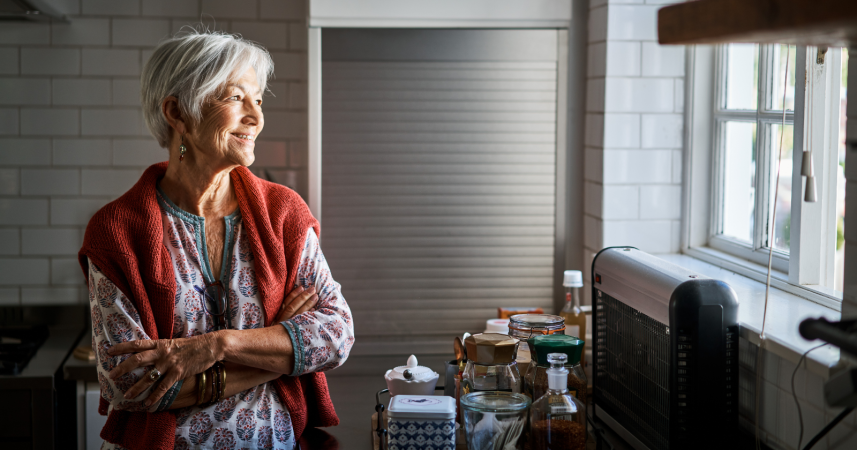
The moment I caught myself gesturing wildly while telling a hilarious pharmacy story to my empty kitchen—pausing for laughs, responding to questions no one asked—I finally understood why my mother spent her last years talking to her plants.
It took me three days to admit to myself what I'd been doing. Standing in my kitchen last month, stirring sugar into my tea, I was mid-story about the absurd encounter I'd had at the pharmacy when their new system crashed. My hands were gesturing, my voice had that particular rhythm it gets when I'm building to the funny part. "So there we all were," I was saying, "twenty people clutching our prescriptions like lottery tickets, and this poor pharmacist who couldn't have been older than my granddaughter was trying to explain that the computers from 1987 were actually more reliable than—"
I stopped. The spoon clinked against the ceramic. The kitchen was empty, had been empty all morning. The person I was telling this story to existed only in my mind, and the realization made my chest tight with something between embarrassment and grief.
The weight of unshared moments
This wasn't the first time. For months, maybe longer, I'd been having these one-sided conversations. Rehearsing anecdotes while folding laundry. Practicing observations while watering my garden. Creating an audience where none existed because the alternative—that suffocating silence—had become unbearable.
After thirty-two years of teaching high school English, I thought I understood solitude. Those early morning hours grading papers, the quiet preparation before the chaos of teenagers filling my classroom. But that was chosen solitude, temporary and purposeful. This is different. This is waking at dawn to a house so quiet I can hear the refrigerator's hum from two rooms away. This is making dinner for one and eating it while reading because the sound of my own chewing feels too loud.
My husband died two years ago. Parkinson's took him slowly, then all at once. We'd had twenty-five years after meeting at that school fundraiser where I accidentally outbid him on a weekend getaway neither of us wanted. The auctioneer's confusion, our mutual laughter, coffee afterwards to sort out the mistake—it became the story we told at dinner parties. Now there are no dinner parties. There's barely dinner, just something quick eaten standing at the counter because setting the table for one feels like admitting defeat.
When connection becomes scheduled
People assume I must be terribly isolated, but my calendar suggests otherwise. Sunday evening calls with my daughter, right after she puts the kids to bed. Monthly widow's support group where we discuss everything except how we talk to our dead husbands while sorting their belongings. Thursday coffee with Helen from next door, fifteen years of that tradition and counting. Church, where people smile and ask how I'm doing but don't wait for real answers.
Between these scheduled points of contact stretch vast prairies of time. Hours accumulate like dust on surfaces I pretend not to notice. When something remarkable happens—like last week when a cardinal built a nest in my lilac bush, or when I figured out how to fix my garbage disposal using a YouTube video—these moments bloom and wither in private. By the time Sunday's call comes, I've either forgotten the story or it feels stale from being preserved too long in my mind.
The pandemic taught everyone about isolation, but for those of us already fading from view—older women whose professional lives have ended, whose children have launched, whose partners have died—the lockdowns simply formalized what was already happening. The world had already been practicing social distancing from us, stepping around us in grocery stores, speaking past us at social gatherings, treating us like benign ghosts haunting our own lives.
Creating witnesses from thin air
What disturbs me most about my imaginary conversations isn't their existence but their completeness. I don't just tell stories to the empty kitchen; I pause for reactions, adjust my timing for laughs, even respond to questions no one has asked. "Well, you know how these things go," I'll say to absolutely no one, as if we're old friends sharing familiar rhythms of conversation.
Sometimes the imaginary listener is specific—a composite of people I've known, with my mother's careful attention and my husband's dry humor. Other times they're shadowy, just a presence that makes the telling worthwhile. They never interrupt or look at their phone or suddenly remember somewhere else they need to be. They're the perfect audience, which is probably why I keep conjuring them.
I wonder if this is why my mother talked to her plants in her final years, why she narrated her activities like a cooking show host with no camera. We thought it was concerning, maybe early dementia. Now I understand she was just keeping her voice active, staying practiced in the art of connection even when connection itself had become scarce.
The garden that nobody sees
My English cottage garden spans the entire back of my property. Thirty years of carefully selected perennials, the climbing roses my husband helped me install before his hands started shaking, the herb garden I planted after retiring because I finally had time. I spend hours there—deadheading, dividing, planning new combinations for spring. The neighbors probably think I'm obsessive. They don't understand that the garden doesn't care if I'm alone. It responds to attention regardless of whether anyone else witnesses the beauty.
This is what I'm learning about loneliness at seventy: it's not about the absence of people but the absence of witness. When I successfully propagate my grandmother's peonies, when I spot the first crocus of spring, when the morning light hits the garden at just the right angle—these moments happen fully whether anyone sees them or not. But something in me still craves the sharing, the "come look at this," the simple acknowledgment that yes, this small beauty matters.
Finding new ways to be heard
Last month, I started writing again. Real writing, not just my bedtime gratitude journal. Essays about teaching, about raising children mostly alone after my first marriage ended, about watching my husband disappear into his illness one word at a time. My granddaughter helped me join an online writing group. "You have to unmute yourself, Grandma," she kept saying during my first meeting, and the metaphor wasn't lost on me.
The group meets Wednesday evenings. We read our pieces aloud, our faces in little squares on the screen. Last week, a woman from Oregon cried after I read about cleaning out my husband's workshop. "I haven't touched my husband's tools in three years," she said. We stayed on after the official meeting ended, trading stories about the strange guilt of moving on, the way grief and loneliness intertwine but aren't quite the same thing.
I've started a blog too, though I'm still too nervous to share it widely. The posts are like letters to the imaginary listener, except now they might find real readers. Someone in Australia commented on my piece about talking to empty rooms. "I thought I was going crazy," she wrote. "Thank you for making me feel less alone." The irony of two lonely women connecting across the planet while sitting in our separate silent houses wasn't lost on either of us.
Final thoughts
I still rehearse conversations in my kitchen. Yesterday, while making soup, I told the whole story about the pharmacy disaster to my empty dining room, complete with voices and dramatic pauses. But now I also write it down, share it with my online group, save it for Sunday's call with Grace.
The imaginary listener hasn't disappeared. They've just become part of my survival toolkit, like my garden gloves and my reading glasses and my stubbornness about making proper tea even when it's just for me. Because staying ready for connection—keeping our stories fresh, our observations sharp, our voices active—that's not giving in to loneliness. That's refusing to let it win.