

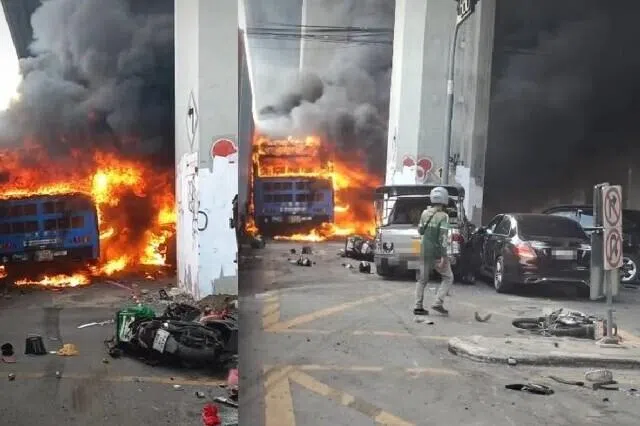
Mandatory drug tests and a PM pledge to replace level crossings follow a collision at an intersection engineers had already flagged as overloaded
The driver of the freight train that ploughed into a stalled Bangkok bus on Saturday afternoon tested positive for drugs, did not hold a rail transport licence, and passed a flagman waving a red warning flag without slowing, Thai authorities confirmed on Sunday. He has been charged with reckless driving causing death. The disclosures have shifted the investigation away from a single failure of judgement and toward the question of why one of Bangkok's busiest railway crossings was still relying on a manually operated barrier and an unlicensed operator.
Eight people died and at least 32 were injured when freight train number 2126, running on the Laem Chabang Port–Bang Sue line, struck a Bangkok air-conditioned bus operating route 206 between Mega Bangna and Kasetsart University. The collision happened at 3:41 pm local time at the Asoke-Din Daeng level crossing in Huai Khwang district, near Makkasan station. The bus burst into flames on impact and was dragged roughly 50 metres along the tracks, striking a motorcycle and several nearby cars. Deputy Transport Minister Siripong Angkasakulkiat told reporters at the scene that all of the bodies recovered so far had been on the bus.
What investigators found
Police did not specify which drugs were detected in the train driver's urine sample. The same driver had no rail transport licence, the Bangkok Post reported on Sunday, citing the head of the Department of Rail Transport. Preliminary data pulled from the train's black box showed the emergency braking system was engaged roughly 100 metres before impact. The freight train was travelling at 35 km/h and would have required nearly two kilometres to stop, according to the South China Morning Post.
A local crossing official waved a red warning flag at the approaching train to signal it to halt because traffic was backed up across the tracks. Police said the train did not slow.
Makkasan police have also charged the bus driver, 56, with reckless driving causing death, and the guard responsible for the manually operated barrier with negligence causing death and injury. Police said the bus stopped on the tracks because the queue at an adjacent traffic light had backed up across the crossing, and that the barriers were unable to descend properly while the bus was in the way.
Mandatory testing ordered
Pichet Kunadhamraks, director-general of Thailand's Department of Rail Transport, said all train drivers and railway staff will now be required to pass drug and alcohol screening before every shift. The Bangkok Mass Transit Authority has pledged initial compensation of 1.5 million baht for each person killed and between 80,000 and 500,000 baht for the injured, depending on severity.
Forensic teams continued recovering charred remains on Sunday. The Police General Hospital's Institute of Forensic Medicine expects to complete DNA identification of all eight victims by Tuesday. Two have already been named: 34-year-old Teekha Teekha-Utmakorn and 57-year-old Tiam Phuangyod.
A crossing engineers had already flagged
The Asoke-Din Daeng crossing sits at the edge of one of Bangkok's most congested intersections. Dr Amorn Phimarnmas, president of the Structural Engineers Association of Thailand, told the BBC that more than 100,000 road vehicles pass through it every day. Asoke Montri Road, which feeds the crossing, was designed for around 35,000.
Motorcyclists at the crossing routinely weave around the descending barriers to avoid being held up by passing trains. Drivers regularly inch onto the tracks during heavy traffic on the assumption that another train will not arrive in the few seconds they expect to be there. The tracks were laid before the surrounding road network existed, and the city grew over them rather than around them.
Amorn calls this dynamic "risk normalisation." As he put it to the BBC:
It's when risk becomes routine. People think 'it'll be fine' and carry on, until one day we end up with exactly the kind of disaster we've just seen.
A pledge, and an antiquated system
Prime Minister Anutin Charnvirakul has pledged to pursue structural change rather than only procedural fixes. In remarks reported by the Bangkok Post, he said:
We must reduce the number of level crossings. At some point, there may need to be route changes or tunnel construction. We also cannot rely solely on the judgement of station staff or signal operators because human error is always possible.
The crash is expected to reopen debate over State Railway of Thailand investment priorities and the slow pace of urban grade separation. Al Jazeera's Tony Cheng, reporting from Bangkok, described the country's rail system as "very antiquated" and predicted the incident will sharpen pressure on SRT to modernise crossings in dense urban zones.
Transport Minister Phiphat Ratchakitprakarn called for a similar review in January after a construction crane at a Bangkok-Nong Khai high-speed rail site in Nakhon Ratchasima province fell onto a passenger train, killing 30 people and injuring 69. The findings of that inquiry have not been made public.
Whether Saturday's collision results in structural change or another inquiry whose conclusions never reach the public will depend on what Thai authorities choose to publish in the coming weeks. The most immediate measures, drug testing and individual charges, address the people who were closest to the collision. The conditions that turned a stalled bus into a fatal trap had been visible to engineers and commuters at the Asoke-Din Daeng crossing for years.
The intersection remained sealed off on Sunday as police photographed damaged infrastructure and reviewed railway operating records.