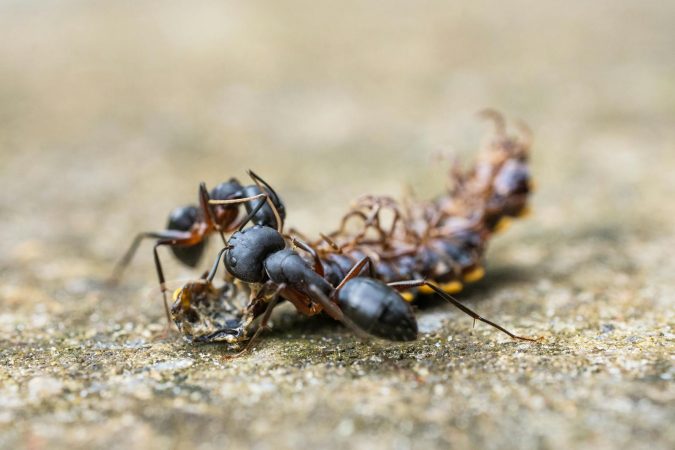
A new iScience study found that low doses of caffeine help invasive Argentine ants learn bait locations faster, cutting foraging times by up to 38% — and potentially reshaping how we control one of the world's most damaging pests.
What if the key to wiping out one of the world's most destructive invasive pests isn't a stronger poison — but making the pest smarter? That's the counterintuitive premise behind new research on Argentine ants and caffeine, and the early data suggest it works. A study published recently found that ants given caffeinated sugar water learned the location of food faster, walked straighter paths, and cut their travel times by as much as 80 percent over successive trials.
The conventional assumption about pest control is that you make the poison more potent or the bait more attractive. Researchers flipped that logic. Instead of changing the bait, they changed the ant.
In controlled experiments, Argentine ants completed multiple foraging trials at three caffeine concentrations: a low dose of around 25 ppm — roughly equivalent to what occurs naturally in the nectar of some plants — a moderate dose of 250 ppm, and a high dose of 2,500 ppm. Ants given the low dose improved their foraging efficiency by approximately 30 percent over repeated visits, with moderate-dose ants showing improvements closer to 50 percent. In some cases, ants that initially took over five minutes to reach a food reward completed the same route in under a minute by the final trial. The highest concentration, however, appeared to impair performance, suggesting a dose-dependent sweet spot rather than a simple more-is-better relationship.
The mechanism isn't speed. It's focus.
The research team noted that caffeinated ants weren't moving measurably faster in terms of walking speed, but their paths were significantly more direct — fewer loops, fewer wrong turns, and less time spent exploring dead ends. This suggested the ants had formed stronger spatial memories of the reward locations and were acting on them with greater precision.
That distinction matters for pest management. Argentine ants are among the most damaging invasive species worldwide, responsible for an estimated billions of dollars in annual agricultural and infrastructure damage globally — with costs in the United States alone running into hundreds of millions per year. Existing poison baits often face challenges because workers may not return to the bait consistently enough to spread toxicant through the colony before the colony learns to avoid it. If caffeine makes foragers better at memorizing bait locations and recruiting nestmates via stronger pheromone trails, the poison gets distributed faster than the colony can react.
The researchers explained that the goal is to help ants find baits more efficiently, creating stronger pheromone trails that attract more workers and distribute poison throughout the colony before the ants recognize the danger. In principle, this means a caffeinated bait could achieve the same colony knockdown with fewer bait stations, less total toxicant, and fewer reapplication cycles — potentially reducing pesticide use by a significant margin compared to conventional approaches.
The implications extend beyond Argentine ants. Invasive ant species collectively — including fire ants, yellow crazy ants, and tawny crazy ants — cause an estimated $6 billion or more in annual damage worldwide through crop loss, electrical infrastructure damage, and displacement of native species. If caffeine's cognitive enhancement effect holds across ant species — and early indications suggest similar octopaminergic pathways exist in many social insects — the approach could be adapted for multiple invasive ant targets. Researchers have also speculated about whether similar cognitive additives might improve bait uptake in other social insect pests, though that work remains in its earliest stages.
Field tests are reportedly underway to see whether the lab results hold up in real landscapes, where weather, competing food sources, and colony size complicate the picture.
The broader point for anyone tracking sustainability in agriculture and urban pest management: the most interesting innovations aren't always stronger chemicals. Sometimes they're smarter delivery. A cognitive additive that lets existing baits work better could mean less poison used overall, fewer reapplications, and less off-target damage to the insects we actually want around. That's a quieter kind of progress than a new pesticide launch, but arguably a more useful one.
Whether caffeinated bait becomes a commercial product depends on ongoing field trials. The lab science is promising. The real world gets a vote next.
If You Were a Healing Herb, Which Would You Be?
Each herb holds a unique kind of magic — soothing, awakening, grounding, or clarifying.
This 9-question quiz reveals the healing plant that mirrors your energy right now and what it says about your natural rhythm.
✨ Instant results. Deeply insightful.

Elena Santos
She/Her
Elena Santos is a writer and former sustainable fashion designer based in Brooklyn, New York. She studied environmental design at the Rhode Island School of Design, where she developed a deep interest in sustainable material systems and traditional craftsmanship. After working at a Brooklyn-based sustainable fashion startup, she spent a year traveling through Central America writing about Indigenous textile traditions, an experience that fundamentally reshaped her understanding of what sustainability actually means in practice.
At VegOut, Elena writes about sustainability, food culture, and plant-based living through the lens of design, tradition, and cultural preservation. Her Brazilian and Cuban heritage informs a perspective that connects food systems to broader questions about identity, community, and how cultures sustain themselves across generations.
Elena maintains a small Instagram account documenting textile craftsmanship and Indigenous knowledge systems. She does her best writing early in the morning in quiet coffee shops, before the day gets complicated. She believes sustainability is not a trend but a return to how people have always lived when they paid attention.
More Articles by Elena