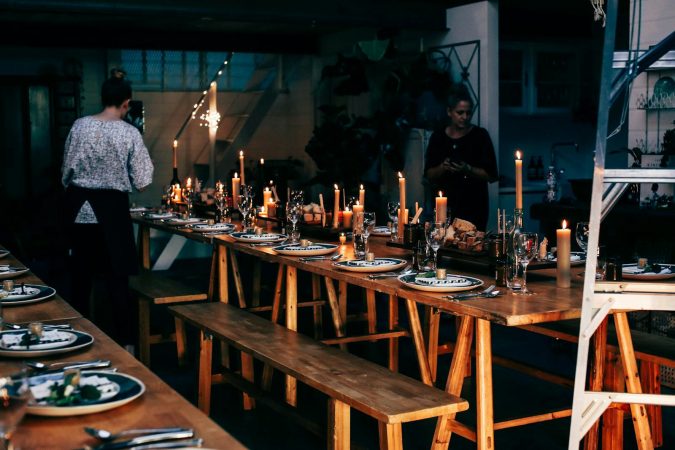
Longtime organizers who quietly step back from hosting aren't burned out—they're confronting an uncomfortable truth about whether they were ever truly valued as guests, not just as the person who made gatherings happen.
The standard explanation for why people in their sixties stop hosting the dinners, organizing the reunions, and chairing the committees is that they are tired. Burnout, the reasoning goes. A reasonable retreat after decades of effort. But that framing misses what is actually happening in a sizeable share of these quiet exits — the host is not exhausted by the work. They are reckoning with what the work was always covering up.
The realization tends to arrive late, often after a specific event. A milestone birthday they planned for themselves where attendance was thinner than expected. A holiday meal where nobody asked how they were doing. A trip they organized for ten people who never once suggested the next one.
It is not bitterness. Bitterness is loud.
What replaces the hosting is something quieter. A slow audit of who, across forty years, ever actually showed up when there was no event to attend.
The role that ate the person
Some people become hosts the way others become eldest daughters or office fixers. Not by choice so much as by the slow accumulation of being the only one who would. The role gets reinforced every time the gathering happens, every time people praise their organizational skills, every time the absence of their effort would mean the absence of the event itself.
Over decades, that role becomes a kind of identity. And when self-worth gets routed through usefulness, the discovery that you don't know who you are outside of your output tends to surface around the same life stage where output starts feeling optional.
The hosting was never really about the parties. It was a structure for belonging.
And structures, once they start to wobble, reveal what they were holding up.
What the sixties keep surfacing
There is a reason this reckoning lands in the sixth decade and not the third. The social world genuinely does begin to shrink around then. Children are grown. Careers wind down. Parents die. The scaffolding of obligation that once forced people into your life starts coming apart, and what remains is whatever was actually chosen.
For people who built their entire social presence around being useful, this is the moment the math becomes legible. Social support quality in later life matters more than social support quantity, and the perceived asymmetry of relationships becomes a stronger predictor of wellbeing than the number of contacts a person maintains.
Translation: it is not about how many people came to the birthday party. It is about whether anyone would have organized one for you.
The guest of honor problem
There is a specific kind of person who has spent a lifetime at events they planned, and who has never once been the reason for the gathering. They threw the baby showers, the retirement parties, the engagement brunches. They were thanked, often warmly. They went home and washed the dishes.
It can take decades to notice the pattern, because the pattern looks like generosity from the inside. It looks like love. It looks like the kind of person you want to be.
What it actually is, sometimes, is a deal nobody else signed.
The host believed that giving was a way of earning a place. The guests believed they had been invited to a party. These are not the same belief, and the gap between them is where the slow, late grief lives.
Why this surfaces now and not earlier
The patterns that get laid down in childhood — about whether your needs are visible, whether your presence requires earning, whether love is conditional on usefulness — don't disappear when you grow up. They go dormant and resurface under the right conditions. Old relational patterns come back online in late adulthood, particularly as social roles shift and the original family system reasserts itself.
For the lifelong host, what reactivates is often the original suspicion: that being needed is not the same as being loved.
This isn't a dramatic insight. It rarely arrives with tears or a confrontation.
It arrives as a thought, on an ordinary afternoon, about whether to send the group email about the summer cookout. And then the thought of just not sending it. And then the strange relief of not sending it. And then the silence that follows, which confirms everything.
The asymmetry nobody names
One of the harder things to look at directly is that the people who organize everything are often people who have spent their lives in the giver role within their friend groups. The role gets so well-learned that the people around them genuinely cannot picture them in any other position. Asking them what they need feels almost grammatically wrong.
This isn't malice on anyone's part. It is a script that everyone in the room has agreed to without ever discussing it.
But scripts can be quit. And in the sixties, when the energy to maintain them gets harder to find, a lot of people quit.
What looks like withdrawal from the outside is often, as we've explored before, a much more deliberate kind of reorganization. The host is not retreating from people. They are reorganizing around evidence.
The evidence audit
The audit tends to follow a quiet sequence. Who called when the surgery happened. Who remembered the anniversary. Who showed up without being asked. Who sent the text that didn't require a response.
The names on that list are usually shorter than the names on the holiday card list, and that gap is where the realization sits.
Most relationship patterns persist not because they are working but because nobody has clearly named them. Once they get named, even silently, the pattern starts to lose its grip.
The naming, in this case, is internal. It rarely gets said out loud. It just changes what the person does on a Saturday in March when the calendar invite would have gone out.
What the disengagement looks like in practice
The hosting does not stop dramatically. There is no announcement, no farewell party (there wouldn't be — they were the one who would have planned it). It tapers.
The annual gathering becomes biennial, then optional. The group chat slowly goes quiet on their end. The reservations don't get made. When people notice — and they often don't, for months — the most common response is mild puzzlement, not alarm. Things just feel a little less organized than they used to.
This confirms the original suspicion in a way that is hard to recover from. The room was warm because of them, and the room stays warm in their memory of it, and the people in the room have, in many cases, simply not noticed the change in temperature.
The witness problem
There is a related grief that often arrives in the same season. The people who knew the host before they were the host — the friends from the early years, the ones who remember the jokes and the references and the early ambitions — start dying, moving, or fading. What gets lost is not just company but the experience of being known across time, the kind of long-term witnessing that makes a life feel continuous instead of episodic.
Without that witnessing, the years of hosting start to feel less like a body of work and more like a long performance for an audience that wasn't watching closely.
This is the part that no amount of new friendships can fix, because new friendships, however warm, start in the middle of the story.
What people do instead
The people who go through this transition gracefully tend to do a few things in common. They stop trying to convert old asymmetrical relationships into reciprocal ones, because by sixty, those patterns are usually load-bearing for both parties. They redirect their organizing energy toward smaller, more deliberate gatherings, often with people who showed up during the audit. They allow themselves to be the guest sometimes, which is harder than it sounds for anyone who has spent decades on the other side of the kitchen.
And they get clearer-eyed about emotional reciprocity. Connection fades during ordinary moments, not dramatic ones — and the reverse is also true. Connection gets rebuilt in ordinary moments, not at parties.
The hosting was, in a way, an attempt to manufacture the ordinary moments through extraordinary effort. Once that's clear, the strategy starts to look less like generosity and more like the long way around.
The quieter calendar
What replaces the old calendar is not isolation. It is a smaller, more honest version of social life. Fewer events. More phone calls. A standing breakfast with one friend. A walk with another. The kind of presence that does not require a centerpiece.
People worry, watching this transition from the outside, that something has gone wrong. Usually something has gone right, and very late.
The reason the room stayed warm was real. It is also possible, after a certain point, to put down the responsibility of keeping it that way for everyone else, and to sit in a smaller room with fewer people who actually came to see you.
That room is quieter. It is also, finally, yours.