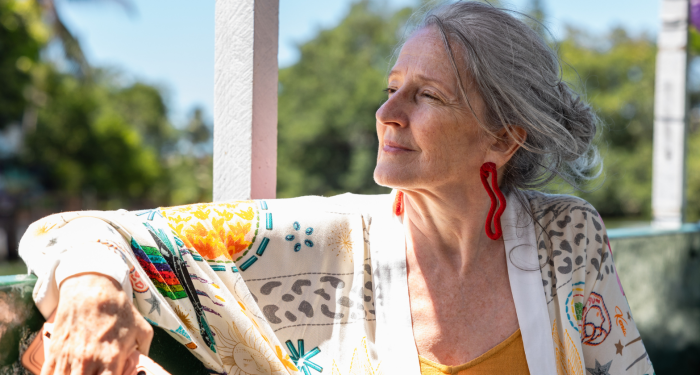
Ask a quietly contented sixty-something how many close friends she actually has, and she'll think about it and tell you the truth. Two. Maybe three. The standard response is to feel sorry for her — and the standard response is wrong
Walk into any room of sixty-somethings and you can usually pick them out within a few minutes.
They aren't the ones working the room. They aren't the ones with the big laugh and the running commentary on everyone's lives. They're often a bit quieter. They have one or two people they actually want to talk to, and they spend most of the night talking to them.
If you asked them, between drinks, how many close friends they have, they'd think about it and tell you the truth. Two. Three, if you count the one who lives overseas. Maybe four.
The standard cultural response to this is to feel slightly sorry for them. Only three close friends? At sixty? Where are all the others?
The cultural response is wrong. These are, on average, the most quietly contented people in the room. And they figured out a truth most of us spend our whole lives chasing the opposite of.
The myth most of us grew up believing
For decades, popularity was the metric. The more friends, the better. The bigger your wedding, the more successful you were. The longer your Christmas card list, the richer your life looked. We've been quietly trained, our whole lives, to associate quantity with worth.
Social media took that lie and put it on steroids. Now you can count the number of people who know your name in real time. Hundreds. Thousands. The dopamine hit is real. The shape of a "rich social life" got redefined as a wall of acquaintances who like your posts.
By sixty, most people have worked out — at some level — that this never quite delivered. The wall of acquaintances was nice. It wasn't, on the hardest day of the year, what kept them upright.
What kept them upright was one phone call to one person.
What the research actually shows
The data on this is now pretty clear.
A study surveyed nearly 1,500 adults of various ages and found that only the number of close friendships was significantly associated with social satisfaction and wellbeing — the wider acquaintance circle didn't move the needle at all. The researchers at the University of Leeds noted that older adults had fewer friends than younger adults but reported higher wellbeing — because their fewer friends were the right kind.
A much larger 2023 study analysed nearly 30,000 people aged 16 to 101 and found something subtler — there is a real benefit to having more close friends, but it diminishes sharply, and in older age, quality matters far more than quantity. A mental health research fellow at Newcastle University, looking at the optimal number of friends for older adults, put a specific number on it: roughly four close friends. More than that doesn't add anything.
Four. That's the number the research keeps landing near. Not forty. Not four hundred. Four — and even that's the upper end. Many of the happiest sixty-somethings have two or three.
The cultural narrative, in other words, is off by an order of magnitude.
What "being seen" actually feels like
The phrase one person who truly sees you gets thrown around so often it can sound vague. Let me try to be specific.
It's the friend who knows, before you've said it, that you're not really fine. The one who can tell from a single text that something's off. The one who, when you finally tell them what's happening, doesn't say oh that's awful — they say one specific thing back that lets you know they actually understood, not just heard.
It's the friend who remembers what you said about your mother three years ago, when nobody else remembered, and asks about it on the anniversary.
It's the friend you can ring in tears without preamble, and they don't ask you to apologise for ringing in tears.
It's the friend with whom you can sit in silence for forty minutes and not feel any pressure to fill it.
That's what being seen actually is. It's not constant attention. It's not even constant contact. It's the cumulative knowledge of someone — built up over years — combined with the willingness to use that knowledge when you need them to.
One person who can do this is worth, by any honest accounting, more than a hundred people who'd come to your funeral but couldn't tell you the name of your sister.
Why most people never build this
It isn't an accident that this kind of friendship is rare.
It requires something the modern world is structured against. It requires the same person, over a long time, with enough difficulty between you that the relationship has actually been tested. You can't get this in six months. You can't get it from someone who's always agreed with you. You can't get it from someone you've only ever seen at their best, or only seen at parties, or only known across a screen.
You build it the way you build a callus. By rubbing against the same surface for a long time. By being present through one of their hard things and letting them be present through one of yours. By letting them see you upset, or wrong, or smaller than you usually appear — and not losing the friendship over it.
Most people, somewhere in their twenties or thirties, decide that this is too risky, too slow, too uncomfortable. They optimise instead for breadth. They build a wide social network of pleasant, well-curated relationships in which nobody quite knows them deeply but everybody likes them moderately.
By sixty, those people often realise the trade was bad. The wall of acquaintances is still there. None of it carries weight. They have a lot of names in their phone and almost nobody they could ring on the worst day of the year.
The sixty-something with three close friends made the opposite trade, often without knowing she was making it. She invested deeply in fewer people. The cost, when she was twenty-five, was that she sometimes felt she was missing out on a bigger life. The reward, at sixty-three, is that she has three people who actually know her. And the research, very clearly, says that's enough.
What the contented sixty-somethings have figured out
A few patterns turn up over and over among the people who've quietly got this right.
They stopped calling people friends who weren't really friends. The colleague they liked, the neighbour they chatted with, the parent of their kid's friend — they enjoyed all of these. They just stopped pretending that warm acquaintances were the same thing as people who knew them. The honest counting kept the language clean.
They didn't try to replace friends who drifted away. Some friendships ended. Some moved overseas. Some changed when life circumstances changed. They mourned the losses and didn't immediately scramble to fill the gaps. They knew, by then, that the deep ones can't be replaced — and didn't pretend they could be.
They put real time into the few people who mattered. Not constant time. Real time. A long phone call once a fortnight rather than a text every day. A weekend visit once a year for a friend who lived far away. Showing up — actually showing up — at the funeral, the hospital, the difficult Sunday lunch.
And they got reasonably comfortable with their own company. Which is, in the end, the foundation that makes the rest possible. The person who needs constant social input to feel okay can't be selective about their friendships, because they're always running on a deficit. The person who can sit with themselves on a Tuesday afternoon can afford to be choosy.
What I'd say to anyone reading this
If you're approaching sixty, or already there, and you've been quietly carrying a sense that you should have more friends — that your circle isn't big enough, that all the magazines say you need to be doing more — I want to tell you what the research actually says.
You probably don't.
If you have two or three people who truly know you, who you can ring at midnight, who would know within thirty seconds that you weren't fine — you have more than most people have, and almost certainly enough.
Spend your remaining decades tending those two or three. Not chasing more. Tending the ones you have. Ring them on a Tuesday. Visit them when you can. Don't let the deep ones drift while you spread yourself across a wider, thinner social network that won't be there when you need it.
The cultural story said the rich life had a hundred names in the phone. The research says the rich life has three or four people who'd drop everything.
Pick the smaller life. Most of the people who got there will tell you the same thing.
It wasn't a downgrade. It was the upgrade nobody ever quite explained to them in advance.