The solo diner has often figured out what the companioned table next to them has not: that some company is structurally worse than solitude
There is a cultural assumption, almost reflexive in its application, that the person eating alone in a restaurant is in some sense to be pitied. The assumption surfaces in small, almost unconscious behaviors. The slight softening of tone when a waiter approaches the solo diner. The discreet seating, often at the back, often at a smaller table. The way other diners' eyes track, briefly, the person who has come in alone, before returning, with a small note of relief, to their own companioned tables.
The assumption underneath all of this is that eating alone in public is a kind of admission. An admission of having no one to eat with. An admission of social failure. An admission, in the contemporary register, of loneliness.
This assumption is, on close examination, often almost exactly wrong. The person eating alone in the restaurant is, in many cases, not lonely. They are, more accurately, someone who has figured out something the companioned tables around them have not yet figured out, which is that eating in the company of someone uninterested in you is a quieter and more corrosive kind of loneliness than eating in your own company has ever been.
The two kinds of meal
It is worth being precise about the distinction, because the cultural framing flattens it in a way that obscures what is actually at stake.
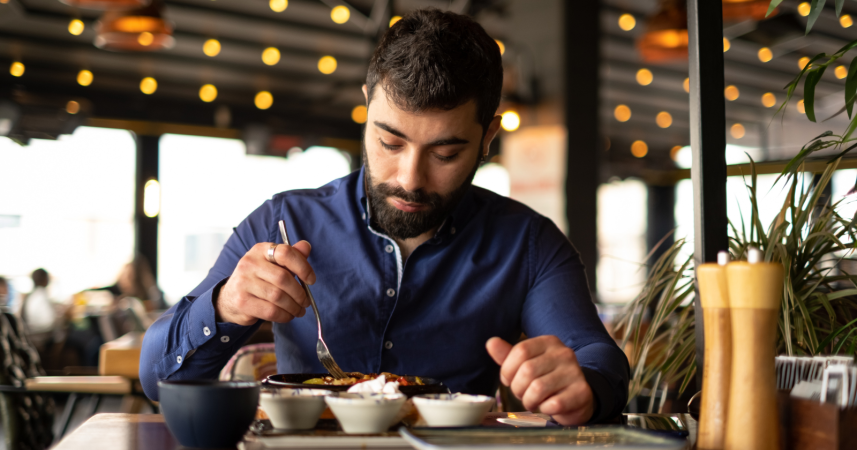
The first kind of meal is the meal eaten alone. The person sits at a table. They order. They eat. They are, by every external metric, unaccompanied. The meal proceeds at the pace they set. They look at what they want to look at—a book, a window, the rest of the room, their own thoughts. The meal does not require them to manage anyone else's experience. It does not require them to perform attentiveness. It does not require them to produce conversation at the rhythm someone else has set. The meal is, in some real way, a small protected period in which they are, finally, on their own time.
The second kind of meal is the meal eaten in the company of someone who is not, in any active sense, present at the table. The person is across from another human being. The human being is talking, perhaps, or listening, perhaps, or scrolling, perhaps. The mechanics of companionship are visible. The meal looks, from any nearby table, like a meal eaten together. What is missing, in this configuration, is the substance of what eating together is supposed to provide.
The substance, when it is operating, is mutual interest. The two people are, in some real way, curious about each other. They notice each other's small reactions. They build, across the meal, a small temporary world that belongs only to them. The world is the point of the meal. The food, the drinks, the conversation are the materials. The world is what the materials produce, when both people are, in fact, participating in its construction.
When one of the two people is not participating—when they are physically present but emotionally absent, or distracted, or simply uninterested in the person across from them—the world does not get built. The materials are still being deployed. The meal still has all its visible features. But the substance is not being produced. The person across the table is, in some structural way, dining alone, with the additional burden of having to pretend that they are not.
Why the second is heavier than the first
The first kind of loneliness—the loneliness of eating actually alone—is, in most cases, surprisingly light. The person has nobody to perform for. They have nobody to wonder about. They have nobody to read for signs of disengagement. They are, in some real way, just eating. The meal, taken on its own terms, is a small unproduced moment in the day. The person at the next table may pity them. The person eating may not, in fact, require the pity.
The second kind of loneliness—the loneliness of eating with someone uninterested in you—is, on close examination, heavier in a particular way. The person carrying it has to manage two simultaneous experiences. The first is the actual experience of not being engaged with by the other party. The second is the social performance required to keep the meal looking, to nearby observers and possibly to the other party themselves, like a meal that is, in some sense, working.
The performance is invisible. It is, however, real. It involves continuing to ask questions whose answers will not be received with much attention. It involves producing the appropriate facial responses to comments that are being made on autopilot. It involves filling, internally, the small empty spaces in the conversation that the other party has not noticed are empty. It involves, in some real way, holding up the visible structure of the meal while the actual substance has, in some structural sense, departed.
This kind of work is, by the end of a meal, exhausting. The person doing it has spent an hour or two performing companionship that was not, in fact, being met from the other side. They leave the meal with the particular fatigue of having had to maintain, alone, a structure that was supposed to be held up by two people. The fatigue does not, in most cases, register as loneliness in the moment. It registers, more accurately, as a small inarticulable depletion. The depletion is what loneliness inside the second kind of meal actually feels like.
What the person eating alone has often figured out
Many of the people who eat alone in restaurants have, on examination, done so deliberately. They have not arrived at the solo table because no one was available. They have arrived because they have, somewhere in their lives, eaten enough of the second kind of meal to have made a structural calculation about which kind of meal they prefer.
The calculation usually goes something like this. The solo meal involves a certain absence of human contact. The absence is real. But the absence is also, in its own way, restorative. There is no work being done. There is no performance to maintain. The person leaves the meal slightly more themselves than when they sat down.
The companioned-but-empty meal involves a particular kind of contact that is, on examination, worse than absence. The person leaves the meal less themselves than when they sat down. The contact has drained rather than restored. The contact has produced, structurally, more loneliness than the solo meal would have produced.
Given the choice between these two, the person who has figured it out chooses the solo meal. Not always. Not in every case. But when the alternative is the second kind of meal, the solo meal is, by their own honest accounting, the less lonely of the two options. The choice is not, in their internal experience, a failure. It is, more accurately, a small piece of self-protection that the wider culture has not given them language for.
What this means for how to read the solo diner
The person at the next table eating alone may be lonely. They may also, with roughly equal probability, be doing one of the more underrated forms of self-care available in adult life. They may be giving themselves a small protected period in which the work of human performance is, briefly, suspended. They may be using the meal as a quiet conversation with their own interior. They may be, simply, eating.
The cultural assumption that solo dining is a sad activity is, in part, a generational artifact. Older generations, particularly women raised in mid-twentieth-century cultures, were taught that being seen alone in public was a kind of social failure. The training has not, in many countries, fully retired. It survives in the small ways nearby diners glance, in the slightly softer tone of the waiter, in the implicit suggestion that the solo diner is to be either pitied or, in some way, accommodated.
The solo diner often does not require either response. They are not, in many cases, the person at the saddest table in the restaurant. The saddest table in the restaurant is, on close examination, frequently one of the companioned tables, where two people who used to know each other are now eating across from one another with the careful smoothness of long inattention.
The companioned table looks, by every external metric, like a successful social configuration. The solo table looks, by every external metric, like a failed one. The internal experience of the people at each table is often the opposite of what the external read would suggest. The solo diner is, in many cases, having a perfectly good meal. The companioned pair is, in many cases, performing a meal that has, in some structural sense, ended.
The acknowledgment this article wants to offer
For anyone who eats alone with some regularity and has, in the back of their mind, absorbed the cultural assumption that the practice is a sad one, this is the small piece of permission to revise the assumption.
Eating alone is not, in itself, evidence of failure. It is, in many cases, evidence of having figured out a piece of social arithmetic that the wider culture has not yet acknowledged. The arithmetic is that not all companionship is nourishing, that some companionship is structurally worse than solitude, and that choosing solitude over the wrong kind of companionship is not a defeat but a small act of integrity.
The book on the table is not a prop to soften the appearance of being alone. The book is, more often, a chosen companion that will, for the duration of the meal, actually engage with the person reading it. The phone is not, in many cases, a substitute for human contact. It is, more often, a way of letting the world in at a pace and intensity the diner has selected for themselves.
The waiter's slight softening of tone is, in many cases, misdirected concern. The diner does not, generally, need to be handled gently. They are not the person in the restaurant most likely to be lonely. The person most likely to be lonely is two tables over, with their partner of twenty-three years, exchanging small functional remarks across a meal in which neither of them has, in any substantive sense, been curious about the other in some time.
The solo diner is, in many cases, finer than they look. They have made a choice. The choice is calibrated for their own protection. The protection is from a particular kind of loneliness the culture has agreed not to see, which is the loneliness of being at a table with someone who is no longer at the table with you.
This is the loneliness the solo meal is, structurally, designed to avoid. The avoidance is not failure. It is, on close examination, a small piece of late-developing wisdom about which kinds of company are worth the cost.