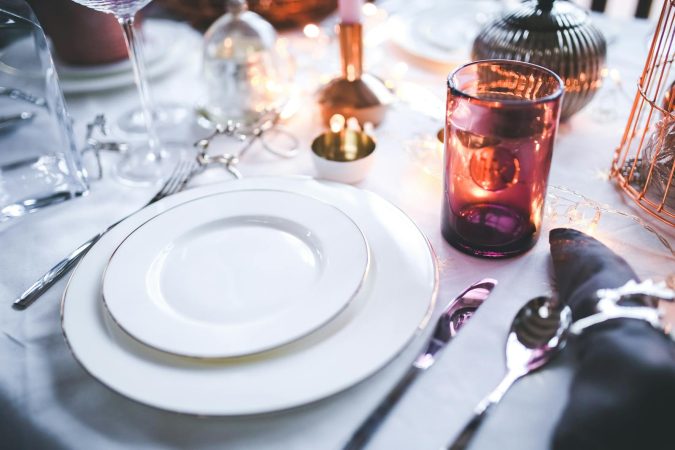
Cooking for yourself deserves the same care as cooking for guests—the plated meal, the lit candle, the undivided attention—because solitude is not a waiting room for your real life.
The single bowl sits in the center of a cleared counter, white ceramic, slightly chipped on the rim from a move three apartments ago. Roasted delicata squash, a tangle of soba, peanut sauce thinned with lime, scallions cut on the bias because that is how they look best. There is a candle. It is a Wednesday. Nobody is coming.
This is the part most people skip. The plating. The candle. The sitting down. When you cook for one, the cultural script tells you to eat standing at the counter, or in front of the laptop, or directly out of the pan because who are you performing for. The answer most people never consider: yourself.
The conventional wisdom treats solo dinner as a holding pattern. A thing you do until your real life — partnered, social, witnessed — resumes. Most people will admit, if pressed, that they cook better for guests than for themselves. They will use the good olive oil for a dinner party and the cheap stuff on a Tuesday. The framing is so embedded we barely notice it: my own company is a placeholder.
What gets lost in that framing is everything that actually happens at the table.
The apology baked into solo eating
There is a specific tone people use when they tell you they ate alone last night. It is sheepish. Slightly defensive. As if eating dinner without an audience were a small failure of social engineering. The apology is so reflexive most of us do not hear ourselves doing it.
Self-worth shapes the small behaviors of everyday life — how we show up, whether we show up, what we believe our presence is worth. The script that asks why bother showing up applies just as cleanly to showing up for yourself at your own dinner table.
If you cannot be bothered to plate your own food, you are telling yourself something. Not loudly. Not dramatically. Just a quiet, repeated message that your presence does not warrant the candle.
What the candle actually does
I cook elaborate things on weeknights. Thai curry that takes an hour. Lentil bolognese that reduces for forty minutes while I drift around the apartment doing nothing useful. My partner sometimes eats with me and sometimes does not — pepperoni pizza calls, what can you do. On the nights I eat alone, the cooking is the meditation and the eating is the reward. Skipping the second part to honor the first feels like abandoning a song halfway through the bridge.
The candle is not decoration. It is a signal — to the part of your brain that decides what counts as a real event — that this moment is one. Small repeated acts of attention have outsized psychological returns. A recent study covered by the National Catholic Register found that praying the rosary produced mental health benefits comparable to secular meditation practices. The mechanism is not theological. It is structural. Repetition plus intention plus a physical anchor equals a nervous system that knows the difference between background noise and a moment that matters.
Lighting a candle for your own dinner is the secular version of the same trick.
The hands know things
There is something about the act of preparing food for yourself with care that bypasses the verbal brain entirely. You are not affirming anything. You are not journaling about self-love. You are dicing shallots.
Work led by Girija Kaimal at Drexel University looked at heritage art practices — fiber arts, calligraphy, knot-tying, the kinds of slow handwork passed down across generations — and found that even brief sessions improved mood and reduced anxiety more than equivalent time spent on neutral tasks like jigsaw puzzles. The takeaway: the act of using our hands and eyes to create something is rewarding and calming on multiple levels, both physiological and emotional.
Cooking is not on their list, but it belongs there. The folding of dumplings, the kneading of dough, the slow stir of risotto — these are heritage practices in the most literal sense, handed down across kitchens and generations, and they do for the cook what the research describes. The fact that you might be doing it for an audience of one does not change the chemistry.
Who taught us to be embarrassed about this
The shame around solo dining is not natural. It is constructed, and it has beneficiaries. The restaurant industry has spent decades optimizing around the two-top and the four-top. Frozen dinner brands made entire fortunes off the implied premise that eating alone is a sad utility to be dispatched as efficiently as possible. The wedding-industrial complex sells coupledom as the destination state of adulthood; everything before it is rehearsal.
Once you notice the framing, you cannot unnotice it. The single-serving pint of ice cream as the visual shorthand for heartbreak. The woman eating salad alone in a stock photo, looking wistfully out a window. The whole genre of films where the protagonist's transformation is signaled by the appearance of someone across the table.
None of this is conspiracy. It is just what happens when industries that profit from togetherness write the cultural script about what togetherness is for.
Body, table, presence
Eating alone with care is also, quietly, an act of resistance against a different kind of script — the one that tells people, especially people in larger bodies, that their relationship with food should be transactional and apologetic. Writing for Psychology Today, researchers describe how internalized weight stigma teaches people to eat fast, eat hidden, eat without ceremony. The candle on the Wednesday table is, among other things, a refusal of that lesson.
The soft life movement has been making a related argument for a few years now, particularly in writing aimed at women who have been told their pleasure is a luxury rather than a baseline. A piece on self-care rituals recently put it plainly: self-care is not a reward for productivity. It is maintenance. The good plate is not earned. It is just the plate.
The friends who already figured this out
The people I know who eat well alone tend to share a few traits. They do not narrate their solo meals as deprivation. They have a small repertoire of dishes they actually love cooking for themselves. They sit down. They use real cutlery. They do not always do this — Tuesday is sometimes cereal at the counter, and that is also fine — but they have made the decision, somewhere along the line, that they are not waiting for permission to eat like a person.
It is the same muscle people exercise when they stop apologizing for a life whose central pleasures don't require witnesses. The garden. The morning walk. The barista who knows the order. The quiet contentment of being your own primary relationship. The candle on Wednesday is just a smaller, daily version of it.
Permission, mechanics, ritual
If you have been treating your own dinners as triage, the rebuild is mechanical, not philosophical. You do not need to feel different first. You just need to do the next thing.
Plate the food. Use the bowl you actually like, not the one closest to the dishwasher. Sit somewhere that is not your couch. Put the phone in another room — not to perform mindfulness, just because the food tastes better when you are tasting it. Light something. A candle, a stick of incense, the ugly tea light from the back of a drawer. The point is not aesthetics. The point is the small punctuation mark that tells your nervous system: this is the meal, this is when it happens, you are here.
You can also notice — gently, without making a project of it — what you are still apologizing for. The way you describe last night's dinner to a coworker. The slight defensiveness when someone asks what you did over the weekend. There is a related VegOut piece on the small tells of people who are genuinely happy alone — most of them come down to the absence of that defensive note.
The tenderness in the title
The word that keeps coming back is tenderness, because what is happening at that one-person table is not self-care in the wellness-influencer sense. It is not a treatment plan. It is not optimized. It is simply the willingness to be soft toward yourself in a way nobody is watching.
The broader research field is moving this direction too. A current research collection in Frontiers in Psychiatry is centered on what its editors call person-centered, recovery-oriented care — the basic premise being that self-determination and the dignity of the individual's own experience are not soft additions to mental health practice but the core of it. The clinical version of the same idea: you are the primary expert on your own life, and the things you do to care for yourself in private are not less important because no one credentialed is grading them.
The candle counts. The bowl counts. The Wednesday counts.
Somewhere out there tonight, someone is sitting down to a plate of food they cooked just for themselves, and they are not apologizing for any of it. They are not waiting for the real meal, the real life, the real version of the evening to begin. The real version is the one where they showed up.