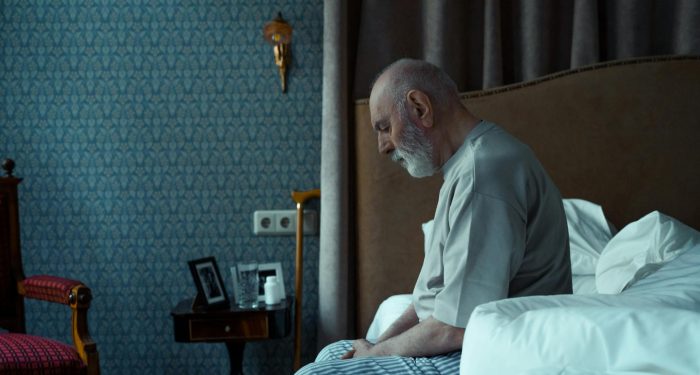


The man trailing his wife from the kitchen to the laundry room isn't smothering her — he's standing in the wreckage of an identity that ended the day his career did.
The boomer husband who follows his wife from room to room is not clingy. He is grieving. He just doesn't have the language for it, and neither does she, and neither does the daughter who calls her mother every Sunday and hears the same low-grade complaint: your father won't leave me alone.
The conventional read on this man is that he's needy, regressed, maybe a little pathetic — a grown adult who can't entertain himself for forty minutes while his wife folds towels. That read is wrong. What he's doing in those hallways is something far stranger and far sadder. He spent four decades inside a structure that gave him a reason to get dressed, people who knew his name, and a clear answer to the question what do you do. Then one Friday in his mid-sixties they threw him a sheet cake, and on Monday morning the structure was gone. The wife was still there. So he follows the wife.
Most people, including the wife, interpret this as a marital problem. It is not a marital problem. It is the visible edge of an identity collapse that nobody in his generation was prepared for, and the marriage is just where the collapse happens to be landing.
The job wasn't a job. It was a country.
For men of this cohort, work wasn't something you did between weekends. It was the architecture of selfhood. The commute, the coffee with Dave from accounting, the secretary who remembered your kids' names, the union meeting, the customer who always asked for you specifically, the project that took eighteen months and felt like building a cathedral — that was the texture of being someone. We spend forty years constructing a self strong enough to carry a career, then act surprised when it collapses the day the career ends.
The collapse isn't loud. It looks like a man making coffee at 9:15 in a quiet kitchen. It looks like him reading the paper twice. It looks like him standing in the doorway of the room where his wife is on the phone with her sister, not saying anything, just standing there, because the alternative is the silence of the den where nothing is happening and nothing will happen for the rest of the afternoon.
His wife, meanwhile, has spent those same forty years building something he didn't notice she was building. She has the friend from the book club. The neighbor she walks with on Tuesdays. The hairdresser who knows about her mother's dementia. The daughter she texts in fragments throughout the day. She has, in the language of the research, a portfolio of intimacies. He has one account, and she is it.
The asymmetry nobody warned them about
This is the part that breaks my heart a little. The hardest piece of retirement isn't boredom, it's the strange loss of purpose nobody prepares you for. And purpose, for a generation of men who were told their job was to provide, was almost entirely outsourced to the workplace. The workplace gave them tasks. It gave them feedback. It gave them, crucially, other men to talk to in a culture that taught them male friendship was supposed to happen incidentally, around shared activity, never around shared feeling.
When the workplace ends, the incidental dies with it. There is no shared activity now. There's a garage and a television and a wife who is, somehow, busier in retirement than she was when the kids lived at home. He cannot understand how she has so much to do. She cannot understand how he has so little.
Researchers who study retirement satisfaction have landed on a finding that should be tattooed on the inside of every pre-retirement planning binder: financial readiness predicts almost nothing about whether retirement goes well. Purpose and connection predict almost everything. The men who do well are the ones who arrive at sixty-five already embedded in something — a community, a craft, a circle of friends that exists independent of their title. The men who don't do well are the ones whose entire relational world ran through a key card.
Why he stands in the doorway
I want to be careful here, because the wives in this story are not villains and they are also exhausted. A woman who spent her own forty years carrying the emotional infrastructure of the family — remembering the birthdays, managing the in-laws, knowing which grandchild is allergic to what — does not necessarily have the bandwidth to also become her husband's sole social world at sixty-eight. She is allowed to want the bathroom to herself. She is allowed to take a phone call without an audience.
But the doorway behavior, the room-to-room following, isn't a power move and it isn't a regression. It's a man who has lost his coordinates and is using the only landmark he has left to figure out where he is. She is the landmark. When she moves, he moves, because if he stops moving he has to sit alone with the question of what he is now, and that question has no answer he can stand.
Successful adjustment in retirement depends heavily on whether the retiree has maintained relational and identity resources outside the workplace — and the asymmetry within heterosexual couples, where wives have typically tended a wider social fabric, creates a specific kind of dependency in the retired husband that neither partner anticipated.

The friendships he didn't keep
Ask a seventy-year-old man to name his five closest friends. Watch what happens. He'll name his wife. He'll name his brother, who he sees twice a year. He'll name a guy from work he hasn't called since the retirement party. He'll trail off.
This isn't a personal failure. It's a generational one. Boys born in the 1950s were often not given a vocabulary for friendship that did not involve doing something — fishing, fixing a carburetor, watching a game. The friendships were real, but they were scaffolded by activity, and when the activity stopped, so did the contact. Nobody taught these men how to call another man at eleven on a Tuesday morning just to talk. The phrase just to talk was, for a lot of them, faintly humiliating.
So the social network thinned across decades while nobody was watching. The Christmas card list got shorter. The funerals started outpacing the weddings. And somewhere in his early sixties, without ever having made a decision about it, he became a man whose entire emotional life was being held by one person. Experts on social networks in retirement note that the men who rebuild social connections successfully almost always do it through structured entry points — a class, a volunteer post, a regular table at a coffee shop — because the unstructured version, the just-call-someone version, was never installed in them in the first place.
What the wife is actually carrying
The cost of this falls heaviest on her, and it falls in a way that's almost impossible to name without sounding ungrateful. She is not being asked to do laundry. She is being asked to be a country. She is being asked to provide the entire civic infrastructure — the conversation, the meaning, the sense that today mattered — for two adults, when she only signed up to provide it for one.
This is the part that connects to the invisible labor she has been performing her whole adult life, except now there is no buffer. The kids are gone. The job is gone. The commute that gave her six hours a day of household sovereignty is gone. He is in the kitchen. He is in the hallway. He is, with the best intentions in the world, asking what she's doing, because he genuinely wants to know, because watching her do something is more interesting than the alternative.
And she loves him. That's the thing nobody captures in the eye-roll version of this story. She loves him and she is also being slowly drained by a need she didn't create and can't fix and isn't supposed to resent, and she resents it anyway, and then she feels guilty about the resentment, and the guilt makes her snap at him, and the snap confuses him, because all he did was come into the room.
The quiet thing he is realizing
Here is what I think is actually happening in the doorway, in those long afternoons, in the slow turn of his head when she picks up her keys to go meet a friend.
He is realizing, without language for it, that the structure he gave his life to did not love him back. The company replaced him within a quarter. The colleagues who were going to stay in touch did not stay in touch. The identity that felt so solid at fifty-five turned out to be rented, not owned, and the lease ran out the day they handed him the cake. What he has left, after forty years of building, is one person. And he is realizing, slowly and without saying it, that she is the whole thing. Not part of the thing. The thing.
That realization is not clinginess. It is closer to awe, and closer to terror, and closer to a grief he cannot name because the men he might have named it with are not on the other end of any phone. So he follows her into the laundry room. He stands in the doorway. He asks if she needs help folding, and she says no, because there are only so many towels, and he goes back to the den, and he sits down, and the house is very quiet, and he waits for her to come find him, because that is now the shape of his day.
If you are watching this happen to your father, or to your husband, or to yourself, the answer is not to push him away and it is not to absorb him completely. The answer, as much as there is one, is to help him rebuild a self that does not run entirely through one person — a class, a volunteer shift, a standing breakfast with another man who is also standing in a doorway somewhere, also waiting. It will feel, at first, like sending a child to kindergarten. That's because, in a way, you are. Nobody ever taught him how to be a person without a job. He's learning now, at sixty-eight, with whatever years he has left, and the tenderness of that should not be lost on anyone watching.
He is not clingy. He is just, finally, paying attention to who was actually there.