
In midlife, the rarest gift costs nothing: listening to someone's repeated story as if hearing it for the first time, without interrupting or revealing you've heard it before.
Your aunt is three sentences into the story of how she gave up dairy in 1998, and you already know the ending. You know the doctor's name. You know the punchline about the cheese drawer. You know she's going to mention the article she read in the waiting room. Your face is already doing something — that small, involuntary shift that says I've heard this. She catches it. The story gets shorter. By the time she reaches the part about the cheese drawer, she has compressed what used to be a five-minute story into ninety seconds, and the warmth has drained out of it.
That small contraction, repeated across a lifetime of family dinners, is one of the most expensive losses in modern relationships. And the most expensive thing a middle-aged person can give another middle-aged person costs nothing and weighs nothing and leaves no record of itself. It is the decision to sit through a story you have heard before, told by someone you love, and let them finish it as if it were new. Not interrupting. Not correcting the year, the name, the punchline. Not indicating you've heard it before. Just letting them have the telling.
The conventional framing of generosity in midlife usually involves money or time. Parents writing tuition checks. Adult children driving aging parents to appointments. Friends who show up with casseroles after a diagnosis. These count. They matter. But they are also the forms of giving that get social recognition, the ones that fit on a sympathy card or a thank-you note.
The harder kind, the one almost nobody applauds, is restraint. Specifically, the restraint of not proving you already know.
Why this small act is harder than it sounds
Anyone who has spent time with a parent, a long-married spouse, or a college roommate now in their fifties has watched the same scene play out. The story begins. You recognize the opening line within three seconds. Your face does something. You either jump in to finish it, or you correct a small detail, or you offer the polite sigh of someone who has been here before.
The instinct to do this is not malicious. It is, in some ways, a sign of intimacy. You know this person well enough to anticipate them. But the effect on the speaker is something else entirely. Their face shifts. The energy of the telling collapses. They were inside a memory, and you reminded them they were performing a rerun.
What looks like a tiny social correction is actually a small theft. The story belonged to them. You took the ending.
The developmental stage nobody warns you about
In the framework of generativity versus stagnation, midlife—roughly ages 40 to 65—marks a shift when the central psychological task moves from establishing oneself to guiding and supporting others. Generativity, in this understanding, is not just about raising children or mentoring at work. It is about a fundamental reorientation away from proving competence and toward making space for the competence of others.
This is harder than it sounds because the previous three decades trained people to do exactly the opposite. Career advancement rewards demonstrating expertise. Social hierarchies reward the quick correction, the well-timed reference, the proof that you were there first. Letting someone tell you a story you already know is a small reversal of everything adulthood selected for.
Small acts of giving without expectation of recognition can produce durable shifts in well-being, both for the giver and the receiver. The catch is that they have to be invisible. The moment generosity becomes a performance, the chemistry changes.
The Carl Rogers framework, applied at the dinner table
The concept of unconditional positive regard—the idea that real listening requires setting aside your own frame of reference long enough to fully receive someone else's experience—was developed for clinical work, but the principle scales down to ordinary life. Most of what passes for listening in adult conversation is not listening. It is waiting for an opening to contribute.
Letting someone tell a familiar story without correction is this principle in its most domestic form. It says: your version of this memory matters more than my version of accuracy. Your need to tell it again matters more than my need to demonstrate I remember.
This is not the same as agreeing with everything. It is not pretending. It is recognizing that the function of the story, in that moment, is not informational. The function is connection, identity, continuity. The teller is not delivering news. They are renewing something.
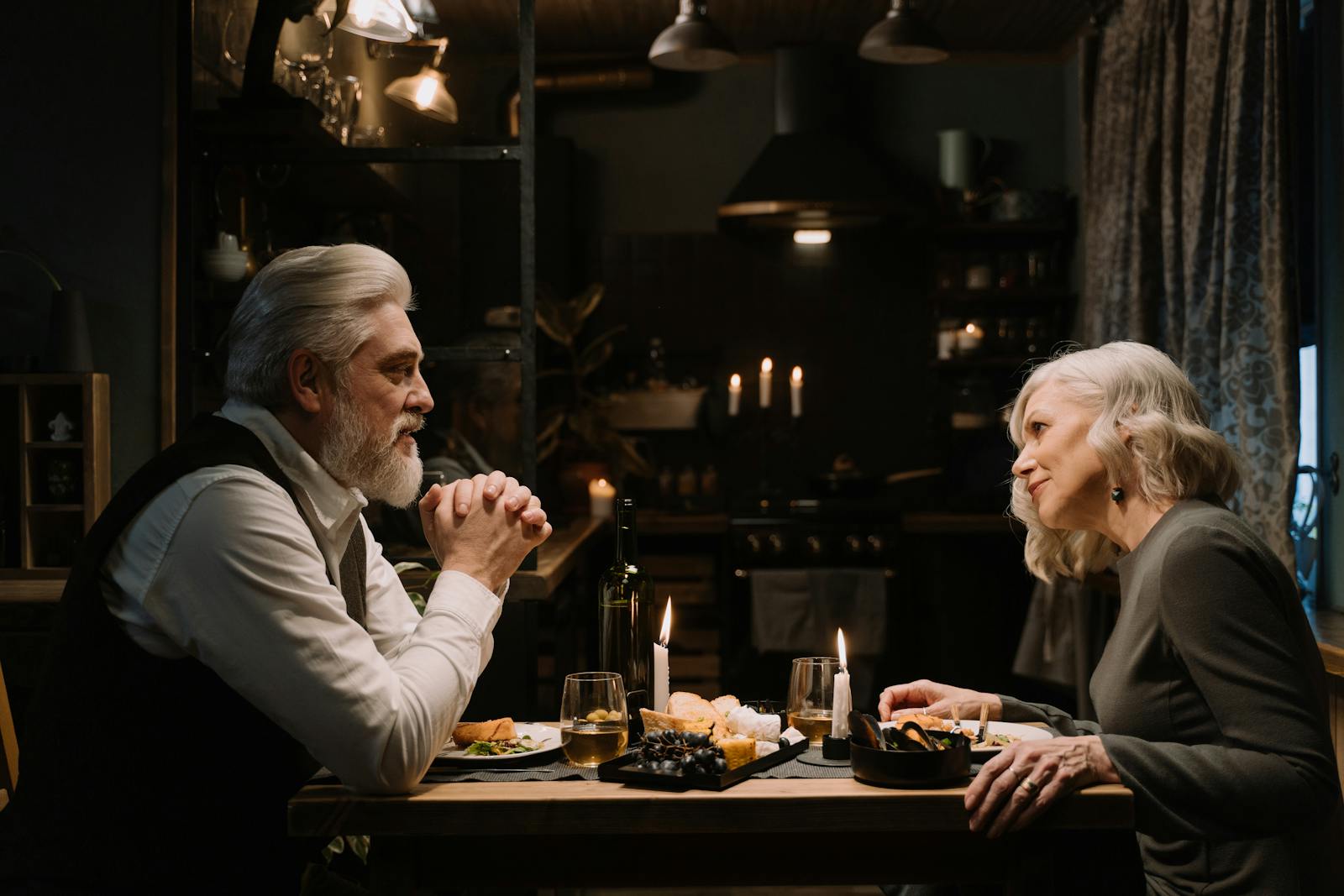
What gets threatened when you interrupt
Human beings maintain a coherent sense of self partly through the recognition they receive from others. Being permitted to share a story, uninterrupted, is a small but real form of social validation. Being corrected, finished for, or visibly tolerated is a small but real threat to that identity.
The stakes look low. They are not low. Multiply one interruption by a thirty-year marriage, a forty-year friendship, a lifetime of family dinners, and you arrive at people who have slowly stopped telling stories at all because the cost of telling them has become higher than the reward.
This is part of how long-married couples end up in the strange silence that observers mistake for contentment. Not because they have nothing to say. Because they have been trained, by thousands of small corrections, that there is no point in saying it.
The narrative psychology piece, and the kitchen
Humans organize their memories, identities, and aspirations into story patterns. We are, in a literal sense, made of the stories we are allowed to tell about ourselves. When someone tells a familiar story, they are not boring you. They are reinforcing a load-bearing wall in their own identity.
This is why food storytelling carries such an unusually heavy load. The story about the time your mother first made the lentil stew the way her mother made it. The story about going vegetarian after the trip to the slaughterhouse in 1991. The story about the first Thanksgiving you skipped the turkey, and what your father said. These narratives function as anchors. Each retelling reinforces who the person has decided they are — and, in the case of dietary choices, often re-justifies a decision that the rest of the family has spent decades quietly questioning.
Plant-based eaters know this dynamic from both sides of the table. The "how I went vegan" story gets told and retold, partly because it is identity-forming and partly because the people listening keep needing to be reminded why. Interrupt the retelling — finish it, correct the year, point out you've heard it — and you do not just inconvenience the speaker. You destabilize, in a small way, the architecture of their selfhood. You also signal that the choice they made, and the story that holds it together, has worn out its welcome at this table.
Why midlife specifically
The reason this generosity becomes especially valuable in midlife is that the people in your life have entered the decade where retelling becomes more important than telling for the first time. New stories slow down. The job has been the job for fifteen years. The marriage has been the marriage. The kids are who they are.
What people in their fifties and sixties are doing, when they tell you the story again, is not running out of material. They are checking that the material still belongs to them. They are confirming that the people who heard it the first time still recognize them as the person who lived it.
This is also why the rarest gift gets rarer with age. The younger you are when someone tells you a familiar story, the easier it is to listen. You have less competing narrative of your own. By midlife, you have your own thirty years of stories pressing against the inside of your throat, demanding to be told. Letting someone else's story go uninterrupted means actively suppressing the urge to tell yours.

The empathy distinction worth making
There is a version of this advice that goes wrong, which is the version where you nod along while quietly checking out. That is not generosity. That is performance. Effective listening distinguishes between cognitive engagement and emotional flooding, and the kind of listening this article is describing is cognitive. It is effortful. It is the active choice to stay present in a conversation whose surface content you have already absorbed.
The reason this is hard is the same reason it is generous. It costs something. Real listening to a familiar story requires noticing what is different this time, the small variations in emphasis, the new emotional weight on a line that used to be a throwaway. The story may be old. The telling never quite is.
This is the kind of attentiveness that makes the people around someone feel taller in the room, less rushed in the conversation. It is rare not because it is complicated but because it is unrewarded.
The recipe is never just the recipe
Spend any time around a family kitchen and you will notice that recipes almost never travel alone. The grandmother who hands down the dal recipe also hands down the story about how she learned it, and the next time she makes the dal, she will tell the story again. The aunt who explains, for the fourth time, why she stopped eating meat is not lecturing. She is rehearsing the moment that made her who she is.
Plant-based households tend to accumulate more of these story-recipes than most, because the food itself is so often the result of a conscious break — with how a person was raised, with what their family expected, with what their younger self would have ordered. Every dish carries a small origin story. And every origin story, by midlife, has been told enough times that the listeners have started flinching.
The generosity is in not flinching. The generosity is in asking your mother how she got the texture right on the cashew cream, even though you have heard the answer, because the answer is the point. She is not transferring information. She is transferring herself. The recipe is the vehicle. The telling is the cargo.
What this looks like in practice
The mechanics are unglamorous. When you recognize the opening of a familiar story, you let it open. When the teller pauses, you do not fill the pause with the next line. When they get a detail wrong that does not matter, you let the detail stay wrong. When they pause to wonder if they've already shared this story, you encourage them to continue.
That last one is the hardest. You encourage them to share it again is not a lie. It is a true statement about what you actually want, which is to hear them tell it. Whether the information is new is beside the point.
This is also one of the few antidotes to the kind of slow loneliness that builds up in long relationships, the kind where people slowly stop sharing what they actually think because the response stopped feeling like reception. Reception is the technical word for what is missing in most adult conversation. Reception is what inviting them to retell it restores.
The part that has nothing to do with the listener
The reason this gift matters more in midlife than in any other stage is that the teller, on some level, knows. They know they have told you this story before. They are watching your face for the flicker of recognition, the small contraction that says here we go again. They are betting that you will let them tell it anyway.
Most of the time, they lose the bet. Most of the time, the flicker happens. The story gets shorter each time it is told because the teller has learned to compress it before the listener can edit it down.
The rarest kind of generosity is being the person who does not flicker. Not because you are pretending. Because you have decided, somewhere along the way, that the people you love are allowed to tell you the same story — about the cheese drawer, about the lentil stew, about the day they finally stopped eating meat — for the rest of your life, and you are going to listen every single time as if you are hearing the shape of who they are, which, in the end, is what you are actually hearing.
That is the gift. It does not cost money. It does not take much time. And almost nobody, by midlife, has figured out how to give it.