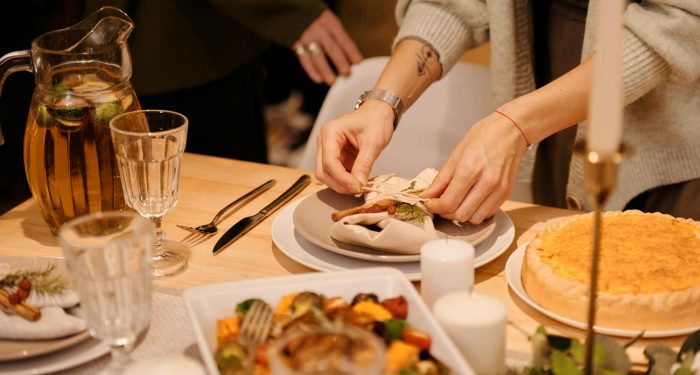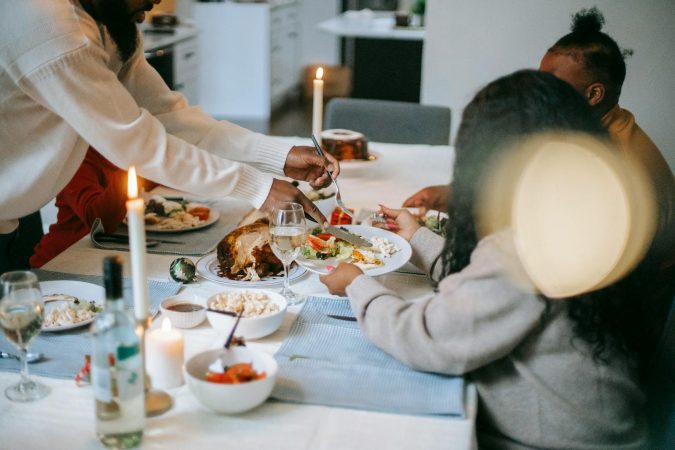
A nervous system trained to monitor others before attending to its own needs doesn't relax at the dinner table—it scans. This learned hypervigilance disguises itself as politeness.
The person who can't pick up their fork until everyone else has theirs isn't displaying good manners. They're running a scan.
Most of us were taught that waiting for the host, or the eldest, or the last plate to land is just etiquette. Polite, considerate, the mark of someone who was raised right. And sure, sometimes that's all it is. But there's a specific version of this behavior that doesn't loosen up at casual dinners, doesn't relax when the host encourages them to start eating before the food gets cold, and doesn't ease off even when everyone at the table is a peer. That version isn't politeness. It's a nervous system that learned to eat second.
If you've ever watched someone push food around their plate while glancing at every other diner, waiting for some invisible signal that it's okay to begin, you've seen it. They aren't performing. They genuinely cannot access pleasure in the meal until the room registers as safe.
The difference between manners and surveillance
Manners are conscious. You can drop them when the context shifts. You can be the person who waits for grandma at Thanksgiving and the person who tears into a slice of pizza standing over the kitchen sink, both in the same week, without internal conflict.
What we're talking about is different. It's pre-conscious. The food cools, the stomach growls, and still some part of the brain is taking attendance: is everyone served, is anyone unhappy, did the person on my left get the dressing they asked for, is the host visibly relaxed yet. Only when the answers come back yes does the body grant permission to enjoy.
This is closer to what family systems therapists have been describing for decades when they talk about parentification—children pulled into adult emotional roles before they had the equipment to handle them. The kid becomes the regulator, the peacekeeper, the one who notices the room.
Why the dinner table specifically
The table is where this pattern lives because the table was where it was rehearsed. Meals are where families perform their dynamics most reliably. Someone serves. Someone is served. Someone monitors whether everyone got enough. Someone notices the silences.
In homes where a parent was overwhelmed, depressed, recently divorced, or simply not coping well, that monitoring job often fell to a child. Research on emotional parentification after divorce describes how parents lean on children for emotional support before they are developmentally ready to provide it. The child becomes a kind of household barometer, scanning for trouble before it lands.
That scan doesn't switch off in adulthood just because the original household no longer exists. It runs every time a meal begins.
The Bowlby piece
Attachment theory gave us the framework for understanding why early caregiving relationships shape adult behavior so durably. When a child experiences inconsistent or unpredictable caregiving, they develop what researchers call hypervigilance — a finely tuned awareness of the caregiver's emotional state, because the child's own safety depends on reading it correctly.
Research covered by Scientific American reinforced what attachment researchers have argued for years: early relationships with parents continue to shape how we relate to the people closest to us in adulthood. The mechanism is straightforward. A nervous system that learned, very young, that its own comfort had to wait for the room to feel okay doesn't unlearn that just because the room changes.
Research on attachment styles in marriage points to how anxious attachment shows up in adult partnerships as a near-constant attunement to the other person's emotional state. The fork-paused-mid-air thing is a small, almost invisible version of the same pattern.
Childhood emotional neglect and the pleasure delay
The term Childhood Emotional Neglect describes a more subtle version of this story. Not abuse, not even necessarily inconsistency — just the steady experience of growing up in a home where your emotional needs weren't really registered. The kid in that house learns, without anyone ever saying it, that their feelings are background noise.
This framework explains why the adult version isn't just "polite." A polite person waits because waiting is the rule. A person shaped by emotional neglect waits because they don't quite believe their own pleasure counts until someone else's has been verified. The hunger is real. The food is right there. But the internal permission slip hasn't been signed.
Understanding how childhood neglect surfaces in adult relationships describes this as the trauma of what didn't happen. There's no story to tell, no incident to point to. Just a slow, accumulated lesson that other people's needs were the foreground and yours were the wallpaper.
The kindness problem
Here's the part that surprises people most. The same wiring that makes someone unable to start eating until the table is settled also makes them weirdly bad at receiving care. Adults who were parentified as children struggle to receive kindness without immediately scanning for the cost.
If you've ever served dinner to a friend who couldn't quite let themselves enjoy the meal you made — who kept jumping up to refill water, kept asking if you needed anything, kept deflecting compliments on the food back toward you — you've watched this in real time. The pleasure of being served is, for them, slightly intolerable. It puts them on the wrong side of the equation.
This is the same pattern people describe when they talk about being raised to be polite above everything else — the difficulty isn't really politeness, it's the inability to take up space without first justifying it.
What it looks like in adulthood
The fork-down-until-everyone's-served thing is just the visible tip. The same pattern shows up everywhere meals happen.
It's the person who can't sit down at their own birthday dinner until they've made sure everyone else has a drink. It's the host who eats standing up in the kitchen, halfway through the second course, because they've been refilling, replating, and checking on guests so consistently that their own plate went cold an hour ago. It's the partner who waits until everyone has commented on the food before forming their own opinion of it.
It's also the person who can't quite enjoy a restaurant meal if someone at the table is visibly unhappy with theirs. The unhappiness lands in their body. The pleasure of their own dish becomes inaccessible. The dinner has been hijacked by an old, automatic loyalty to someone else's comfort.
This isn't pathology, it's just unfinished work
I want to be careful here, because the language of trauma has gotten bloated in the last decade. Not every careful, considerate eater is wounded. Some people just like waiting for the table to be set. Some cultures explicitly require it, and reading that as damage would be its own kind of arrogance.
Therapeutic vocabulary can both help and distort our understanding of family dynamics. Behaviors once considered ordinary now get pathologized. Not every adult struggle is the direct result of parenting — genetics, temperament, peer relationships, and plain bad luck all matter too.
So the question isn't whether this indicates something is wrong with the person. The question is whether the pattern is costing them something. If you genuinely enjoy waiting, if the small ritual of serving others before yourself is part of the pleasure, that's a real thing and it doesn't need fixing. If, on the other hand, you can't actually relax at meals, can't taste your own food until the room is calm, can't enjoy a birthday dinner thrown in your honor — that's the part worth looking at.
The grandmother memory
I think about this whenever I think about my grandmother's Thanksgiving table years ago, the year I'd recently changed how I ate and refused most of what she'd cooked. She cried. I remember being so locked into my own certainty that I couldn't really feel her. It took me a long time to understand that the meal wasn't about the food. It was about whether she'd done her job, whether the people at her table were okay, whether she could finally sit down.
She was, I now realize, doing the adult version of the kid scan. Counting plates. Reading faces. Looking for permission to relax. And I, in my righteousness, had refused to give it.
The table is rarely just the table. It's the place where every family rehearses what it means to be cared for and to care, and most of us are still running scripts written for us before we could talk.
What changes when you notice it
Awareness alone doesn't dissolve a forty-year-old pattern. But it interrupts it. Once you can see that the fork pausing in the air is doing a job — checking the room, confirming safety, granting permission — you can start asking whether the job is still necessary.
Sometimes the answer is no. The dinner is with friends who love you, the food is good, nobody is going to fall apart if you take the first bite. Sometimes you might recognize that you genuinely prefer to eat this way, and that's allowed too.
The point isn't to become someone who shovels food in before everyone is seated. It's to notice the difference between a chosen pause and an automatic one. Between waiting because you want to and waiting because some part of you still believes your hunger is contingent on the room.
Most of the people I know who eat this way are, not coincidentally, also the people who hosted everyone else's birthdays, who remembered everyone's allergies, who built dinner parties around making other people feel held. The world needs them. They're often the warmest, most attentive people at the table.
I just want them to taste their own food while it's hot.