A woman spent her thirties chasing the approval of her younger self, only to discover the younger version wanted something far simpler: freedom from fear instead of the pressure to impress.
This spring, walking home from a coffee shop I'd been going to every morning for a week, I noticed I had stopped scanning. Not for danger, exactly. For approval. For the next conversational landmine. For whatever I was supposed to be bracing against. I was thirty-three years old and I was just walking, and the ordinariness of it was so foreign that I had to stop on the corner of my own street to register it.
That was when I understood what the photograph on my desk had been trying to tell me for a decade.
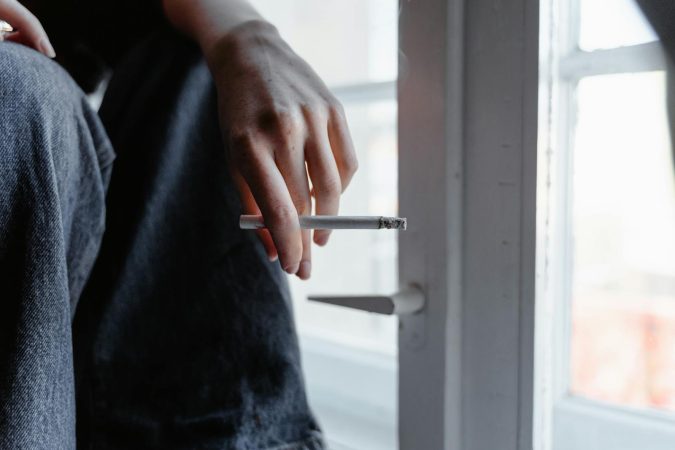
It's a picture of myself at twenty-two, standing on a rooftop in Tokyo, wearing a coat she couldn't really afford, holding a cigarette she didn't actually smoke because someone had handed it to her and she didn't want to seem ungrateful. That detail is the whole story. I have spent the better part of a decade trying to become someone she would respect, and it took me until that morning on the corner to understand that she wasn't waiting for me to become impressive. She was waiting for me to stop being afraid of everyone in the room.
The conventional wisdom about your thirties is that you're supposed to come into yourself. The phrasing is almost always passive, as though selfhood is a package that arrives once you've paid enough into the system. Career capital, relationships, the apartment with actual furniture. I bought into that framing for most of the last ten years, which is to say I confused accumulation with arrival.
What I'm realising now is that the project was never about becoming someone. It was about subtracting the parts of me that were performing for an audience that had long since left the room.
The audit nobody warns you about
Somewhere around thirty-two, the performance starts costing more than it returns. You notice it first in small ways. A dinner where you laugh at a joke you don't find funny. A work email signed with warmth you don't feel. Small inauthenticities that, taken individually, seem like the price of being a functional adult.
Then one day the bill comes due.
Psychological well-being depends on something more granular than purpose or achievement. It depends on the subjective valuation of your day-to-day experiences, and on whether the small moments feel like they belong to you. When too many of them are spent managing other people's perception of you, the deficit shows up as a low-grade exhaustion that no amount of sleep fixes.
This is what my younger self could see clearly, and what I lost the ability to see somewhere along the way. She wasn't impressed by the performance. She was suspicious of it.
What fear actually looks like in your thirties
Fear in your twenties is loud. It announces itself as panic before a job interview, as the specific dread of an unread message from someone you're sleeping with, as the sweat of being twenty pounds underqualified for the room you talked your way into.
Fear in your thirties is quieter. It looks like competence.
It looks like saying yes to a project you don't want because turning it down feels indulgent. It looks like not asking for the raise because you've already mentally argued your way out of deserving it. It looks like staying friends with someone whose company drains you because the friendship has tenure and tenure feels like proof of something.
The most insidious version, for me, was geographic. I've moved a lot. Tokyo in my early twenties, Lisbon in my late twenties, Los Angeles since. From the outside it looked like adventure. Some of it was. But a lot of it was just a more sophisticated way of leaving the room when the conversation got hard. I'd like to say I can tell the difference now, but I mostly can't, and I've stopped pretending the question has a clean answer.
The cost of becoming someone
The project of self-improvement, as it gets sold to people in their thirties, is essentially a project of replacement. You replace the disorganised version of yourself with a more disciplined one. The anxious one gets swapped for the regulated one. The broke one for the financially literate one.
What nobody mentions is that this framing assumes the original was the problem.
I've written before about how discipline is often misdiagnosed exhaustion, and the same logic applies to the larger project of self-becoming. We assume we are insufficient and need to be expanded. The truth, more often, is that we are over-extended and need to be edited.
The girl in the photograph wasn't underdeveloped. She was undefended. She had not yet learned to flinch in advance of disappointment, to soften her opinions before voicing them, to apologise pre-emptively for taking up space she was already entitled to.
What the research keeps pointing toward
There's a psychological concept called mattering, which is roughly the sense that one's existence is significant to oneself and to others. It turns out this isn't built through achievement. It's built through being witnessed, including by yourself, in moments that don't require justification.
The fear that defined most of my thirties was, at root, a fear that I didn't matter unless I was producing evidence that I mattered. Articles published. Cities lived in. Friends maintained across time zones. The evidence was real. The premise was the problem.
Reading about attachment style and adult well-being, I've come to think a lot of what we call ambition in our twenties and thirties is just compensatory behaviour with better branding. We work hard not because the work itself feels meaningful but because stillness feels dangerous. The achievement is real. The motor underneath it is fear.
People will tell you both forms of drive look identical from the outside, and they do. But they don't feel identical from the inside, and at some point the distinction matters. For those of us who learned early to read the weather of a room, the line between drive and dread is hard to locate, and pretending otherwise is part of how we keep paying the bill.
The friction of slow understanding
One of the more interesting things I've read this year is a piece about AI and the temporal nature of human cognition, which argued that meaning is built across time, through revision and lived continuity, in a way that machines fundamentally cannot replicate. The phrase that stayed with me was that wisdom requires the friction of time.
I think that's what my thirties have actually been for. Not arrival. Friction.
The version of me at twenty-two could see things clearly because she hadn't yet had time to convince herself otherwise. The version of me at thirty-three is starting to see things clearly again, but for the opposite reason. I've had enough time now to notice which fears were prophetic and which were just inheritance.
Growing up between two countries — Sweden with my mother, Australia with my father after they separated when I was eight — taught me to read context before I trusted it. That's a useful skill, and it's the engine of the work I do now. But attention can curdle into vigilance. The work of my thirties has been figuring out which moments call for the skill and which moments are just an old habit running on autopilot.
What stops being negotiable
There's a phase, sometime in your early thirties, when you start to notice which of your preferences have hardened into non-negotiables. Not in a self-righteous way. Just in the sense that you've stopped apologising for wanting what you want.
For me it was small things first. I want to live somewhere I can walk. I want to write about cities the way they actually feel, not the way the tourism board would prefer. I want a kitchen with light in it. I don't want to spend another summer pretending I'm available to people who only call when they need something.
The bigger ones came slower. I want to be in the company of people who don't require me to perform competence. I want to stop apologising for taking the long route, geographically and otherwise. I want to be allowed to be wrong without it becoming an identity crisis.
None of this is an achievement. It's the absence of an apology that used to live there.
What the photograph actually shows
I look at her sometimes, the version on the rooftop in Tokyo, and I try to imagine what advice she would give me if she could. For a long time I assumed she would want me to be braver in some grand sense. To take bigger risks. To write the difficult book.
I think now she would want something much smaller. She would want me to stop calculating before I spoke. She would want me to leave the dinner when I was tired. She would want me to spend less of my energy managing the comfort of people who weren't extending the same courtesy back.
She would, more than anything, want me to stop bracing.
Bracing is the posture of fear in adulthood. It's the way you tense your shoulders before opening an email. It's the way you rehearse a difficult conversation seventeen times before having it. It's the way you treat your own life as a thing you have to keep getting away with rather than a thing you are entitled to live.
What this year has actually taught me
The morning I stopped scanning was the most ordinary feeling in the world. It was also the most foreign one I'd had in a decade. I want to report that it has stayed, but it hasn't, not consistently. Some days I am the woman walking home from the coffee shop. Some days I am still the sentry.
Reading about shared activities and well-being, I find the underlying claim believable enough: anxiety eases when you stop performing your existence and start inhabiting it. Whether I have actually learned to do that, or have just gotten better at narrating the moments when I do, is a question I can't answer honestly yet.
Here's what I'm less sure about than I used to be. I don't know if the girl on the rooftop was actually wiser, or if she just hadn't been hurt enough yet to know what the vigilance was protecting. I don't know if becoming a sentry was a mistake or a necessary apprenticeship. I suspect she would look at the woman I've become and find her cautious in ways she would not have chosen, and I suspect she would also be wrong about some of what she saw.
The photograph stays on my desk. Some days it feels like a homecoming. Other days it feels like a reproach. I haven't decided yet which version is telling the truth, and I'm beginning to think the not-deciding is the most honest thing I've done this year.