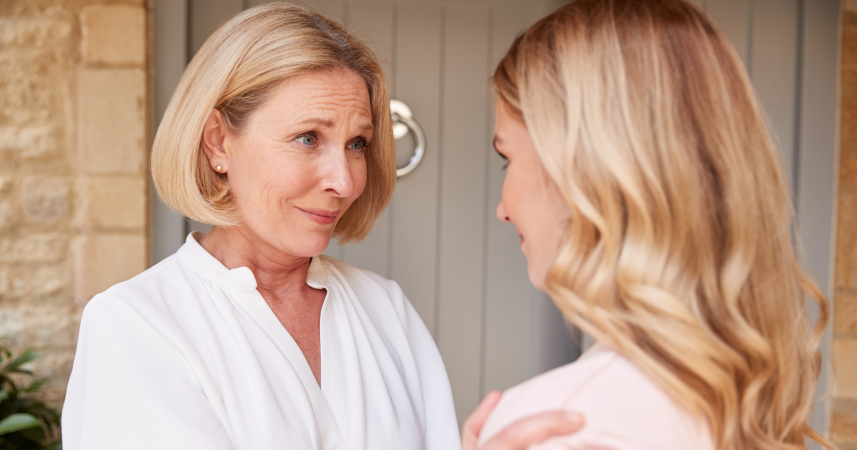
At seventy, when her daughter's simple birthday question left her speechless for three days, she discovered the heartbreaking truth: decades of putting everyone else first had made her forget how to want anything at all.
"Mom? You still there?"
I was. I was standing in the kitchen with the phone pressed to my ear, watching a square of late afternoon sun crawl across the counter, and my daughter was waiting for me to answer a perfectly ordinary question. What did I want for my birthday. That was all she'd asked. And I had been quiet long enough that she thought the call had dropped.
"I'm here," I said. "Can I think about it and call you back?"
She laughed, the easy laugh of someone who assumed I was being modest, or saving her the trouble of guessing. "Sure, Mom. Take your time." We hung up, and I stood there with the phone still in my hand. Three days went by before I called her back. Three whole days. I walked around my house, made lists in my head, stared at catalogs that came in the mail. Nothing. Not because I have everything I need, though that's what I've trained myself to say. The truth is far more unsettling: I've forgotten how to want things. Somewhere along the way, I let that muscle atrophy until even the simple act of desiring something for myself feels foreign, almost dangerous.
The slow disappearance of desire
You don't notice it happening, this gradual erosion of wanting. It starts small, practical. You skip the nice shampoo for the store brand because the kids need school supplies. You pass on the comfortable shoes because the car needs new tires. You learn to find satisfaction in their joy, to feed yourself on their fullness. You tell yourself this is what good mothers do. You say "I don't need anything" so many times it becomes your truth, and then it becomes your personality, and then it becomes the only honest answer you know how to give. I trace it back decades now, to those early years of single motherhood when wanting anything beyond survival felt like betrayal. My children needed so much, and there I was, one paycheck standing between us and disaster. By the time the danger had passed, the habit had set like concrete.
But even after I remarried, after financial stability wasn't a question anymore, the pattern held. My husband would ask what I wanted for Christmas, for birthdays, for anniversaries. "Surprise me," I'd say, or "Just a card is fine." He'd bring home flowers and I'd say they were too expensive. He'd suggest a weekend away and I'd list all the reasons we should save the money instead.
What is it about women of my generation that makes us so accomplished at self-denial? We perfected the art of invisible wanting, of swallowing desires before they could fully form. We called it being reasonable. Being grateful. Being good.
Examining the roots of "I don't need anything"
Last week, I found myself flipping through old photo albums, searching for evidence of when this started. There's a picture of me in my thirties, holding up a handmade birthday card from my kids, smiling. But if you look closely, really look, you can see the exhaustion behind my eyes. That was the year I wanted desperately to take a watercolor class on Saturday mornings. Instead, I spent those Saturdays at soccer games and piano recitals, telling myself there would be time later.
Later came and went. The watercolor class became a "someday" that never arrived.
Virginia Woolf wrote about needing a room of one's own, but what about the permission to want that room in the first place? How many of us can't even articulate that desire because we've spent so long convincing ourselves we're fine without it?
My friend called yesterday, excited about a leather jacket she'd bought herself. "I don't need it," she said quickly, as if I were the wanting police. "But I just loved it." The apology in her voice was so familiar it made my chest ache. When did we learn to apologize for joy? When did pleasure become something that required justification?
The fear behind the silence
If I'm honest, and at 70 I'm trying to be more honest, there's fear wrapped up in this forgetting how to want. Fear that if I start wanting things, really wanting them, I'll seem frivolous. Selfish. Like I don't understand that I have more years behind me than ahead, that I should be focused on meaning, not materials.
But there's a deeper fear too. If I let myself want that writing workshop in Vermont, that stack of hardcover books, that cashmere sweater in the window, then I have to acknowledge all the years I said no to myself unnecessarily. All the small pleasures I labeled as excess when they were really just life.
Do you know what haunts me most? The things I said no to when my husband was still alive. The dance lessons he suggested we take together. The bed and breakfast he found in the mountains. "Maybe next year," I said. Always next year. Now there are no more years with him, and I'm left holding all those unopened possibilities like stones in my pocket.
Learning to want again at 70
Something shifted when I couldn't answer my daughter's question. The silence where my desires should have been felt suddenly unbearable.
Like discovering you've been holding your breath for decades.
So I started small. I bought the expensive coffee, the kind that costs three times what my usual brand does. I sat with that first cup and actually tasted it, let myself enjoy the indulgence without the accompanying guilt. The world didn't end. My character wasn't corrupted. I just had a really good cup of coffee.
Then I bought a novel in hardcover instead of waiting for the paperback. I signed up for the meditation class that meets on Thursday mornings, the one I'd been walking past for two years. I made a dinner reservation for one at the Italian place I'd been curious about, and I ordered the appetizer and the dessert.
Each want I acknowledged felt like a small rebellion against years of self-imposed austerity. Each "yes" to myself felt like recovering a piece of who I was before I learned to disappear my own desires.
The gift of wanting
When I finally called my daughter back, I had a list. A real list. The silk scarf I'd admired downtown. A subscription to the literary magazine I'd been reading at the library. A weekend at the coast by myself, just to write and walk and think.
"Mom," she said, and I could hear the smile in her voice, "you sound different."
I am different. Or I'm trying to be. At 70, I'm learning that wanting things doesn't make me greedy or unconscious of my mortality. It makes me alive. Present. Still engaged with this world and all its small beauties.
Final thoughts
My birthday is next week. The list is on the refrigerator, held up by a magnet shaped like a lemon. I look at it sometimes and feel something close to excitement, and other times I feel something I don't have a word for yet — a kind of self-consciousness, maybe, or grief for the woman who could have been writing these lists for forty years and wasn't. I don't know yet whether this new wanting will feel like joy or just like noticing. Maybe those aren't as different as I once thought. The muscle is moving again, stiffly, the way any part of you moves after a long sleep. Whether it remembers how to work, or only how to ache, I suppose I'll find out next Tuesday, when she asks me to open the first gift.