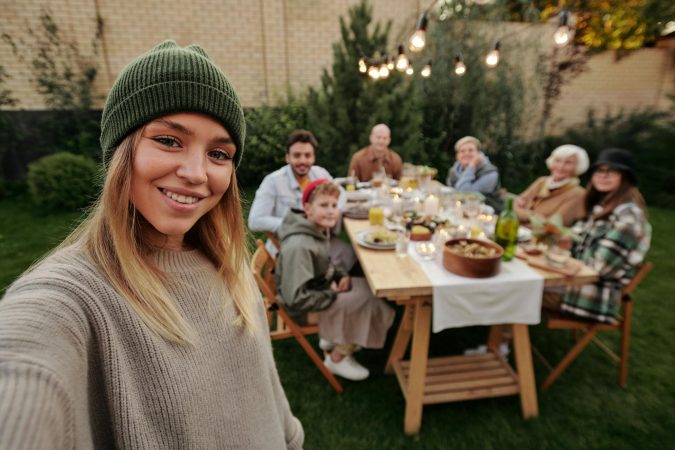
When your aunt suddenly becomes a nutrition expert at Thanksgiving dinner, wielding protein statistics like weapons against your plant-based plate, she's not protecting your health—she's protecting herself from questions she doesn't want to ask.
The fork hovered halfway between my plate and my mouth when my aunt leaned across the table and asked, in the careful tone usually reserved for intervention speeches, where I was getting my protein from. My lentil curry sat there, steaming, apparently suspicious. Three people stopped chewing to hear my answer.
What followed was a familiar cascade. My mother mentioned an article she'd read about B12. My father brought up his old college roommate who "tried that vegetarian thing" and got sick. Somebody's cousin apparently knew someone whose friend became anemic on a plant-based diet. Within four minutes, my dinner plate had become the subject of a medical panel convened entirely without my consent.
Here's what I've learned after years of navigating these conversations: When your family's first response to a major life choice is to throw scientific-sounding objections at you, they're not actually worried about your amino acid intake. They're experiencing discomfort they can't quite name, reaching for rational-sounding arguments to avoid examining why your decision bothers them so much.
When concern becomes control
I made the switch to veganism at 35 after reading about factory farming. Once I understood what really happened behind those sanitized supermarket packages, I couldn't unsee it. The decision felt clear, even inevitable. But my family's reaction? You'd think I'd joined a cult.
The protein question came first, naturally. Then calcium. Iron. B12. Suddenly everyone had a cousin who knew someone whose friend became anemic on a plant-based diet. My mother, who hadn't cracked a nutrition textbook since high school health class, started forwarding me studies about essential fatty acids.
What struck me wasn't their concern itself, but its intensity. These were the same people who never batted an eye when I lived on coffee and takeout during my finance days. Nobody interrogated my nutritional choices when I was stress-eating my way through quarterly reports. But vegetables? That required an intervention.
The pattern is worth naming: people become experts on topics they've never shown interest in precisely when your choice threatens something they haven't put into words.
The real conversation nobody wants to have
Psychologist Carl Jung once wrote, "Everything that irritates us about others can lead us to an understanding of ourselves." When our choices trigger strong reactions in others, we're often bumping up against their unexamined beliefs, their identity, their sense of how things "should" be.
Think about what your dietary choice might represent to your family. Maybe it challenges traditions. Sunday roasts. Holiday turkeys. The recipes passed down through generations. When you say no to meat, are you also saying no to these shared experiences? To them, maybe it feels that way.
Or perhaps it touches on deeper anxieties. If you're making ethical choices about food, does that mean they should be too? Your decision might hold up a mirror they'd rather not look into. It's easier to question your protein intake than to question their own choices.
And that, honestly, is what's happening most of the time. The concern isn't misplaced love — it's self-protection wearing love's clothing. I remember sitting at a family dinner, my plate different from everyone else's, when my uncle launched into a defensive monologue about how humans evolved to eat meat. Nobody had asked him about it. Nobody had criticized his choices. But there he was, justifying himself to someone who was just trying to eat their lentil curry in peace.
Understanding the language of love and fear
My mother still introduces me as "my daughter who worked in finance" rather than "my daughter the writer," even though I left that world years ago. At first, this drove me crazy. Didn't she see who I'd become? Didn't she respect my new path?
Then I realized something. My parents express love through concern about financial security. When they question my choices, whether about career or diet or anything else, they're speaking their language of care. The protein question? That's "I love you and I'm scared you'll get hurt" translated into nutritional concern.
Understanding this doesn't mean you have to accept every critique or engage with every argument. But recognizing the emotion beneath the science-speak can help you respond with compassion rather than defensiveness.
Sometimes I gently redirect: "I appreciate that you care about my health. I'm working with my doctor and feeling great." Other times, I share what I've learned about plant-based nutrition, not to convince them, but to show I've thought this through. And sometimes, honestly, I just change the subject.
Setting boundaries without building walls
Here's what nobody tells you about making choices that challenge the status quo: You don't owe anyone a detailed defense of your decisions. You don't have to become a walking encyclopedia of plant-based nutrition facts. You don't have to convert anyone or justify yourself at every meal.
What helped me was developing what I call "bridge responses." These acknowledge the other person's concern without getting dragged into debates. "I've done my research and I'm monitoring my health" works better than citing twenty studies they won't read anyway. "This feels right for me right now" is harder to argue with than a moral stance that might make them feel judged. I've also learned to recognize when someone genuinely wants to understand versus when they're looking for a fight. Curiosity sounds like: "What made you decide to make this change?" Resistance sounds like: "I could never give up bacon." One deserves a thoughtful response. The other deserves a shrug and a subject change. Most people, if you're being honest about it, fall into the second category — and that's useful information, not a tragedy.
The growth that comes from standing firm
Years ago, I had to confront my parents' disappointment and realize I couldn't live for their approval. Whether it was leaving finance, becoming vegan, or choosing to write about psychology rather than pursue something more "stable," each decision that diverged from their expectations forced me to strengthen my own sense of self.
And here's what surprised me: The more comfortable I became with my choices, the less I needed others to validate them. The protein questions stopped bothering me. The concerned looks at restaurants became almost amusing. When you're solid in your decisions, other people's discomfort becomes less about you and more clearly about them.
Relationships still evolve. Some of them struggle. But you get to live authentically, even when that authenticity makes others uncomfortable. You get to choose based on your values, not their expectations.
Finding your people while keeping your family
One unexpected joy of making choices that align with your values? You find others who've walked similar paths. The running group that gets why I agonize over the carbon footprint of my shoes while still choosing to run. The farmers market vendors who light up when discussing sustainable agriculture. The online communities that share recipes without the side of judgment.
These connections don't replace family, but they provide something family might not: understanding without explanation.
You need both. The people who've known you forever and the people who know who you're becoming.
Conclusion
If your family's first response to your dietary change was "but what about protein," take heart. Their reaction says more about their own fears, beliefs, and discomfort than it does about your choice or your health. They're grappling with change, with difference, with questions they'd rather not ask themselves.
And here's the part the self-help scripts tend to skip: their discomfort is not a problem to be smoothed over. It's doing work. A family that feels uneasy when one of its members makes a considered ethical choice is a family being forced, however briefly, to look at itself. Rushing to resolve that discomfort — yours or theirs — robs everyone of the only part of this that might actually change anything.
So let the protein question sit there, unanswered if you like. Let the silence at the table be uncomfortable. You are not responsible for reassuring people that your existence doesn't implicate theirs, because sometimes it does, and pretending otherwise is just another way of passing the dish back around.
What’s Your Plant-Powered Archetype?
Ever wonder what your everyday habits say about your deeper purpose—and how they ripple out to impact the planet?
This 90-second quiz reveals the plant-powered role you’re here to play, and the tiny shift that makes it even more powerful.
12 fun questions. Instant results. Surprisingly accurate.