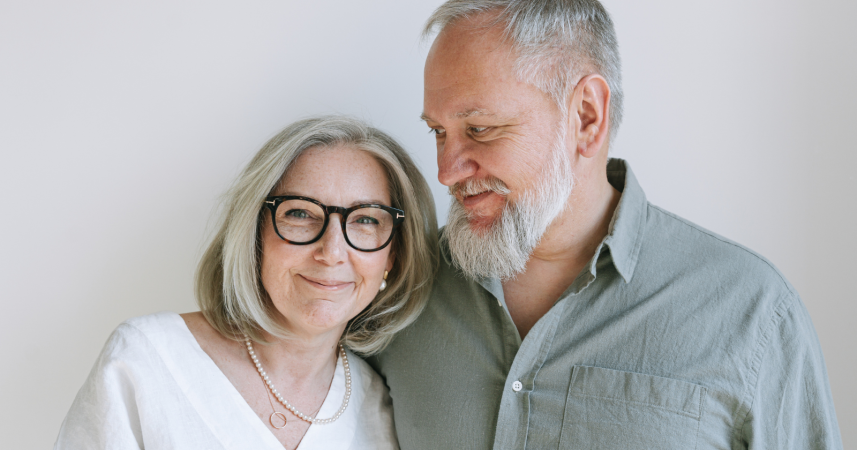
Real love later in life often looks quiet because it no longer needs to prove itself to anyone watching. What seems boring from the outside can be the deepest kind of intimacy: two people at ease, unmasked, and finally home.
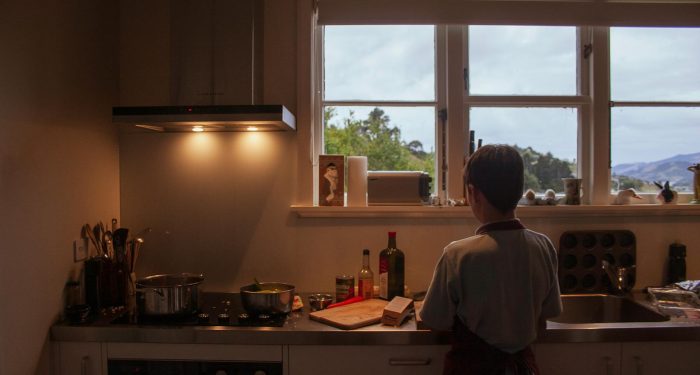
It is 7:14 on a Tuesday evening. She is at the kitchen counter, slicing tomatoes for a salad neither of them is particularly hungry for. He is in the next room, half-watching the news, half-reading a paperback with the spine cracked open against his knee. Every few minutes one of them says something — a word, a fragment, nothing that would make sense to anyone listening. The other answers without looking up. A timer goes off. He gets up to turn it without being asked.
They eat at the table. He tells her, for the third time that week, something he read about bees. She already knew, and she lets him tell her anyway. After dinner she does the dishes and he dries. They go to bed at 9:45. Neither of them takes a photograph of any of it.
And if you're 35 and scrolling past that image, you might think, how sad. How ordinary. How utterly unremarkable. You'd be wrong. What you're looking at is the whole point.
The Performance We Mistake for Passion
When we're young and new to love, we perform it, and I don't mean that unkindly. I did it too. I was 23 once, getting dressed for an hour before a date, laughing a little too loudly at jokes that weren't quite funny, tilting my head just so in photographs. We perform love because we're terrified of being truly seen and found wanting. We audition for the role of worthy partner, and we run the audition for years sometimes, long after the relationship has technically "started." We curate. We manage. We present our best, most charming, most patient selves and quietly hope the real version never gets too close to the stage lights. This is exhausting, of course. And it is also completely normal. It just isn't intimacy. Not yet.
There's good research to back up what so many of us have lived. Authenticity studies on romantic partners have found that perceiving your partner as genuinely authentic, not performing, not managing their image, but simply being themselves, leads directly to greater trust, satisfaction, and commitment. The performance, however charming, actually gets in the way. What we're all really starving for, underneath all the effort, is the experience of being known.
What Happens in Your 50s and 60s
Somewhere in the middle decades, something shifts. Life has a way of doing that. You've buried people you loved. You've watched a marriage end, or a parent decline, or a career change direction without your permission. You've sat in hospital waiting rooms. You've had the conversation you were dreading and survived it. And gradually, some of the performance falls away, because you simply don't have the energy for it anymore, and because you've stopped believing it was ever the point.
Research consistently shows that older people are often happier and more satisfied with their lives and marriages than younger people are, and that when people sense their years are limited, they shift perspective and focus on present positive experiences rooted in peacefulness rather than excitement.
There's a whole body of science around this, actually. Stanford psychologist Laura Carstensen developed what she called Socioemotional Selectivity Theory, which explains that as we age and our sense of time becomes more precious, we begin to prioritize emotionally meaningful goals over everything else. Her research found that as perceived time horizons shorten, emotionally meaningful goals get prioritized over exploration, novelty, and social performance.
In other words, we stop trying to accumulate impressive experiences and start deepening the ones we already have. We stop casting wide and start casting true.
I felt this shift in my own bones, though I couldn't have named it then. After raising two kids on my own through most of my 30s and 40s, after rebuilding myself quietly while keeping the whole household upright, I had very little patience left for pretending. When I met my second husband, Harold, at a school fundraiser auction where I accidentally outbid him on a set of antique bookshelves neither of us particularly needed, I didn't perform. I was tired and a little cranky and I told him so. It turned out that was exactly the right thing.
The Boring Parts Are the Real Parts
Here is what "boring" love actually looks like from the inside: you know what he's going to order at the restaurant before he opens the menu. You know which stories he'll tell when he's nervous. You've seen each other frightened, you've seen each other wrong, you've seen each other at 3 in the morning when all the armor is off and there is nothing left to protect. And you're still there. Not out of habit, not out of obligation, but because the knowing itself has become a kind of home.
A 2023 study in Sexuality and Culture found that individuals in midlife show improved communication, reduced need for control, and decreased jealousy in their relationships compared to younger adults. Less jealousy. Less need for control. Think about what that actually means for a moment. It means you've stopped gripping. You've stopped white-knuckling the relationship, trying to shape it into a thing that reassures you. You've let it be what it is.
That loosening, that ease? It looks like nothing from the outside. It feels like everything from the inside.
A landmark study by Levenson, Carstensen, and Gottman found that older couples showed reduced potential for conflict and greater potential for pleasure compared with middle-aged couples, including less pronounced gender differences in what brought them joy. They'd grown, over time, toward each other. They'd become easier together.
Stopping the Performance Is a Choice, Not an Accident
I want to be clear about something, because this matters: the quiet ease of older love doesn't just happen to you. It requires, somewhere along the line, a decision to stop performing. To let your partner see you without the flattering light on. To say, this is actually who I am, and this is actually what I need, and I am done pretending otherwise. That is terrifying for most people, no matter the age. But the willingness to do it, and to receive it when your partner does the same, is what turns a relationship from a production into a life.
My friend Margaret, who has been with her husband for 34 years, said to me once, "I stopped trying to be interesting to him and started just being myself. And then, funny thing, he found me interesting." She laughed when she said it. But she wasn't joking. She had stumbled onto the whole secret.
There's another thing nobody mentions about love in the later chapters, which is the grief woven through it. Every couple of a certain age is also a couple who has survived things together. Illness, loss, disappointment, the particular loneliness that can exist even inside a long marriage. I cared for Harold through seven years of Parkinson's, and I will tell you that what passed between us in those years was the most unperformed, most unguarded love of my life. There was no room for anything else. There was only the truth of two people trying to hold on with grace.
Here is what younger people get wrong about the couple on the couch. They see two people who have settled, when they're actually looking at two people who have arrived. They read the quiet as absence, when the quiet is the evidence. They assume the spark died, when in fact the spark simply stopped needing to be witnessed to exist. A love that has to be photographed to be real is not a stronger love. It is a younger one, still auditioning.
The spark doesn't die. It stops needing an audience. And the love that remains when the performing is done is not a smaller love at all. It is the only kind that was ever going to be worth anything.