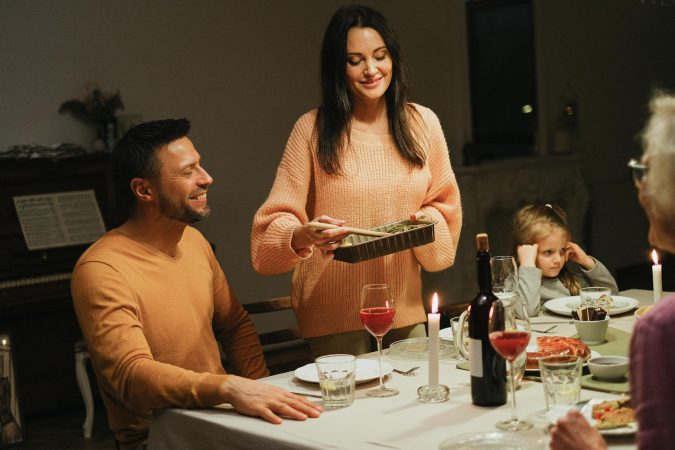
The black sheep gets the family's attention. The easy child gets forgotten, and the forgetting starts so early nobody notices it happened.
In a family of six, seven, eight children, the one who grows up loneliest isn't the one who slammed doors or failed out of community college or married the wrong person at twenty-two. Those children get attention, even when the attention arrives as exasperation. They get phone calls. They get worried about at Thanksgiving. They occupy a seat in the family imagination that everyone has to keep dusting off, because a black sheep is still, by definition, part of the flock.
The loneliest child is the other one. The one who caused no trouble. The one everyone describes with the same sentence for forty years: oh, she was just always so easy.
Most people hear that sentence as a compliment. It isn't. It's a diagnosis.
Conventional family wisdom says the troubled kid gets hurt and the good kid turns out fine, because being good is what produces fine outcomes. But some family therapists who've observed adult siblings trying to repair their relationships in midlife suggest something stranger: the sibling who was labeled easy is often the one who grew up into an adult who cannot locate her own wants without a map, who answers I'm fine before the question finishes, who attends every family event and leaves feeling as though she attended someone else's.
The currency of a crowded house
Parents with many children are not negligent. They are rationed. Attention in a large family is a finite resource divided across multiple small people with incompatible needs, and every child in that system learns, without anyone teaching them, what behavior gets them kept close and what behavior gets them pushed to the edges of the parent's awareness.
The child who screams gets attention through friction. The child who achieves gets attention through performance. The child who struggles gets attention through concern. And then there's the child who figured out, probably before she could articulate it, that the fastest route to staying in the family's good graces was to require almost nothing.
She didn't ask for help with homework. She didn't have big feelings at bedtime. She shared without being asked. She read quietly in her room while the louder siblings consumed the oxygen downstairs. And the reward for all of this was a specific sentence that followed her for the rest of her life: you were always so good, we never had to worry about you.
What that sentence actually means, if you translate it honestly, is we never asked.
Research on attachment has explored this pattern for decades. A large study covered in Scientific American found that early relationships don't just shape how children feel loved. They shape what kinds of bids for connection a child will risk making as an adult. A child who learned that bids for attention were inconvenient, or that crying got met with not now, doesn't stop needing. She learns to route the need underground and to present only the parts of herself that don't strain the room.

Easy is not a personality
Here is the thing no one says out loud at the family reunion. Easy is a performance. It is a child's earliest and most successful theatrical production, staged nightly, with an audience of adults too tired to notice it's a show.
The easy child is watching. Constantly. She's tracking her mother's mood across the kitchen like a pilot reading weather. She's clocking which sibling is about to need something, so she can preemptively need nothing. She's absorbing the emotional temperature of a room and adjusting her own internal thermostat to match, because a child who runs hot when the room runs cold is a child who creates work, and work is what loses you your seat.
Psychologists who study behavioral health patterns have described this kind of early self-monitoring as adaptive, which it is. The child adapts to her environment. She survives it beautifully. The problem is that the adaptation doesn't expire when the environment changes. She carries it into every friendship, every marriage, every workplace, every doctor's appointment where she's asked on a scale of one to ten, how bad is the pain and some reflex older than language answers three even when the real answer is eight.
This is the quiet crisis of the easy child grown up. She doesn't know what she actually feels, because no one ever asked her when feeling it would have mattered, and eventually she stopped checking.
The sibling who sees everyone and is seen by no one
At family gatherings, the easy child-turned-adult is often the one refilling drinks, redirecting conversations away from arguments, remembering that her brother's wife doesn't eat dairy, catching her niece before she runs into the coffee table. She is the connective tissue of the whole event. She makes it possible.
Then she drives home and cries in the car, and cannot explain to her partner exactly why, because nothing bad happened. Nothing ever happens to her. That's the whole problem. Not belonging in a large family doesn't look like being excluded. It looks like being indispensable and invisible at the same time, which is a very specific kind of math.
Her siblings love her. They'd say so without hesitation. But if you asked any of them — the black sheep, the achiever, the funny one, the baby — to describe her inner life, they'd stall. They know her role. They don't know her. And she has spent decades perfecting the skill of not correcting them.
Why the question never gets asked
In most families, big or small, attention follows demand. The child who needs a ride to the ER at 2am gets the parents' time that week. The one who's threatening to drop out of school gets the emergency summit. The one who's crumbling visibly gets the therapist's number.
The easy child gets a Christmas card that says we're so proud of you, you've always had it together.
What she hears, if she's honest with herself in the car on the way home again, is we never learned how to look at you, because you never made us. She knows her siblings' crises in detail. They know her job title and her husband's first name.
Family therapists often observe that the person who was easy as a kid becomes an adult who cannot ask for anything without feeling like she's imposing. She will drive three hours to help a friend move and then apologize for texting that same friend when her own mother is in the hospital.
The cost nobody calculated
Coverage of people-pleasing and mental health suggests that chronic accommodation carries psychological costs. Every yes the easy child said when she meant no was a small withdrawal from a bank account she didn't know she had. Every feeling she swallowed to keep the dinner table peaceful was deposited somewhere. Not gone, just deferred.
Forty years of deferred feelings do something to a person.
They calcify into a kind of low-grade numbness that other people read as serenity. She looks calm. She looks well-adjusted. She looks, in the word her family has used her entire life, fine. Research suggests this pattern represents the shadow side of compliance, the way habitual people-pleasing can mask a complete estrangement from one's own interior weather.
She has replaced feeling with functioning, and because functioning is rewarded in most cultures, and rewarded most of all in overloaded families, no one has any incentive to notice. Researchers looking at attachment style and adult well-being have documented what follows: the adults who scored highest on avoidance and self-reliance almost always trace back to childhoods where needing things openly was met with friction or fatigue. They learned to stop needing. They did not learn to stop hurting.
The late discovery
Sometimes, in her forties or fifties or sixties, the easy child wakes up to the fact that she adapted to a climate that no longer exists. Her parents are older, or gone. Her siblings have their own families. The crowded house emptied out decades ago. And she is still behaving as though attention is a scarce resource that must be earned by requiring nothing.
The discovery usually arrives through a small rupture. A friend asks how are you and actually waits for the answer. A therapist asks what she wants and she cannot finish the sentence. Her own child says you never tell me when you're sad and she realizes her child is describing the exact wound she inherited from her own mother, transmitted silently through the same I'm fine she thought was protecting everyone.
This is the moment, if she's lucky, when the easy child starts to suspect that her easiness was not a gift to her family. It was a tax she paid so they wouldn't have to notice her. And she's been paying it her whole life.
What asking looks like
The work of unlearning easy is not the work of becoming difficult. It's the work of becoming legible. Of letting a real answer come out of her mouth when someone asks how she's doing. Of allowing a preference to sit on the table next to her brother's preference, without immediately collapsing hers to accommodate his. Of believing that she can be a burden for thirty seconds and still be loved on the other side of it.
Her siblings may not know how to handle the new version of her. The role she played was load-bearing for the whole family structure, and a family that stopped needing her to be easy would have to figure out a different way to hold itself together. Some of her relationships will not survive the change. That is the price of asking to be known at fifty when no one has practiced knowing you for the previous forty-nine.
So here is the question the easy child has to stop waiting for other people to ask. What do you actually want. Not what would be convenient. Not what would keep the dinner peaceful. Not what would let your siblings continue recognizing you as the reliable one. What do you want, and are you willing to say it out loud in a room where saying it costs you something.
Because no one is coming with the question. They were never going to. The family that raised you to be easy is not the family that will suddenly, in its sixties and seventies, develop the curiosity it lacked in its thirties. If you keep waiting for the invitation to be yourself, you will die having been easy, and the epitaph will be the same sentence you've been hearing for forty years, and no one at the funeral will know who you actually were. Stop waiting. Say the thing. Be inconvenient. Find out what happens.