

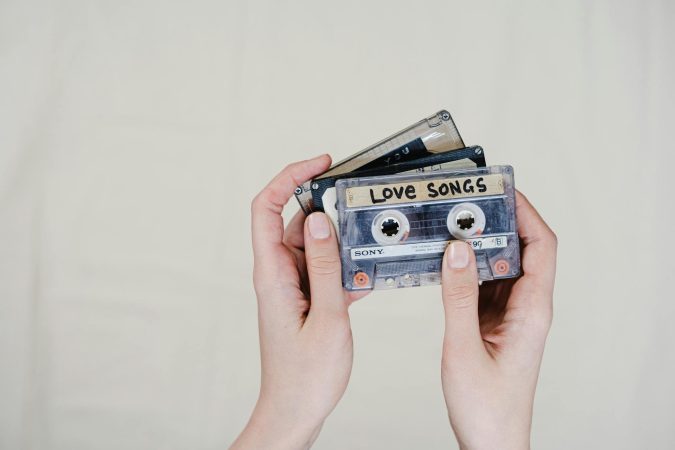
The mixtape wasn't sentimental object — it was the last widely-practiced ritual where attention had to be earned through hours of physical labor, and we miss it because we know what replaced it.
The mixtape was never about the music. People who came of age in the 1980s know this, even if they can't always say it out loud at dinner parties when someone younger asks why Gen X gets misty about cassette tapes. The songs mattered, sure. But what mattered more was the four-and-a-half hours someone sat on a bedroom floor, finger hovering over the pause button, listening to the entire song through their cheap headphones while waiting for the exact right moment to release the record button so the next track wouldn't get clipped. That was the gift. The music was just the wrapping.
Most people assume the nostalgia is for the analog warmth, the hiss of tape, the handwriting on the J-card. That misses what's actually being mourned. What people in their fifties are remembering, often without naming it, is the last cultural era when attention had to be physically assembled and could not be faked.
You could not auto-generate a mixtape. You could not copy and paste one. You could not, on a Wednesday afternoon during a meeting, dash one off in two minutes to make someone feel briefly seen. To make a mixtape, you had to sit with the recipient in your mind for hours. You had to think: she'll like this song, but only if it follows that one, because the key change matters and the lyrical bridge connects to the conversation we had on the bus. You had to decide what to say with someone else's words, because you couldn't say it with your own.
That kind of attention is now functionally extinct.
The collapse of effortful affection
Something specific happened to intimate communication between roughly 1995 and 2010, and we still haven't fully metabolized it. The asynchronous, labor-intensive love letter — whether written, recorded, or assembled — got replaced by the synchronous, effortless ping. A mixtape took a weekend. A heart emoji takes a thumb-twitch.
Both are signals. But signals carry meaning in proportion to their cost, and the cost of contemporary affection has fallen so close to zero that many of us now struggle to feel anything when we receive it. The shift from effortful to instantaneous communication doesn't just change how we connect — it changes whether the connection registers as meaningful in the first place.
This is not a moral failing on anyone's part. It's a feature of the medium. Texts are designed to be cheap. That's their genius and their limitation.
I think about my granddaughter sometimes, who is eight and already has a tablet, and I wonder what the equivalent of a mixtape will be for her generation. A curated Spotify playlist? Possibly. But a Spotify playlist takes seven minutes to assemble and the algorithm does most of the work. The friction is gone. And friction, it turns out, was the whole point.
Why the labor was the love
There is a psychological principle here that's worth naming clearly. Effort signals value. The harder something is to produce, the more meaning it carries when received. We're descended from people who learned to distinguish reliable bonds from cheap ones, and one of the clearest signals our nervous systems still respond to is: did this person spend something costly on me?
Time is the costliest thing we have. Always has been. A mixtape was four to five hours of someone's irreplaceable life, spent thinking about you. Not multitasking. Not half-watching television. Sitting on the floor with a stack of records or CDs, deciding whether "In Your Eyes" should come before or after the Cure song, whether the recipient would understand why you put the Smiths track third instead of opening with it.
That's not nostalgia. That's a measurable transfer of life. Understanding how humans read relational signals reveals that perceived effort is one of the strongest predictors of whether a gesture is interpreted as genuine bonding behavior or social filler. The mixtape was unmistakably the former. A streamed playlist link, however thoughtfully curated, often falls into the latter — not because the curator cares less, but because the medium can't carry the weight.
What was being practiced
Children of the 1980s grew up in households where adult attention was often rationed, distracted, or unreliable. We learned to read the emotional weather of a room the way other generations learned to read books. Which is partly why the mixtape mattered so much. It was an antidote to the ambient absent-mindedness of the era. It was someone saying: for these four hours, I am thinking only of you.
That was rare then. It is unimaginable now.
I'm not saying people don't love each other anymore. They do. The capacity is intact. What's atrophied is the practice — the muscle of sustained, single-pointed attention directed at one person for hours, without checking anything, without optimizing anything, without doing anything but considering them. The mixtape was a training ground for that muscle. So were handwritten letters. So were long phone calls on a kitchen wall-mounted receiver, the cord stretched into the hallway for privacy.
None of those exist as common practices anymore. We replaced them with mediums that don't require us to be still.
The asymmetry that changes everything
Here's the part that often gets missed when people sneer at Gen X nostalgia. The mixtape worked because making one and receiving one were asymmetrical experiences. The maker spent hours. The recipient could listen on the bus, while doing homework, while falling asleep. The labor was front-loaded into the gift, and then the gift kept giving — because every time the recipient pressed play, they were entering an artifact someone had built specifically for them.
Modern communication has flattened that asymmetry. The effort I put into a text matches roughly the effort you put into reading it. We're trading equally cheap signals back and forth. The transaction is balanced, but nothing accumulates. Nothing becomes an artifact. Nothing can be held in the hand twenty years later and still mean what it meant.
I have a shoebox somewhere with three mixtapes from 1987. I haven't owned a tape player in over a decade. The tapes still mean something. The thousands of texts I've sent and received in the last five years mean, collectively, almost nothing — not because the people sending them didn't love me, but because the medium doesn't allow love to accumulate that way.
What we can't get back, and what we still might
I don't think mixtapes are coming back. I don't even think they should. The point isn't the cassette — it's the principle the cassette accidentally enforced, which is that real attention has to cost something or it doesn't register as real.
Some of this principle survives in unexpected places. People still write letters, occasionally. Some send voice memos that go on for ten or fifteen minutes — long enough to feel like the sender actually sat with their thoughts. The way someone uses their phone in an intimate relationship now reveals more than they probably realize, and many of us have started noticing the difference between a text that took thought and a text that was reflexive.
The friends I feel closest to are the ones who still occasionally do something inefficient on my behalf. Mail me a book they were reading. Send a long email instead of a text. Show up at my door instead of asking when I'm free. Low-cost communication, no matter how frequent, can't substitute for high-cost gestures, no matter how rare.
Gen X knows this. We don't always articulate it well. When we get sentimental about the eighties, younger people sometimes assume we're nostalgic for our youth, the way every generation gets nostalgic for the era when their bodies worked better. The recent surge in eighties and nineties nostalgia gets read as boomer-adjacent decline, a refusal to let the past be past.
That reading is wrong. We're not mourning our youth. We're mourning a specific kind of relational labor that the world stopped requiring of us, and that we stopped requiring of each other, somewhere around the time we all got phones in our pockets.
The gift you can still give
The honest version of the mixtape now is whatever costs you four hours of undivided attention. It might be a meal cooked slowly for someone who'd rather have take-out. It might be a letter, handwritten, that takes you three drafts. It might be a single afternoon where you sit across from someone with your phone in another room and ask them what they've been afraid of lately, and listen to the whole answer.
The medium was never sacred. The cost was. And the cost is still available, if we're willing to pay it — which most of us, most of the time, are not.
That's what the mixtape generation knows in our bones. We were the last group raised in a world where you had to assemble attention with your hands. We watched it disappear in real time. And every time we hear someone dismiss us as sentimental about cassette tapes, we know they've missed the point so completely they're proving it.
The hiss of tape was never the gift. The four hours were.