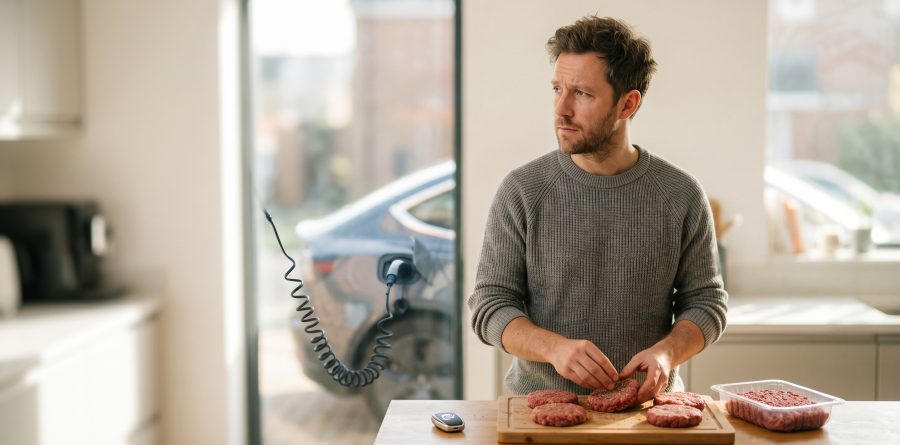
The disconnect between proudly driving a Tesla to pick up a ribeye dinner isn't about moral failure—it's the predictable result of one industry spending billions to make change look sexy while another spends billions to make sure you never question what's on your plate.
Years in the restaurant business taught me something fundamental about human behavior: we're excellent at accepting truths that align with our desires and equally skilled at dismissing ones that don't. The electric car parked next to the steakhouse isn't a contradiction—it's exactly what happens when one industry successfully markets change while another buries it.
After going vegan at 47 and watching countless dinner conversations turn into debates about protein and tradition, I've come to understand this isn't about hypocrisy. It's about which messages get amplified and which get silenced.
The marketing machine behind your choices
Walk into any Tesla showroom and you'll be surrounded by sleek displays about saving the planet, cutting-edge technology, and joining a revolution. The message is clear, well-funded, and wrapped in aspirational packaging. Ajit Niranjan notes that "A wave of affordable Chinese-made EVs is accelerating the shift away from petrol cars, challenging long‑held assumptions about how transport decarbonisation unfolds."
The car industry discovered something brilliant: they could sell environmental consciousness as a product upgrade rather than a sacrifice. Buy this car, save the world, look good doing it.
Meanwhile, the meat industry operates from a different playbook. One focused on defense rather than transformation. When scientists publish research about cattle emissions, industry-funded counter-studies appear within weeks. When documentaries expose factory farming practices, legal teams mobilize. The strategy isn't to promote change but to prevent it.
I watched this defensive machinery in action during my restaurant years. Beef suppliers would send us glossy brochures about "sustainable ranching" while lobbying against any regulation that might reduce consumption. The message was always the same: the problem isn't the product, it's the perception.
Why car companies won the narrative war
The psychology behind why we embrace electric vehicles while clinging to our steaks reveals something fascinating about how we process environmental information. Research shows that both rational and norm-directed motives significantly influence consumers' intention to adopt electric vehicles, with personal and social norms explaining the highest variance in adoption intention.
Think about it. When did driving an electric car become cool? When celebrities started arriving at red carpets in Teslas. When your successful neighbor installed a charging station. When government incentives made it financially attractive. The entire narrative shifted from sacrifice to status.
Rowan Atkinson captures this perfectly: "Electric vehicles may be a bit soulless, but they're wonderful mechanisms: fast, quiet and, until recently, very cheap to run." Notice what's missing from that endorsement? Any mention of giving something up.
Food operates in completely different psychological territory. When I switched to plant-based eating, my Greek father treated it like I'd renounced our heritage. My kitchen staff saw it as a rejection of everything we'd built together. Food isn't just fuel. It's identity, tradition, family history served on a plate.
The information asymmetry nobody talks about
Here's what most people don't realize: Prof Tim Benton states, "The biggest intervention people could make towards reducing their carbon footprints would not be to abandon cars, but to eat significantly less red meat."
Let that sink in. The bigger impact comes from changing what's on your plate, not what's in your garage. Yet which message dominates our cultural conversation?
During my final years running the restaurant, I started introducing more plant-based options. Not as statements but as delicious alternatives. The resistance wasn't about taste. My cashew-based alfredo consistently outsold the dairy version in blind tastings. The resistance came from the story people told themselves about what a "real meal" looked like.
Nathan Fiala puts it bluntly: "Producing beef for the table releases more heat-trapping greenhouse gases than most people realize—far more, pound for pound, than are generated by the production of most other kinds of food."
Yet this information rarely penetrates mainstream consciousness with the same force as an electric car advertisement during the Super Bowl.
Following the money trail
The disconnect between our transportation choices and our food choices starts making sense when you follow the money. Electric vehicle companies need you to buy something new. Their entire business model depends on convincing you to upgrade, to join the future, to be part of the solution. The meat industry needs you to keep buying what you've always bought. Their business model depends on tradition, habit, and not asking too many questions.
Jonathan Watts reveals an uncomfortable truth: "The environmental impacts of meat consumption could be rapidly and cheaply reduced if governments applied full VAT on products such as beef, pork, lamb and chicken."
But that message threatens profits, so it gets buried under campaigns about protein deficiency, agricultural heritage, and personal freedom.
The real psychology at play
After decades of feeding people and years of observing their choices, I've learned that humans aren't naturally hypocritical. We're naturally responsive to our information environment. Dr Chris Bretter warns, "We know this sort of false information is out there and circulating, but the scale of acceptance is concerning and poses a significant challenge to the global transition to more sustainable transport."
If misinformation affects even electric vehicle owners about their own cars, imagine how it shapes our understanding of food systems we've never questioned.
The couple next door with their Model 3 and their weekend barbecues aren't failing at environmentalism. They're succeeding at exactly what they've been programmed to do. They've absorbed the message that technology can solve our problems without requiring fundamental change.
Studies indicate that consumers' attitudes, perceived behavioral control, subjective norms, and moral norms significantly impact their intention to adopt battery electric vehicles, with attitude being the strongest influencer. Notice what drives adoption: attitude, norms, perception. All things that can be shaped by marketing.
Breaking through the narrative
Joe Fassler doesn't mince words: "If we're serious about avoiding the worst of the climate crisis, we need to consume fewer animal products."
But seriousness doesn't sell cars or steaks. Stories do.
When I cook for my granddaughter now, I don't lecture her about methane emissions or water usage. I make her incredible meals that happen to be plant-based. When her friends come over, they devour everything and ask for recipes. Change happens through experience, not statistics.
The shift in my own kitchen came gradually. First, meatless Mondays became something the staff actually looked forward to. Then, customers started requesting the vegan specials even when they weren't vegan. Eventually, what started as an accommodation became our signature.
Final words
The person charging their electric car before heading to a steakhouse isn't confused. They're responding predictably to an asymmetric information environment. One industry sold them a future they could buy into. Another industry worked overtime to ensure they never questioned what was already on their plate.
Real change won't come from shaming people for incomplete environmental consciousness. It'll come from making the full picture as visible, appealing, and accessible as the partial one currently being sold. Until then, we'll keep seeing parking lots full of Teslas at barbecue joints, and that's not hypocrisy—it's exactly what the market ordered.
What’s Your Plant-Powered Archetype?
Ever wonder what your everyday habits say about your deeper purpose—and how they ripple out to impact the planet?
This 90-second quiz reveals the plant-powered role you’re here to play, and the tiny shift that makes it even more powerful.
12 fun questions. Instant results. Surprisingly accurate.