
Why a documentary about a 1994 abduction can feel, weirdly, like being tucked in
I fold laundry to murder.
That's the sentence, isn't it. I put on a documentary about a thirty-year-old cold case in Wisconsin, and I match socks, and my shoulders drop about an inch, and I feel—genuinely, embarrassingly—calm.
For a long time I assumed this made me a bit of a freak. Or, more charitably, that it was just one of those modern quirks, like falling asleep to videos of strangers cleaning their kitchens. Then, a couple of years ago, a friend who's a therapist watched me put on an episode of Forensic Files the way you'd light a candle, and she said something I haven't been able to unhear.
"Oh," she said. "You're soothing yourself."
The morbid label is wrong
True crime fans get one of two reads from the rest of the world. Either we're ghoulish—rubber-necking at other people's worst days for entertainment—or we're worried women learning how not to die. (Most of the audience is women. The data on this is consistent.)
Both reads have a sliver of truth. Neither one explains what's actually happening when someone like me, a man in his late thirties, puts on a documentary about a missing person and feels his nervous system unclench.
The morbid framing in particular irritates me, because it gets the emotion exactly backwards. I'm not titillated. I'm not even especially interested in the crime, most of the time. I'm interested in something the crime is wrapped inside.
I'm interested in the shape of the story.
What unpredictable households actually do to a kid
I want to be careful here, because I'm not telling a sob story and I don't think most people in my situation are either.
The kind of childhood I'm talking about doesn't have to involve anything dramatic. There doesn't need to be a villain. It can just be: a parent whose mood you couldn't predict from one hour to the next. A house where the temperature shifted without explanation. A dinner table that was warm on Tuesday and electrified by some invisible storm on Wednesday, and nobody ever explained what changed, because nobody ever explained anything.
A kid in that house develops one very particular skill above all others: scanning. They become, by necessity, an excellent reader of microexpressions, footsteps, the angle of a door being closed. Their nervous system learns to stay on, low and constant, like a refrigerator hum you can't turn off.
The clinical term is hypervigilance, and it doesn't go away when you turn eighteen. Cleveland Clinic psychologists describe it as a state where you're constantly scanning for the bad thing—every white van becomes a kidnapper's van, every late-night text is bad news. People who didn't grow up scanning think this is a strange way to live. People who did grow up scanning don't know there's any other way.
The format is the medicine, not the content
Here's what I figured out, sitting on my Bangkok floor with a sock in my hand, listening to a narrator describe a 1994 abduction.
I wasn't there for the murder. I was there for the structure.
The structure of a true crime documentary is almost obscenely tidy. Something terrible happens in the first ten minutes. The middle is a controlled descent through evidence. By the end of the hour, someone has named the danger, explained how it worked, and—most of the time—resolved it. The killer has a face. The motive has a sentence. The credits roll.
That arc is exactly the thing my childhood didn't have.
In my house growing up, bad things happened and were never spoken about again. Tension built and dissolved without anyone naming it. The danger, whatever it was on a given day, was never explained, contained, or resolved—it just moved on, and you were expected to move on with it.
What the documentary does, for an hour, is the opposite. It says: here is the thing that went wrong. Here is why. Here is what happened next. Here is the end of it. A psychologist writing in Psychology Today called these shows little morality plays, and that's exactly right. They're not stories about violence. They're stories about chaos being interrupted by sense-making.
For a nervous system raised on the unsense-making kind of chaos, that's not entertainment. That's a balm.
Why the contained version works when the real thing doesn't
Real life doesn't do this. Real life serves you ambiguity for breakfast and ambiguity for dinner. The argument from three years ago is never "explained." The friend who went weird on you is never named as a suspect. The bad year is never officially closed; it just becomes another year you don't talk about.
A documentary about a stranger's bad year, by contrast, has a beginning, middle, and end. It has a Wikipedia page. It has a verdict. The pain is real—I'm not minimizing the families involved, who go through something I can barely imagine—but the narrative is finished.
And a finished narrative, to a person who grew up inside unfinished ones, feels like a deep breath you didn't know you'd been holding for thirty years.
That's why I fold laundry to it. The mundane chore plus the resolved story equals a kind of order I never quite trusted to exist.
The catch nobody mentions
I'd be lying if I said this was all healthy.
There's a tipping point with this stuff, and I've watched myself walk past it more than once. Three documentaries in a row is a comfort. Six is a personality reorganization. After enough hours of women being abducted from parking lots, my already-vigilant brain starts adding new threats to its watch list. The white van really does start to look suspicious. Strangers in elevators get filed under "potential."
This isn't theoretical. The same trait that makes the genre soothing for people like me—an already-active threat detection system—also makes us the most vulnerable to it spiraling. The medicine and the poison are the same molecule, just at different doses.
So I've put a couple of guardrails on it, which I'll share in case any of this sounds familiar.
I don't binge. One episode, occasionally two, never three. The point is the resolution, and resolution gets diluted when you stack episodes on top of each other.
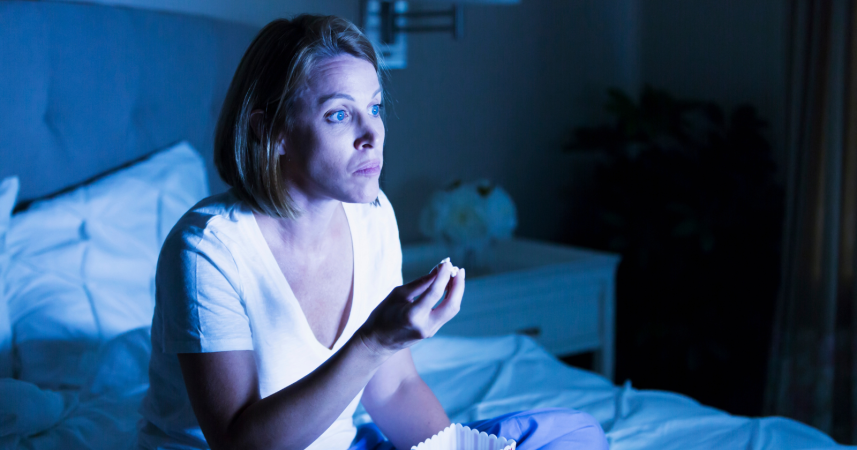
I don't watch in bed. I learned this the hard way. The brain does not need a podcast about a serial predator chasing it into the unconscious.
And I check in with myself afterward, the way my therapist friend taught me to. Am I calmer or am I wired? If wired, I've crossed the line from contained story to fuel for the hum, and it's time to put on something with dogs in it.
If this is you
You're not morbid. You're not weird. Your nervous system isn't broken. It's doing exactly what it learned to do when you were small, which is look for patterns, scan for threats, and try to find the shape of a story that nobody was ever going to give you in the actual house you grew up in.
The documentaries are giving it to you now. An hour at a time. With commercial breaks.
That's not a flaw to be ashamed of. It's a clue. It's your brain telling you, very politely, what it never got—and what it's still, decades later, looking for.
The longer answer is that the real version of this is therapy, or close friendships where things actually get talked about and finished, or a quiet life where the days don't carry weather you can't predict. Those are slower than a Netflix episode and a hell of a lot harder to put on while you fold laundry. But they work on the same muscle. They give you, in real time, what the documentaries only simulate: the experience of bad things being named, examined, and put down.
Until then, I'm not judging anyone for the show on their second monitor. I'm folding socks too.