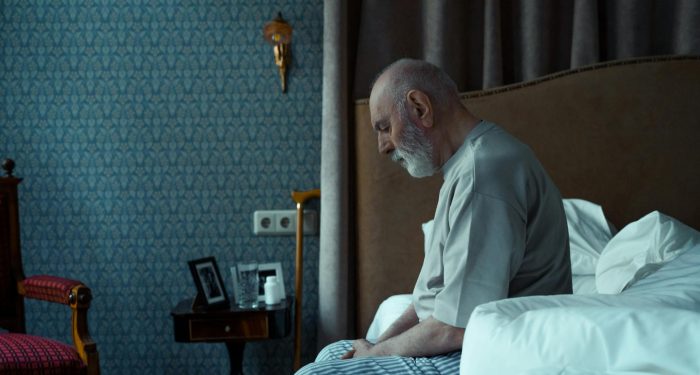


The news anchor at six o'clock isn't entertainment. Sometimes's he's the partner who still shows up at the table on time
I want to tell you about my Uncle R, who is not really my uncle—he's a friend of my parents who became, over decades, an honorary one—and who, since his wife died in 2019, has watched approximately six hours of television a day.
I want to be precise about the six hours, because the number itself does some of the work of what I'm trying to describe. It's not casual viewing. It's not a hobby. It's a structural feature of his daily life. The television goes on at around 7 a.m., when he comes downstairs. It stays on through breakfast. It stays on through the morning. It is on during lunch, which he eats on a tray in the living room, facing the screen. It goes off briefly while he walks the dog, and then comes back on for the entirety of the afternoon and evening, until he goes to bed at around 10:30.
If you ask Uncle R what he's watching, he will tell you, slightly defensively, that he's watching the news. This is partly true. He watches a lot of news. But he also watches the panel shows that follow the news, the chat shows that follow the panel shows, the antiques programs in the afternoons, and, in the evenings, whatever drama or detective series happens to be on. The television is not, in any meaningful sense, programmed by him. It is just on. It is on the way the lights are on. It is the texture of the room.
For a long time, when I'd visit, I'd find this slightly depressing. I'd think, in the way visiting nephews do, that he should be doing something. Reading a book. Going to a club. Taking a class. The television, in my visiting-nephew opinion, was a kind of slow surrender to inactivity, and I'd leave his house with a small worry about him that I'd report, vaguely, back to my mother.
It took me until last summer, on a long visit, to understand what the television was actually doing. And once I understood it, I stopped finding it depressing, and started finding it something more like ingenious.
What his wife had been
I want to describe what Uncle R's wife had been, because the description is the whole article.
They had been married for forty-seven years when she died. They were, by every account I have, genuinely fond of each other right up until the end. They were not, however, what anyone would have called a deeply communicative couple. They didn't have long, intimate conversations. They didn't sit across from each other and discuss their feelings. They didn't, by the standards of any modern relationship guide, do the deep work.
What they did do, all day every day for forty-seven years, was provide each other with the kind of low-grade running commentary that constitutes most of the actual texture of a long marriage.
"Did you see what next door has done with the front garden."
"That cat's back."
"What time is it."
"He's late."
"There's a documentary on at nine I want to watch."
"I don't think I can be bothered with potatoes tonight."
"Where did I put the post."
"That looks like rain."
None of these sentences, individually, was load-bearing. None of them was, by any standard of significance, a sentence worth recording. They were the small auditory furniture of a shared life. They were the constant, low-volume companionship of two people who had been in the same room as each other, on and off, for forty-seven years.
When Uncle R's wife died, what he lost—on top of the larger and more obvious loss of his life partner—was the running commentary. The kitchen, which had been full of small remarks for nearly half a century, went quiet. There was no one to mention the cat. There was no one to comment on the rain. There was no one to say, at 5:45 in the afternoon, that they couldn't be bothered with potatoes. The constant low-grade audio track of a shared life had been switched off, and the silence it left behind was, by his own account afterwards, the part of widowhood he had not been prepared for.
He had, like most people, prepared for the big absences. The empty side of the bed. The Christmases. The big anniversaries. What he had not prepared for was the small daily absence of someone making remarks at him about the rain.
What the television actually does
I want to talk about what the television does, because once you see it, you can't unsee it.
The television, in Uncle R's house, is not entertainment. It is a substitute presence. It is the running commentary that has gone missing. It is the steady, low-volume audio track of another person being in the room and making remarks.
The news anchor at six o'clock is, in some functional sense, his late wife. The news anchor shows up at the same time every day. The news anchor has a voice he has come to know. The news anchor talks, in measured tones, about things in the world that Uncle R might otherwise have heard remarked upon by the woman who used to sit in the chair next to his. The news anchor, in the absence of the original commentator, performs the role of the commentator. The role is, structurally, what was missing. The fact that the commentator is now a man on a television screen rather than a wife in the next chair is, from a certain angle, beside the point. The commentary itself is the thing.
The same goes for the panel shows. The chat shows. The afternoon antiques programs. They all involve a small group of people, in a room, making remarks. The remarks are about objects. The remarks are about politics. The remarks are about things that happened in the news. It almost doesn't matter what the remarks are about. What matters is that there are remarks. There are voices. There is the steady, low-volume sound of other people being in a room and saying things that can be half-heard from the kitchen, the way the half-heard remarks of a wife in the next room used to be the texture of a life.
This is, I think, the thing my generation has gotten wrong about why older people watch so much television. We assume they're watching for content. They're watching, in many cases, for company. The content is, in some real way, secondary. The primary thing is the audio track of human voices in the room, on a reliable schedule, saying things at a comfortable volume, requiring nothing in return.
The other relative I want to mention
I want to describe one more person, briefly, because I think the contrast is useful.
My mother's older sister, who lives alone and never married, doesn't watch much television. She listens, instead, to the radio. The radio is on, more or less continuously, throughout her flat, from the moment she gets up until the moment she goes to bed. She listens to the same station almost exclusively. She knows the presenters by name. She has opinions about the new ones. She has a strong sense of which programmes are good and which have, in her view, gone downhill.
My aunt is doing the same thing Uncle R is doing, by a different mechanism. The radio is performing the role of the absent companion. The radio presenters, who change voices throughout the day, are providing the running commentary that her flat would otherwise lack. She has, in some sense, married the radio. The radio has been her companion for longer, by now, than most actual marriages last.
What I notice in both of them is that the form is interchangeable. Some lonely older people gravitate to the television. Some gravitate to the radio. Some gravitate to specific podcasts, which the more digitally-fluent ones have started to discover. Some gravitate to the kind of YouTube channel where a person sits in a kitchen and talks at the camera for an hour. The mechanism is the same in each case. The lonely older person is finding, in the medium available to them, a way to keep the room from going quiet. The voices are not theirs. The voices are not anyone they know. But the voices are reliable, and they are warm, and they are scheduled, and they ask nothing in return.
This is not pathology. This is, I have come to think, something closer to ingenuity. The body, which has been calibrated by decades of marriage to expect the continuous low-volume presence of another person making remarks, has found a way to provide itself with a substitute when the original is no longer available. The substitute is imperfect. The substitute is, in some real way, sad. The substitute is also, in another real way, doing important work.
Why this is so easy to misjudge
I want to write directly to anyone reading this who has an aging parent or relative whose television habits seem excessive, because I made this mistake for years and I want to spare you a few of the dead ends.
The television is not the problem. The television is the solution to a problem you cannot easily solve from the outside. The problem is that the room has gone quiet, and the person in it has been calibrated, by half a century of company, to need a certain volume of voice in the room in order to feel like the room is a room.
If you take the television away, or reduce it, or shame the person for the amount of it they consume, you are not improving their life. You are removing the substitute companion they have, with no fanfare and no help from anyone, found a way to install for themselves. The original companion is not coming back. The substitute is what's keeping the room from being unbearable.
What you can do, if you have the energy and the proximity, is provide some of the original kind of companionship yourself. Not in the form of long, deep conversations. In the form of running commentary. Visit. Sit in the room. Make remarks about the cat. Mention the rain. Comment on the news, which is probably already on, and let the comment go nowhere in particular. The point is not to communicate. The point is to be in the room with them and let small remarks happen, in the way small remarks happened for forty-seven years between them and the person who is no longer there.
Most adult children do not, by default, do this. They visit, and they try to have meaningful conversations. The meaningful conversations are exhausting for an older person who has spent a long marriage not having them. The thing that nourishes is the lower-volume thing. The remark about the cat. The shared cup of tea. The half-heard radio in the kitchen. The afternoon spent in the same room without any particular plan.
I started doing this with Uncle R last year. I'd come over for the afternoon and just be in the room. The television would stay on. We'd both watch some of it. I'd say, occasionally, something about whatever was on the screen. He'd respond. We'd be quiet for a while. He'd say something about the dog. I'd respond. We'd be quiet again. The afternoon would pass, in the same low-volume rhythm his afternoons used to have.
He'd thank me when I left, often more warmly than the visit had seemed to warrant. I think now I understand why. I had not, on those afternoons, given him much. I had given him, for a few hours, the running commentary the television had been doing alone for the previous five years. The television is good. It is reliable. It shows up at the right hour. It is not, however, a person who knows him.
An afternoon of low-volume remarks from a person who knows him is something the television cannot, by structure, provide. It is also the thing his late wife used to provide, every day, for forty-seven years.
I am not her. I cannot be. But I can, on the afternoons I have available, make a small remark about the cat, and let it go nowhere, and let the afternoon pass with the kind of ambient companionship he was built, by half a century of marriage, to need.
That, I now think, is one of the small loving services available to anyone with an aging widowed relative whose television habits seem excessive. Don't take the television away. Sit in the room with it. Let the room be a room with another voice in it. The voice doesn't have to say much. It just has to be there. That, in the end, was almost everything his wife had been. It is, in some small measure, what he is still missing.