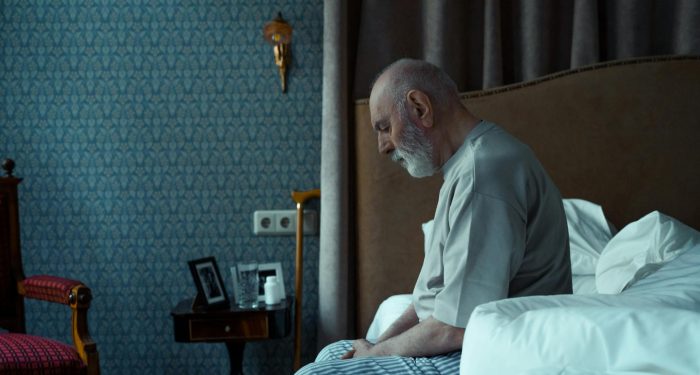


He was seventy-four when he fell in the bathroom and didn't tell anyone for three days. He was bruised. He was shaken. He had hit his hip on the edge of the tub in a way that hurt every time he sat down. His daughter, who lived twenty minutes away, would have come immediately if […]
He was seventy-four when he fell in the bathroom and didn't tell anyone for three days.
He was bruised. He was shaken. He had hit his hip on the edge of the tub in a way that hurt every time he sat down. His daughter, who lived twenty minutes away, would have come immediately if he had rung. His son, who lived further, would have driven down that weekend.
He told neither of them. He limped through three days alone, made his own meals, refused to take anything stronger than paracetamol, and only mentioned it the following Sunday at lunch, in the tone of a man reporting the weather. I had a bit of a tumble in the bathroom on Thursday. Nothing serious.
His daughter went very still. She asked, carefully, why he hadn't called.
He looked at her like the question itself didn't quite parse. And then he said the sentence that I think a lot of children of his generation have heard, in one form or another, from a parent who grew up in the 1960s.
I didn't want to bother you.
That sentence is doing more than it sounds like. It is not modesty. It is not stoicism. It is the visible tip of a very deep, very old fear that the people in his generation carry quietly, almost unconsciously, and that their children rarely fully understand. The fear of becoming a burden. The fear of needing help. The fear of becoming the thing they spent fifty years defining themselves against.
What that decade actually taught them
To understand the fear, you have to understand the decade that produced it.
Children growing up in the 1960s were raised by adults who had survived the war, the depression, the rationing, the loss. Their parents had buried siblings. Their parents had watched neighbours not come home. Their parents had grown up in households where help was not a casual transaction but a last resort, and where needing help was associated, often fairly, with the worst moments of family memory.
The lesson handed down was not subtle. Look after yourself. Don't be a bother. Don't expect people to do for you what you can do for yourself. Pull yourself together. Get on with it.
This was not cruelty. It was a survival strategy translated into a child-rearing philosophy. The adults who had lived through the previous thirty years had every reason to believe that life was unreliable, help was scarce, and the best thing you could do for yourself and the people who loved you was become someone who didn't require very much.
The children who absorbed this lesson — and most of them did, deeply — grew into a generation of remarkably capable adults. They were practical. They were self-sufficient. They could fix things. They could cope with difficulty without falling apart. They could weather divorces, redundancies, illnesses, family crises with a kind of stoic competence that their own children sometimes find slightly alien.
But there was a cost to this competence, and the cost is finally arriving now, in their seventies and eighties.
The identity that got built around the absence
What happened, slowly, over decades, is that not needing help stopped being a behaviour and became an identity.
It wasn't just something they did. It was who they were. It was the thing they were proudest of, the thing they used to evaluate other people, the thing they measured their own worth against. The competent ones. The capable ones. The ones who managed. The ones who didn't whinge. The ones who, when something went wrong, sorted it out themselves and didn't make a fuss.
This identity worked beautifully through their thirties and forties and fifties, when they had the bodies and the energy and the circumstances to back it up. It worked, in many ways, through their sixties.
What it doesn't have a clean answer for is what to do when the body finally stops cooperating.
Because dependence, for this generation, isn't just an inconvenience. It is the loss of the central thing they thought made them themselves. To need help with the bathroom, the stairs, the medication, the cooking — to need help, full stop, at the level of daily life — is to become, in their own internal accounting, the thing they spent fifty years not being.
That is not a small adjustment. That is a quiet, ongoing identity collapse, and most of them are going through it without language for it, because the generation that taught them not to need help also did not teach them how to talk about needing help.
What the children of these parents are missing
I want to say something to the adult children of these parents, because I think the dynamic is often misread from the outside.
When your seventy-five-year-old father refuses help that he obviously needs — when he insists on carrying his own suitcase, climbing his own ladder, making his own way home from the hospital — it is easy to read this as stubbornness. Pride. Old-fashioned masculinity. A refusal to accept help that you find frustrating, sometimes infuriating, occasionally frightening.
That reading is not entirely wrong. But it is incomplete.
The deeper thing happening, the thing he probably could not articulate even if you asked him directly, is that accepting your help feels, to him, like the beginning of a slide he has spent his entire adult life trying to prevent. It is not that your help feels insulting. It is that needing your help feels, to him, like becoming someone he has spent seventy years not being.
He is not refusing the suitcase. He is refusing the version of himself that needs the suitcase carried.
When you understand this, you start to see his small refusals differently. They are not him being difficult. They are him trying, sometimes desperately, to hold on to an identity that the body is in the process of taking from him. The identity that has been the centre of his self-respect for half a century. The identity that his own parents praised him for, that his own peers competed with him over, that his own marriage was partly built around.
Of course he doesn't want to put that down. Nobody would.
The reckoning these parents eventually have to have
I want to be careful, because I know children of these parents read pieces like this hoping for an instruction manual, and the truth is that there isn't one.
But there is something the parents themselves often eventually do, quietly, on their own, that is worth naming.
At some point, usually in their late seventies or eighties, often after a fall or an illness or a small humbling, they make a private peace with something they could not have made peace with at sixty. They begin to understand that the identity they built around not needing help was a young person's identity, and that no human being, eventually, gets to keep it.
They begin to understand that letting their daughter help with the shopping is not the beginning of becoming nothing. It is just the next chapter of being a person. They begin to understand that their grandchildren are not going to remember them as the man who never asked for help. They are going to remember them as the grandfather. Full stop. The category does not require self-sufficiency to qualify for membership.
This reckoning, when it comes, is one of the quiet and underrated dignities of late life. It is the recognition that the identity that served them so well for fifty years has become, in the last chapter, slightly too small to live inside. It is the slow opening of a door they had bolted from a very young age.
Not everyone gets there. Some people die still refusing help, still insisting on the suitcase, still falling in the bathroom and not telling anyone. That is its own kind of integrity, and I am not going to pretend it isn't.
But many of them, given time and patience, find their way to a softer version. A version in which needing help becomes, slowly, less of a verdict on who they are, and more of a weather they are passing through, the way everyone passes through it eventually.
What to actually do, on a Tuesday
If you have a parent like this, and you are reading this, I want to offer two small things.
The first is to stop reading their refusals as personal. They are not refusing your help. They are refusing the implication of needing it. If you can offer help in ways that don't trigger that implication — quietly, casually, framed as you doing something for yourself rather than for them, I'm going to the shops anyway, what do you need — they can often accept it without the identity cost. This isn't manipulation. It's translation. You are giving them a way to receive without the receiving feeling like surrender.
The second is to give them time. The identity took fifty years to build. It is not going to come down on a Sunday afternoon because you suggested it should. Each small acceptance — each yes, actually, that would help — is a quiet act of letting go, and it is harder than it looks from the outside. They are doing it. They are doing it slowly. They are doing it without language. They will probably never thank you for it, and they will probably never acknowledge what it cost.
That doesn't mean it isn't happening.
The fear of dependence does not go away in this generation. But it can soften. Slowly. With patience. With the kind of help that is offered carefully, in a vocabulary they can accept, by people who understand that what looks like stubbornness from the outside is actually grief — grief for an identity the body is no longer willing to keep up with.
Be patient with that grief. They were not given the language for it. You may have to be the one who offers some.