
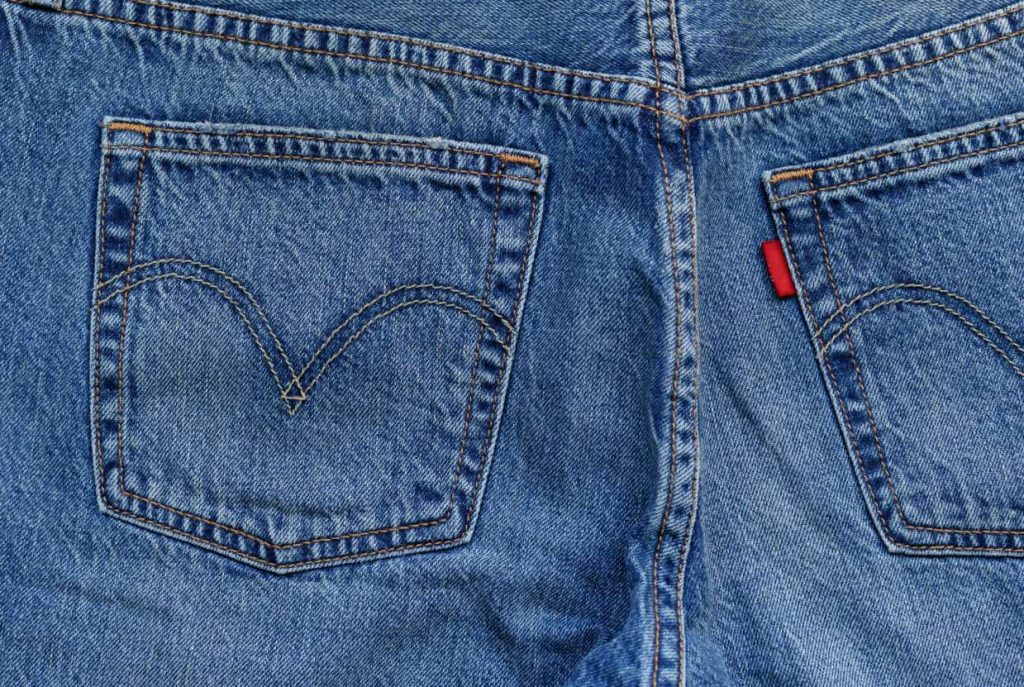
Anyway, I took them as my own and since then, they've become my favorite jeans. They just feel like quality. And I think their lifespan is proof of it. This pair of jeans got me thinking about my own wardrobe. I don't think I have anything older than three or four years. Do I have a consumption problem? Well, the easy answer would be a resounding yes and it sure seems like that's what a lot of marketing wants us to believe. But the more I've investigated this, the more I think the real issue isn't that we consume too much out of choice; it's that we have a waste system. Let me explain.

Products are designed for replacement
In some product categories, design choices, repair costs and market incentives can encourage replacement. The evidence is not uniform across clothes, electronics and appliances, and a shorter observed lifespan does not by itself prove deliberate planned obsolescence.
Those jeans survived about a decade of wear from my dad, and they are still in good enough shape to be my favourites today. Many pairs I have bought myself stretched, frayed or fell apart within a year or two. I also replaced disposable razors with a stainless-steel safety razor about seven years ago; it is still going strong and has reduced what I spend and throw away. The widely repeated claim that two billion razors are discarded each year has no transparent global source, so it has been removed.
Planned obsolescence is a real concept, but it is not a complete explanation for every failed product. Legal and consumer-policy analyses examine incentives to shorten functional lifespans, while actual durability can also reflect price pressure, technology changes, use, repair access and design trade-offs.
A 2025 Norwegian modelling study estimated significant lifetime declines around the 1990s and 2000s for washing machines (45 percent) and ovens (39 percent). Crucially, it did not find the same clear decline across all six appliance categories and said its results challenge a blanket planned-obsolescence narrative. The authors pointed to several possible technical, economic and social causes.
My experience still makes me ask whether some products are built to last, but the evidence calls for a narrower conclusion: durability and repairability vary widely, and consumers often cannot see either one clearly at the point of sale.
Fast fashion is, perhaps, the clearest example
Clothing is where this gets really visible.
The UN Environment Programme reports that clothing production doubled from 2000 to 2015, estimated garment-use duration fell by 36 percent, and only 8 percent of textile fibres produced in 2023 came from recycled sources. The earlier version incorrectly said 'recyclable sources.'
Spending more does not guarantee durability. In a University of Leeds project testing 65 garments, a £15 pair of women's jeans outperformed a £150 designer pair, and researchers found no overall correlation between price and the durability tests. The work was commissioned with Primark and Hubbub, with garments supplied by Primark and independent testing by the university. It shows price alone is insufficient, not that cheaper clothing is always stronger.
My dad's jeans lasted. Today's clothes vary widely, and durability is hard to judge before buying.

Repair has been made impractical, if not impossible
Even when people want to fix things, design, unavailable spare parts and high repair costs can make repair impractical. These barriers are among the concerns behind European right-to-repair policy.
An EU study found that 77% of surveyed citizens would prefer to repair goods rather than buy new ones.
Many people say they prefer repair, but whether they can act on that preference depends on price, parts, information, design and access to a repairer.
The European Parliament estimates that discarding repairable consumer goods rather than repairing them accounts annually for 30 million tonnes of resource use, 261 million tonnes of CO2-equivalent emissions and 35 million tonnes of waste in the EU. These are EU-wide modelled impacts for repairable goods, not a global total for all premature disposal.
When repair costs more than replacement, or when products are literally designed so you can't fix them, waste becomes the rational outcome. That's not a consumer problem. That's a system problem.
Recycling isn't the safety net we think it is
I think it's fair to say, most of us recycle and feel like we're doing our part. I know I do, at least. But are we even making a dent?
According to the OECD's 2019 global accounting, 9 percent of plastic waste was recycled. Fifteen percent was collected for recycling, but 40 percent of that collected material was disposed of as residues; 19 percent of all plastic waste was incinerated, 50 percent landfilled and 22 percent mismanaged. Recycling remains useful where a local system can process the material, but these figures show why reduction, reuse, design and producer responsibility also matter.
The "reduce your footprint" message protects the wrong people
Here's the part that really shifted my thinking on all of this.
BP helped popularise personal carbon-footprint language. Its own 2005 sustainability report described launching an online calculator that year, and later scholarship has examined how the company's Beyond Petroleum campaign placed individual choices inside its climate messaging. The earlier version conflated that calculator with an unsupported claim that BP spent more than $100 million in each year from 2004 to 2006.
Producer accountability matters, but the numbers require careful scope. The Carbon Majors database traces emissions from the fuels and cement produced by 178 large entities and covers about 70 percent of global fossil-fuel and cement emissions since the Industrial Revolution. It attributes the downstream combustion of sold fuels to their producers; it is not evidence that companies alone physically emitted 70 percent of every kind of global greenhouse-gas emission.
Personal choices and producer responsibility are not mutually exclusive. Individuals operate within systems shaped by product design, infrastructure, prices, regulation and corporate decisions; effective climate and waste policy has to address more than one level at once.
It's a neat trick when you think about it.
The bottom line
That old pair of Levi's have outlasted just about everything in my wardrobe combined. And I don't think that's because my generation have a consumption problem. I think it's because the system around us has changed.
Some products are difficult or uneconomic to repair, while others last well. Recycling captures only part of the material stream. Personal-responsibility campaigns can also understate the role of producers and policy, which is why transparent durability information, repair access and producer accountability matter.
Guilt-driven minimalism isn't the answer. Systemic redesign is. Circular economies, producer accountability, and infrastructure that treats materials as resources rather than inevitable garbage.
The question isn't "why do we buy so much?" It's "why does everything we buy become waste?"
Correction (14 September 2026): Product-lifetime, textile, repair, recycling and carbon-accountability figures were corrected, linked to their sources and given their original scope.